Save or print this page by clicking on “Download” below:
August 23, Sunday
Reading B235 — Isaiah 29 — Superficial Worship Audio: Isaiah 29 (ESV)
An audio recording of the following comments is available below:
Needed Cleansing — The opening word “Ariel” seems to refer to Jerusalem, “the city where David encamped … [and] the feasts run their round” (v. 1; cf. “Mount Zion” in v. 8). God said that the reason He had silenced the prophets (v. 10) was because “this people draw near with their mouth … while their hearts are far from me” (v. 13). They worshiped in action but not in spirit, like some of us do today. Their superficial worship resulted from their sinful actions, which they tried to hide, asking, “Who sees us?” (v. 15). What they lacked was the indwelling Spirit of God, which was prophesied for later, when “In that day the deaf shall hear … the blind shall see. The meek shall obtain fresh joy in the LORD” (vv. 18-19). We Christians now live in that forecasted day and enjoy the powerful presence of God in our hearts. Sin still tempts us and we sometimes fall into superficial worship because of it, but forgiveness and refreshment are readily available through confession and faith. Then, in purity and openness, we “stand in awe of the God of Israel” (v. 23).
August 24, Monday
Reading B236 — Isaiah 30 — Stubborn Children Audio: Isaiah 30 (ESV)
An audio recording of the following comments is available below:
The Best Way — Fear of Assyria was paralyzing many nations in the path of their expanding empire. They would conquer and deport Israel, so Judah was very fearful. Their solution was to seek help from Egypt, although God had warned them through Moses, “You shall never return that way again” (Deut. 17:16). So, God called them “stubborn children” (Isa. 30:1). They had a plan, but it wasn’t God’s plan. They had not even thought to ask Him for His plan because “they were unwilling to hear the instruction of the LORD” (v. 9). They loaded donkeys and camels with material tribute to hopefully pay for Egypt’s help (v. 6). God’s plan was that “in returning [in repentance] and rest you shall be saved” (v. 15). Although they continued with their rebellious plan, God said, “the LORD waits to be gracious to you” (v. 18). God allows us to learn the hard way if we insist on going apart from Him in our stubborn ways. Painful lessons. Finally, God promised that, in His own timing and in His own way, “The Assyrians will be terror-stricken at the voice of the LORD, when he strikes with his rod” (v. 31), while the people of Judah would respond in joy with “the sound of tambourines and lyres” (v. 32). They had learned their lesson: God’s way is the best way. That is still true in our day.
August 25, Tuesday
Reading B237 — Isaiah 31 — Running to Egypt Audio: Isaiah 31 (ESV)
An audio recording of the following comments is available below:
Leaning on Yahweh — The people of Judah were not seeing clearly. They were depending on their own ability instead of on God—on appearances instead of reality. They looked hopefully toward the Egyptians, who seemed very strong with their many horses, chariots, and horsemen, but they were strong only from a human perspective. God said, “The Egyptians are man, and not God, and their horses are flesh, and not spirit” (v. 3). Judah’s problem was that they “do not look to the Holy One of Israel” (v. 1). Like a lion over its prey, God was not terrified by the shouting Assyrians (v. 4), and like a bird over her nest, God would protect Judah (v. 5). We also sometimes suffer from misplaced trust. We, too, tend to look primarily for human solutions against human threats. Judah’s solution to their fear was repentance: “Turn to him from whom people have deeply revolted” (v. 6). God would conquer Assyria in a supernatural way. He had a plan that only He could perform. We need to learn to turn to God in every situation that gives us concern. He loves us, and He is infinitely wise and powerful to work for our good. Lean on the Lord!
August 26, Wednesday
Reading B238 — Isaiah 32 — False Complacency Audio: Isaiah 32 (ESV)
An audio recording of the following comments is available below:
Quietness and Trust — Both near and far views are displayed in this chapter. The current condition of Judah was dominated by the attitudes of sinful and complacent people, described by the “fool … [and] the scoundrel” (vv. 5-8) and by people at ease (vv. 9-11a). Isaiah cried out for them to repent before it was too late. They were told to “tremble … tie sackcloth around your waist. Beat your breasts” (vv. 11b-12). The chapter begins and ends with predictions of the coming Messianic kingdom, when “a king will reign in righteousness” (v. 1) and “the Spirit is poured upon us from on high” (v. 15). Closely related Hebrew words emphasize the shift from feelings of being falsely “at ease … [and] complacent” (v. 11) to the experience of living in real “quietness and trust” (v. 17). Thankfully, we Christians are partially living in this real bliss through the Spirit who has come to dwell in our hearts. We have left the world’s sinful and complacent standards in order to embrace the internal peace that only God can give.
August 27, Thursday
Reading B239 — Isaiah 33 — Waiting for Rescue Audio: Isaiah 33 (ESV)
An audio recording of the following comments is available below:
Recoiling at Evil — There are four sections in this chapter, presented in chronological order. First was the threat to Judah from Assyria, who is referred to as “destroyer … [and] traitor” (v. 1). The leaders of Judah had sent tribute to Assyria in an attempt to appease them, but they took the money and attacked them anyway (“Covenants are broken”—v. 8). Second was that Judah began to recognize their need for divine help. In desperation they cried out to God: “O LORD, be gracious to us; we wait for you” (v. 2). They were helpless without God’s help. Third was the Lord’s decision to step in with His answer: “Now I will arise,’ says the LORD, ‘now I will lift myself up; now I will be exalted‘” (v. 10). His timing is always perfect, and He was praised for His actions. Fourth was a view into the future when the Messiah would reign on earth: “Your eyes will behold the king in his beauty” (v. 17) and “the LORD is our judge; the LORD is our lawgiver; the LORD is our king” (v. 22). One verse that stood out to me was the description of one “who walks righteously and speaks uprightly, who despises the gain of oppressions … who stops his ears from hearing of bloodshed, and shuts his eyes from looking on evil” (v. 15). What is presented on the news every evening? The majority of it seems to be about crime because that is what so many people want to hear and see. Many Christians, on the other hand, recoil at that display of unrighteous living and find other sources of getting important news.
August 28, Friday
Reading B240 — Isaiah 34 — Judgment on Edom Audio: Isaiah 34 (ESV)
An audio recording of the following comments is available below:
An Example of Judgment — This chapter seems to be a mixture of judgment on Edom, a perpetual enemy of Israel, and the whole world in the end. It begins with a call for “nations, to hear” (v. 1) about God’s rage “against all the nations … [resulting in their] destruction” (v. 2), which appears to look forward to the final judgment of God. The emphasis then shifts specifically to Edom, the descendants of Jacob’s brother, Esau, who lived south and east of the Dead Sea. God said, “my sword … descends for judgment upon Edom” (v. 5). Part of God’s reason for vengeance was “for the cause of Zion” (v. 8). When Assyria was attacking Judah, it seems that Edom joined in the fight to defeat God’s people. The result of God’s judgment against Edom would be to destroy and empty their land to the point of permanent uselessness, where its “streams … shall be turned to pitch, and her soil into sulfur” (v. 9). Its destruction would be so complete that the Hebrew words for its “confusion … and … emptiness” (v. 11) are the same Hebrew words that describe the condition of the world at its beginning as being without “form and void” (Gen. 1:2). What God did to Edom, He will do to all the nations who have rejected Him. Thankfully, we are on the Lord’s side!
XXX
August 29, Saturday———————-ACCOUNTABILITY TIME!
Reading B241 — Isaiah 35 — The Way of Holiness Audio: Isaiah 35 (ESV)
An audio recording of the following comments is available below:
Gladness and Joy — The prophetic perspective turns here to what God has in store for His faithful followers in the future. God had led His people from Egypt with gladness and joy, and they wandered through a dry desert to the Promised Land. That was only a weak illustration, however, of the joy and magnificent conditions that were yet to come when “the dry land shall be glad … [and] it shall blossom abundantly” (vv. 1-2). This will be accomplished by God and will represent “the glory of the LORD, the majesty of our God” (v. 2). His glory will be displayed, and then His salvation will be shown: “He will come and save you” (v. 4). The repeated use of the word “then” in verses 5 and 6 point ahead to the physical and emotional healing that will take place when “the eyes of the blind shall be opened … and the tongue … sing for joy.” The location of this place is called Zion in verse 10, so it may be referring literally to the rule of Christ on earth during the Millenium, or figuratively to our final heaven. The pathway to that place is called “the Way of Holiness” (v. 8) on which only “the redeemed shall walk” (v. 9). The chapter ends the same way it started, with expressions of gladness and joy.
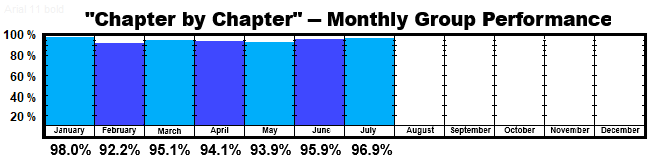
ACCOUNTABILITY TIME! If you are up to date in your reading as of today,
please let me know at accbibleread@gmail.com.

