Save or print this page by clicking on “Download” below:
November 22, Sunday
Reading B326 — Jeremiah 36 — Jeremiah’s Scroll Audio: Jeremiah 36 (ESV)
An audio recording of the following comments is available below:
Tender or Callous — We see another contrast in today’s reading, this one between the tender concern of the King of kings and the haughty disregard of King Jehoiakim. God’s gentle mercy is shown in the twice repeated expression, “it may be…” (vv. 3, 7), opening the door for repentance. God ordered Jeremiah to record on a scroll all the divine words spoken to him for the past 23 years against Jerusalem and its leaders. Why? God’s purpose was that “it may be that … Judah will hear … [and] turn from [their] evil way, and … I may forgive their iniquity” (v. 3). The scroll was written for the purpose of repentance. Jeremiah then commanded Baruch to read it publicly at the temple when a day of fasting was called (v. 6). Why? The reason was this: “It may be that their plea for mercy will come before the LORD, and that every one will turn from his evil way” (v. 7). The scroll was also read for the purpose of repentance. It was read not only to the people at the temple, but also to the king, the same year that Babylon first conquered Jerusalem and Jehoiakim was bound in chains to be taken into exile (2 Chron. 36:6). When the scroll was read to King Jehoiakim, he casually cut off the parts already read and threw them into the fire (v. 23). That was an act of callous contempt for God’s warnings, which he ignored to his own harm. God’s loving warnings and man’s hardhearted unwillingness to repent continue until today. Please pray right now for the leaders of your nation and your church, that they would listen to and heed God’s commands.
November 23, Monday
Reading B327 — Jeremiah 37 — Jeremiah in Prison Audio: Jeremiah 37 (ESV)
An audio recording of the following comments is available below:
Staying True — We jump ahead in this chapter to the last king of Judah, Zedekiah. King Nebuchadnezzar had already conquered Jerusalem and deported many of its people to Babylon. The king of Babylon then appointed another son of Josiah, Zedekiah, to be king over Jerusalem (v. 1). Zedekiah was no better than his two brothers and nephew, who ruled before him, and he rebelled again against Babylon and refused to accept Jeremiah’s prophecies (v. 2). He did secretly contact Jeremiah, however, asking him, “Please pray for us” (v. 3). When Babylon’s army temporarily lifted its siege of Jerusalem to chase away the Egyptian army (v. 11), Jeremiah was arrested and imprisoned under false charges (v. 13). Much later, King Zedekiah secretly sent for imprisoned Jeremiah to ask, “Is there any word from the LORD?” (v. 17). No, it was the same message: Zedekiah would be captured by the king of Babylon (v. 17). Deep down, Zedekiah must have known that Yahweh was the source of truth. Jeremiah mockingly asked the king, “Where are your prophets who prophesied … ‘The king of Babylon will not come against you’?” (v. 19). Those prophets couldn’t tell the truth because they didn’t know the truth. Do you feel like Jeremiah sometimes? He was righteous and faithful, but his message was dismissed and he was persecuted. What should we do in those kinds of situations? Just like Jeremiah, we should stay true to God and declare His truth, no matter what consequences might follow.
November 24, Tuesday
Reading B328 — Jeremiah 38 — In a Muddy Cistern Audio: Jeremiah 38 (ESV)
An audio recording of the following comments is available below:
Fearing God — In spite of being confined in prison, Jeremiah bravely found a way to declare his message of warning “to all the people” (v. 1). In contrast to him, there are many statements in this chapter that show King Zedekiah to be weak and cowardly. When his officials complained to him about what they considered to be undermining words of Jeremiah, the king weakly submitted to their desire, saying, “he is in your hands, for the king can do nothing against you” (v. 5). A braver Ethiopian eunuch pleaded with the king to save Jeremiah from the cistern into which he had been thrown, and Zedekiah gave in to him as well (vv. 7-10). Later, the king secretly sent for Jeremiah, wanting to ask him a question, which was never stated in our text (v. 14). Jeremiah repeated the same “surrender or die” warning to the king (v. 18). The cowardly reason Zedekiah gave for not wanting to surrender to Babylon was that he was “afraid of the Judeans” (v. 19), who had already surrendered and gone to Babylon. After this secret meeting, King Zedekiah instructed Jeremiah, “Let no one know of these words” (v. 24). This man was not a leader because he made decisions out of fear of others rather than fearing God. An unwillingness to fear God, in the sense of believing and obeying Him, will always lead to confusion and instability, which applies to us today as well. In spite of being sunk in mud, Jeremiah continued to fear the Lord.
November 25, Wednesday
Reading B329 — Jeremiah 39 — Fall of Jerusalem Audio: Jeremiah 39 (ESV)
An audio recording of the following comments is available below:
Punishment and Protection — Jeremiah’s prophecies about the destruction of Jerusalem were fulfilled in this chapter. The city was punished by being destroyed through demolishing the protective walls and burning the city’s houses. The cowardly and unbelieving King Zedekiah was punished severely, having to watch all his sons killed, before having his own eyes blinded and being marched off to Babylon (vv. 6-7). God’s Word proved to be true. On the other hand, God rewarded men who were true to Him. Ebed-melech, the Ethiopian who had saved Jeremiah from the cistern, was saved from those whom he feared because of his faith. God said that it was “because you have put your trust in me” (v. 18). The Lord also rewarded Jeremiah because of his faithfulness. King Nebuchadnezzar apparently knew about Jeremiah from people who surrendered in the first wave of exiles 19 years earlier. This pagan king respected Jeremiah greatly, instructing his military general to take special care of him and to “deal with him as he tells you” (v. 12). The prophet was given authority by the general! Jeremiah was allowed to stay in Judah under the care of Gedaliah, the newly appointed governor (v. 14, cf. 2 Kings 25:22). God had promised Jeremiah protection years before, saying, “I am with you to deliver you, declares the LORD” (Jer. 1:8; cf. 25:20-21). That was fulfilled in today’s reading.
November 26, Thursday
Reading B330 — Jeremiah 40 — Jeremiah Released Audio: Jeremiah 40 (ESV)
An audio recording of the following comments is available below:
Our Place of Service — As instructed by the king of Babylon, his captain of the guard respected and released Jeremiah to go wherever he wanted (vv. 4-5). His choice was to live in Mizpah with Gedaliah, the newly appointed governor. Now that most of the Babylonian army had left with the exiles, Jews started returning to Judah from surrounding nations, including military leaders (v. 11). Governor Gedaliah gave them the same advice that Jeremiah had given: to live quietly under the control of Babylon (v. 9). God was allowing a 70-year peaceful pause for these people while the exiles served out their sentence of discipline in Babylon. God chose some to suffer and some to wait. Both groups had the disadvantage of being under the authority of a foreign nation. The response of these people should be to faithfully serve Yahweh and obey what He had commanded. It should also be our constant mindset to live in obedience to God in whatever physical, social, or political situation we find ourselves. It is ultimately God we are serving and obeying.
November 27, Friday
Reading B331 — Psalm 74 — How Long? Audio: Psalm 74 (ESV)
An audio recording of the following comments is available below:
Remember Through Suffering — This psalm was written after Babylon had destroyed Jerusalem and its temple. It admits no responsibility for the defeat, but that will appear in tomorrow’s psalm. The psalmist doesn’t seem to understand the reason for the disaster, three times asking God, “Why?” Their foreign enemy now displayed its “own signs” (v. 4) and the Jews “do not see our signs” (v. 9). Home seemed foreign. One complaint was that “there is no longer any prophet, and there is none … who knows how long” (v. 9). Wasn’t Jeremiah still there? He predicted that the exile would last for 70 years (Jer. 25:11). Was Judah still not listening or remembering? In wanting God to do something about their uncomfortable situation, the psalmist asked four times for God to “remember” something. Remember that You have purchased and redeemed us! (v. 2a). Remember where Your presence once dwelt! (v. 2b). Remember that our enemy scoffs at You! (vv. 18, 22). God had not forgotten—they had. He told them to repent but they didn’t. He told them they would be punished for 70 years but they didn’t believe Him. In the meantime, they needed to learn while they waited. Do we learn from our failures? Do we remember what we failed to do that would have prevented God’s penalty?
November 28, Saturday——————-ACCOUNTABILITY TIME!
Reading B332 — Psalm 79 — God of Our Salvation Audio: Psalm 79 (ESV)
An audio recording of the following comments is available below:
Growing Through Discipline — The attitude and action of God’s people in this chapter has been encountered throughout Israel’s history. God had punished them; they admitted their fault; they asked for divine punishment on their enemies; and they promised to do better in the future. With their history, their vow sounds somewhat shallow and presuming. They felt special because God had chosen them from among all peoples, but that familiarity developed into laxity as they neglected their side of keeping the covenant God had made with them. Their punishment came with “Jerusalem in ruins” (v. 1). They asked God for forgiveness for “our former iniquities … and … our sins” (vv. 8-9). They asked this from Him: “Pour out your anger on the nations … [and] Return sevenfold … [their] taunts” (vv. 6, 12). Then they ended with the promise that they “will give thanks to you forever” (v. 13). They had gone through this cycle many times in their history, but so have we. Even with the indwelling Holy Spirit, we have been disciplined for admitted wrongdoing and then promised to be more faithful in the future. Like Israel, we are also chosen by God to be His own and called into a covenant relationship. We need to do better than Judah and we need to do better than we have been doing. God is watching our progress and so are unbelieving people around us. We should be seen to be genuine and improving.
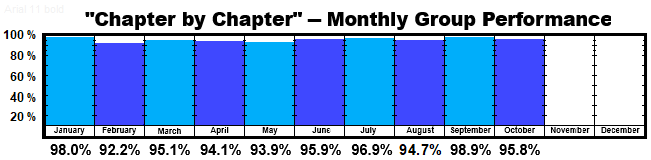
ACCOUNTABILITY TIME! If you are up to date in your reading as of today,
please let me know at this UNLINKED address: accbibleread@gmail.com
or go to the “Contact” link on the homepage.

