Save or print this page by clicking on “Download” below:
April 26, Sunday
Reading B116 — Eccl. 10 — How Foolishness Works Audio: Eccl. 10 (ESV)
An audio recording of the following comments is available below:
A Little Folly — Even with all that Proverbs and Ecclesiastes warn about foolishness, too many of us are willing to give in to a little folly now and then. That is a work of Satan’s forces and it is part of our sinful nature. Don’t fool around with folly! This chapter begins with the warning: “… a little folly outweighs wisdom and honor” (v. 1). It doesn’t take much. That reminds me of a lesson that a father once taught his sons. He presented beautiful, aromatic, baked brownies to his boys and told them, “I have made this dessert for you, but before you eat them, I want you to know that I stirred in just a teaspoon of dog poop before I baked them.” When the boys refused to eat them, the father told them that is the same reason we should never allow even a little bit of sin into our lives because it spoils everything that is good. It is like a dead fly in a perfumed ointment (v. 1). Don’t tolerate it!
April 27, Monday
Reading B117 — Eccl. 11 — You Do Not Know Audio: Eccl. 11 (ESV)
An audio recording of the following comments is available below:
Know This… — So much of life is uncertain. Four times in this chapter, we are reminded about things we do not know. The first one has to do with catastrophes: “…you know not what disaster may happen on earth” (v. 2). We should prepare by not “putting all our eggs in one basket.” Next, “you do not know the way the spirit comes to the bones in the womb” (v. 5a). Even with our technology today, there is still much mystery about how a baby develops in a mother’s body. The second half of that verse adds the much broader picture that “you do not know the work of God who makes everything” (v. 5b). Finally, when the farmer plants seed, Solomon says, “you do not know which will prosper … whether both alike will be good” (v. 6). Life is filled with uncertainty. The chapter ends, however, with something that can be known for sure, which is that when a youth strays away from the path of righteousness, “know that for all these things God will bring you into judgment” (v. 9). Though the world may crumble around us, God is stable as our only certain hope for purpose and enjoyment in life.
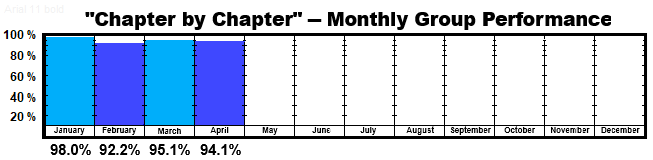
April 28, Tuesday————————–ACCOUNTABILITY TIME!
Reading B118 — Eccl. 12 — The Preacher’s Final Words Audio: Eccl. 12 (ESV)
An audio recording of the following comments is available below:
Parting Words — Solomon, the Preacher, concludes this book with four primary commands for us to apply to our own lives. The first is this: “Remember also your Creator…” (v. 1a). This first paragraph is all about aging, instructing us to connect ourselves to God “in the days of your youth” (v. 1b). Start out right! The key to everything that is good for us is related to God. If you are a young person, pay close attention to this! The “evil days” of aging are coming when “strong men are bent, and the grinders [teeth] cease because they are few, and … windows [eyes] are dimmed” (v. 3). Death is coming, when “the silver cord is snapped … and the dust returns to the earth … and the spirit returns to God who gave it” (vv. 6-7). Always remember God! After speaking about “words of delight, and … words of truth” (v. 10), Solomon then warns us to “beware of anything beyond these … [coming from] many books” (v. 12), rather than “words of the wise … given by one Shepherd” (v. 11). God’s Word is our standard, and all other teaching is to be judged by those divine words. The final two commands constitute “the whole duty of man,” which is to “Fear God and keep his commandments” (v. 13). Throughout our life, our whole focus must be on respecting and obeying our Maker.
ACCOUNTABILITY TIME! If you are up to date in your reading as of today,
please let me know at accbibleread@gmail.com.
XX
April 29, Wednesday—————–ACCOUNTABILITY REMINDER
Reading B119 — 1 Kings 10 — Wisdom and Wealth Audio: 1 Kings 10 (ESV)
An audio recording of the following comments is available below:
Mixed Wisdom — The primary reason for the queen of Sheba to visit Jerusalem was because she had “heard of the fame of Solomon concerning the name of the LORD” (v. 1). It was not solely his wealth; it was also something spiritual that drew her there. She expressed honor to the one true God, Yahweh, saying, “Blessed be the LORD your God, who has delighted in you and set you on the throne of Israel! Because the LORD loved Israel forever, he has made you king…” (v. 9). She was right; there was something spiritual involved. Solomon answered all her questions because “there was nothing hidden from the king that he could not explain to her” (v. 3). This shows that God was the source of his wisdom, which is stated more clearly later: “And the whole earth sought the presence of Solomon to hear his wisdom, which God had put into his mind” (v. 24). Even with all this wisdom, however, this chapter and the next show that this was the beginning of Soloman’s falling away from Yahweh. Even though God had commanded that Israel’s king “must not acquire many horses for himself or … return to Egypt in order to acquire many horses … nor shall he acquire for himself excessive silver and gold” (Deut. 17:16-17), that was exactly what Solomon did (1 Kings 10:28). Spiritually, he put himself on a downward, slippery slope. We will see tomorrow that it got even worse.
ACCOUNTABILITY REMINDER. If you are up to date in your reading as of today,
but did not report yesterday, please let me know at accbibleread@gmail.com.
XX
April 30, Thursday——————ACCOUNTABILITY FINAL DAY
Reading B120 — 1 Kings 11 — Solomon’s Fall Audio: 1 Kings 11 (ESV)
An audio recording of the following comments is available below:
Accommodating Sin — Solomon’s life did not end well, and it all started with his blatant disobedience to God’s clear command against marrying women who worshiped other gods. God had warned him: “…surely they will turn away your heart after their gods” (v. 2), and the expected result was that “his wives turned away his heart” (v. 3). I am sure that the problem began with Solomon thinking that he would just provide places for these foreign wives to worship their gods, and that he would not be involved in their worship. But his association with those gods turned his heart toward them, just as God had warned. God even told Moses to “make no mention of the names of other gods, nor let it be heard on your lips” (Ex. 23:13). God wants total separation for us. Jesus warned His followers to “beware of the leaven of the Pharisees and Sadducees” (Matt. 16:6), and Paul warned the Galatians: “A little leaven leavens the whole lump” (Gal. 5:9). Sin has a way of creeping in and taking over. Is there some temptation in your life that you know is on the edge of outright disobedience, but you are toying with it? Back off! It is dangerous and deadly.
ACCOUNTABILITY FINAL DAY! If you have not yet reported for this month,
please let me know your reading status today at accbibleread@gmail.com.
XX
May 1, Friday
Reading B121 — 2 Chron. 9 — The Queen of Sheba Audio: 2 Chron. 9 (ESV)
An audio recording of the following comments is available below:
Just Recognize, or Follow? — This account of the visit of the queen of Sheba (modern Yemen) and the end of Solomon’s life closely follows what we have just read in 1 Kings 10-11, but there are some differences. In today’s reading, the queen said that “the LORD your God … has … set you on his throne as king” (2 Chron. 9:8, emphasis added), while in 1 Kings 10:9, it simply says that Yahweh “set you on the throne of Israel” (emphasis added). She recognized that the elaborate throne Solomon built was really God’s throne in Israel. It makes me wonder if she brought back to Sheba anything she had learned about Yahweh in Israel. Did she follow Him? Another difference between these two accounts is that today’s passage says nothing about the decline of Solomon into apostasy that we read about yesterday in 1 Kings 11. It was as if the story was too distasteful for the writer of Chronicles to even think about. It was remembered, however, even in Ezra’s time following the Babylon captivity, and it is remembered today. Sin’s reputation follows you.
May 2, Saturday
Reading B122 — Proverbs 30 — Limits of Human Wisdom Audio: Proverbs 30 (ESV)
An audio recording of the following comments is available below:
God’s Word is Truth — Who was the writer of this chapter? In the Bible, nothing else is said of Agur, the son of Jakeh, except in the title of this chapter of Proverbs. We can see here, however, that he was a godly, wise, and creative man. He began this chapter with a recognition of the limits of human wisdom: “I have not learned wisdom, nor have I knowledge of the Holy One” (v. 3). There is a vast difference between the wisdom of man and that of God. An example of this is the perfection of God’s Word: “Every word of God proves true” (v. 5). It is not just that every “idea” or “concept” from God is true, but every “word” from Him is true. This verse supports the doctrine of the “plenary” (full and complete) inspiration of Scripture. His Word is supremely wise and, because of that, we are warned, “Do not add to his words, lest he rebuke you and you be found a liar” (v. 6). Mankind is not to add, subtract, or in any way modify what God has said in His Word, the Bible. It is our absolute standard. This is why I treat paraphrased versions of the Bible very cautiously because they contain many inserted human interpretations. My suggestion is that since most of us do not know Hebrew or Greek, it is best to read and study from more word-for-word translations, like the New King James Version, the New American Standard Bible, and the English Standard Bible. Stick to the standard!

