Save or print this page by clicking on “Download” below:
May 3, Sunday
Reading B123 — Proverbs 31 — The God-fearing Woman Audio: Proverbs 31 (ESV)
An audio recording of the following comments is available below:
The Look of Godliness — Who was King Lemuel? We don’t know. He was not one of the Jewish kings of Judah or Israel because they were all well documented in the books of Kings and Chronicles. We can learn a bit about him from this chapter, however, e.g., he was teachable because he learned, preserved, and presented this chapter as “An oracle that his mother taught him” (v. 1). He recognized true wisdom and followed it. We also learn about his mother in this chapter. She was wise and practical. She knew the life of a woman in a family by experience and learned important lessons from it. This chapter contains the values she had taught him. The last 22 verses of this chapter are easily recognized because of the concentrated message about the value of an ideal woman in the home. It is also poetry—a special kind of poetry—because it is in the form of an acrostic, with each verse beginning with the successive 22 letters in the Hebrew alphabet. What it primarily describes is “a woman who fears the LORD” (v. 30), i.e., a godly woman. It provides a great example that is worthy of being copied as a model. It is a model that is contrary to a worldly standard that honors women because they have charm and beauty; yet God declares that “a woman who fears the LORD is to be praised” (v. 30).
May 4, Monday
Reading B124 — 1 Kings 12 — Dividing the Kingdom (A) Audio: 1 Kings 12 (ESV)
An audio recording of the following comments is available below:
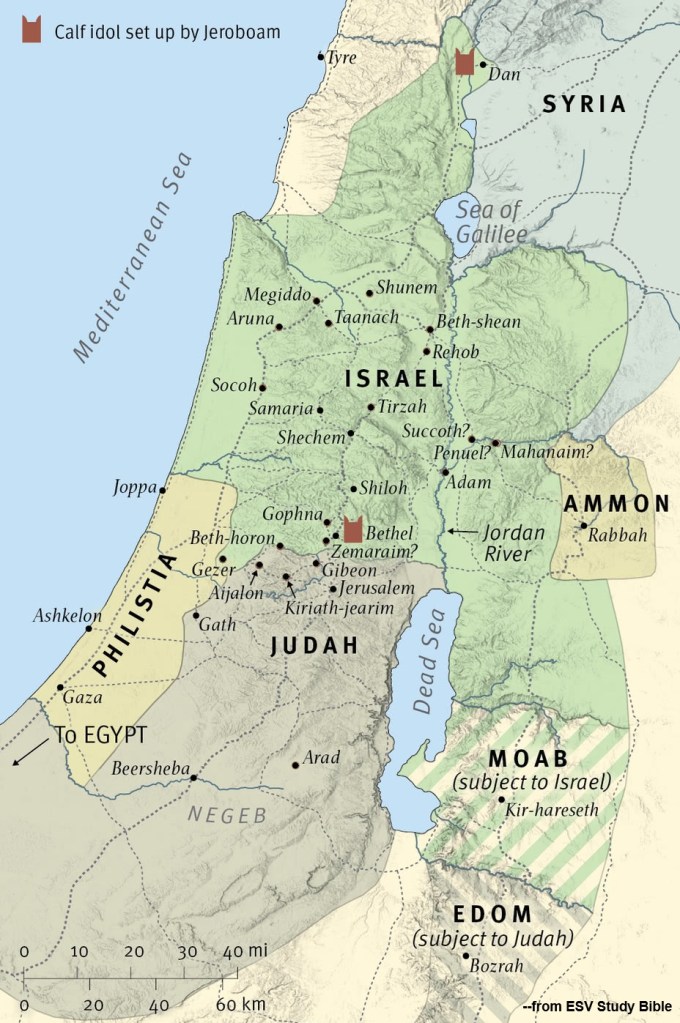
Divided in Punishment — The division of the kingdom in Israel can all be blamed on Solomon as punishment for marrying foreign wives who turned his heart away from Yahweh to false gods (1 Kings 11:9-13). God used Solomon’s son, Rehoboam, to carry out the promised division through his foolish approach to leadership. Twice it says that “the king did not listen” to the complaints of his people (12:15, 16). He demanded obedience, but he did not have the hearts of his people with him. His rival, Jeroboam, did no better, making two calves of gold, much like Aaron had done in the wilderness when the people responded with, “These are your gods, O Israel, who brought you up out of the land of Egypt!” (Ex. 32:4). Jeroboam copied that response as well, saying, “Behold your gods, O Israel, who brought you up out of the land of Egypt” (1 Kings 12:28). It doesn’t take long for a whole nation to be led away from truth. The Promised Land was now divided between Judah and Benjamin in the south and Israel to the north (see the map; Benjamin not labeled, just north of Jerusalem).
May 5, Tuesday
Reading B125 — 1 Kings 13 — The Altar at Bethel Audio: 1 Kings 13 (ESV)
An audio recording of the following comments is available below:
Characters — There are three main characters in this story: a disobedient prophet, a lying prophet, and a stubborn king. The first unnamed prophet carried out God’s command by prophesying against the false altar of Israel, forecasting that someone named King Josiah, almost 300 years later, would be leading Judah’s continuing dynasty 60 years after the northern kingdom of Israel had been overthrown by Assyria. This prophet was obedient to God’s command until he was tricked by the lying prophet, who said that an angel told him, basically, that God had changed his mind about how he should return home (v. 18). Being killed by a lion might seem like much too severe a punishment for disobedience after being tricked by the other prophet, but it should emphasize to us the absolute importance of obeying what God has commanded in His Word, rather than listening to conflicting declarations of influential people. The third character, Jeroboam, was certainly a stubborn king. After his outrage against the first prophet, God paralyzed his pointing hand and then restored it later, after the prophet’s prayer. Did that convince him that God was in control? No! “After this thing Jeroboam did not turn from his evil way” (v. 33). Evidence does not always overcome stubbornness.
May 6, Wednesday
Reading B126 — 1 Kings 14 — Two Evil Kings Audio: 1 Kings 14 (ESV)
An audio recording of the following comments is available below:
Misguided Leadership — We see three similar names in this chapter that might cause confusion. Abijah (v. 1) was Jeroboam’s son who was sick; Ahijah (v. 2) was the prophet to whom Jeroboam sent his wife; and Abijam was the surviving son of Jeroboam (v. 31). We see more of the stubborn unwillingness of Jeroboam to follow Yahweh in obedience, although he knew that God was real and powerful. We saw in yesterday’s reading that God shriveled his hand and then healed it. In today’s chapter, Jeroboam shows some faith in God, telling his wife that God’s prophet “will tell you what shall happen to the child” (v. 3). On the other hand, he thought he could fool God’s prophet into giving a positive prediction by disguising his wife (v. 2). But God demonstrated His power again by having blind Ahijah immediately greet this disguised mother with, “Come in, wife of Jeroboam” (v. 6), and then predicting the time of her child’s death: “When your feet enter the city, the child shall die” (v. 12). Both Jeroboam and Rehoboam were evil kings who led their people away from serving the one true God. Leaders of nations are powerful people, who can lead millions toward good or evil. Please take time right now to pray for the leader of your nation.
May 7, Thursday
Reading B127 — 2 Chron. 10 — Dividing the Kingdom (B) Audio: 2 Chron. 10 (ESV)
An audio recording of the following comments is available below:
The Ignored Tribes — This is the second time we have read about how the kingdom was divided into two uneven parts, Judah and Benjamin in the south, and the remaining tribes to the north and east, called Israel. One great difference exists in the historical reports, however, in that although 1 Kings describes much of what happened with Israel, 2 Chronicles basically ignores the northern tribes, except for events that intersect directly with the two southern tribes, usually referred to as Judah. The writer of Chronicles, likely Ezra, felt that after the great division, only Judah qualified as the true people of God and that the history of Israel in the north was not worthy of being recorded.
May 8, Friday
Reading B128 — 2 Chron. 11 — Migrating South Audio: 2 Chron. 11 (ESV)
An audio recording of the following comments is available below:
Sacrificial Faith — We learn something very important in this chapter that is not mentioned in 1 Kings, which is that Jeroboam dismissed the priests and Levites from the northern tribes when he established his own form of worship. In response, they “left their common lands and their holdings” (v. 14) to go to live in Judah. That was a great sacrifice to make, but they were convinced that Yahweh was the only God and was worthy to be worshiped exclusively. There were also many other people in those northern tribes “who had set their hearts to seek the LORD God of Israel” (v. 16). They followed the priests and Levites to migrate to Judah. All these people abandoned their God-given properties in order to live where they could worship God freely. They sacrificed rather than compromised. Most of us have not had to make that kind of decision because our worship was not threatened, but many of us have sacrificed in other ways. Can you think of a time in the past when you made a step of faith that you knew would involve a sacrifice? God honors sacrificial faith. Those migrating priests and Levites also made an impact on their new home: “They strengthened the kingdom of Judah” (v. 17).
May 9, Saturday
Reading B129 — 2 Chron. 12 — The Choice to Follow Audio: 2 Chron. 12 (ESV)
An audio recording of the following comments is available below:
Cause and Effect — The national changes mentioned in this chapter happened very quickly. Yesterday, we read that the migration to Judah of priests, Levites, and faithful worshipers of Yahweh made a great, positive impact, but twice it is said that it lasted for only three years (11:17). At the beginning of today’s chapter, it says that although King Rehoboam was established and strong, “he abandoned the law of the LORD, and all Israel with him” (12:1). It doesn’t take long for people to turn away from God; it took Judah only one year. It didn’t take long for God to respond in judgment, either: “In the fifth year of King Rehoboam, because they had been unfaithful to the LORD, Shishak king of Egypt came up against Jerusalem” (v. 2). God is merciful, but sometimes He strikes quickly in punishment. All the wealth that Solomon had accumulated vanished quickly in one attack from Egypt. The nation that once enslaved Israel, now controlled them again. Another change came quickly through God’s messenger, the prophet Shemaiah: “You abandoned me, so I have abandoned you” (v. 5). Thankfully, the reaction of Judah’s king and leaders was also quick: they humbled themselves before God (v. 6). In turn, God agreed to not destroy Jerusalem but only strip it of its wealth (v. 7). Although all changes do not happen so quickly, God adjusts His relationship with us by the decisions we make. Are we going to be obedient to His commands or are we going to rebel against them? Are we going to enjoy His favor or will we have to be disciplined to the point of becoming humble again? You choose!

