Save or print this page by clicking on “Download” below:
November 29, Sunday————-ACCOUNTABILITY REMINDER
Reading B333 — 2 Kings 24 — Jehoiakim and Jehoiachin Audio: 2 Kings 24 (ESV)
An audio recording of the following comments is available below:
Required Obedience — This historical chapter repeats much of what we have already read in Jeremiah. King Jehoiakim rebelled against Babylon, and after his death, his young son, Jehoiachin, reigned for only three months before surrendering to Nebuchadnezzar (vv. 8, 12) and being taken to Babylon along with at least 10,000 captives (v. 14). Jehoiachin’s 21-year-old uncle, Zedekiah, was appointed to replace him. He reigned for 11 years before also rebelling against Babylon, as we will read more about tomorrow. Jeremiah had told the Jewish leaders what was coming if they didn’t completely surrender to Babylon, but they continued to think they could successfully hold out. Maybe they remained hopeful that God would rescue them because they were His special chosen people. God required obedience for His protection in their land, however, and they had refused to comply. Some Christians today seem to have a similar attitude of believing that because they have become part of the family of God, it doesn’t matter if they continue in their patterns of sin. Let us learn from the lesson Israel and Judah had to endure, so we will not have to go through periods of God’s discipline for sin!
ACCOUNTABILITY REMINDER. If you are up to date in your reading, but have not yet reported, please let me know at this UNLINKED address: accbibleread@gmail.com or go to the “Contact” link on the homepage.
XX
November 30, Monday————–ACCOUNTABILITY FINAL DAY
Reading B334 — 2 Kings 25 — Jehoiachin Honored Audio: 2 Kings 25 (ESV)
An audio recording of the following comments is available below:
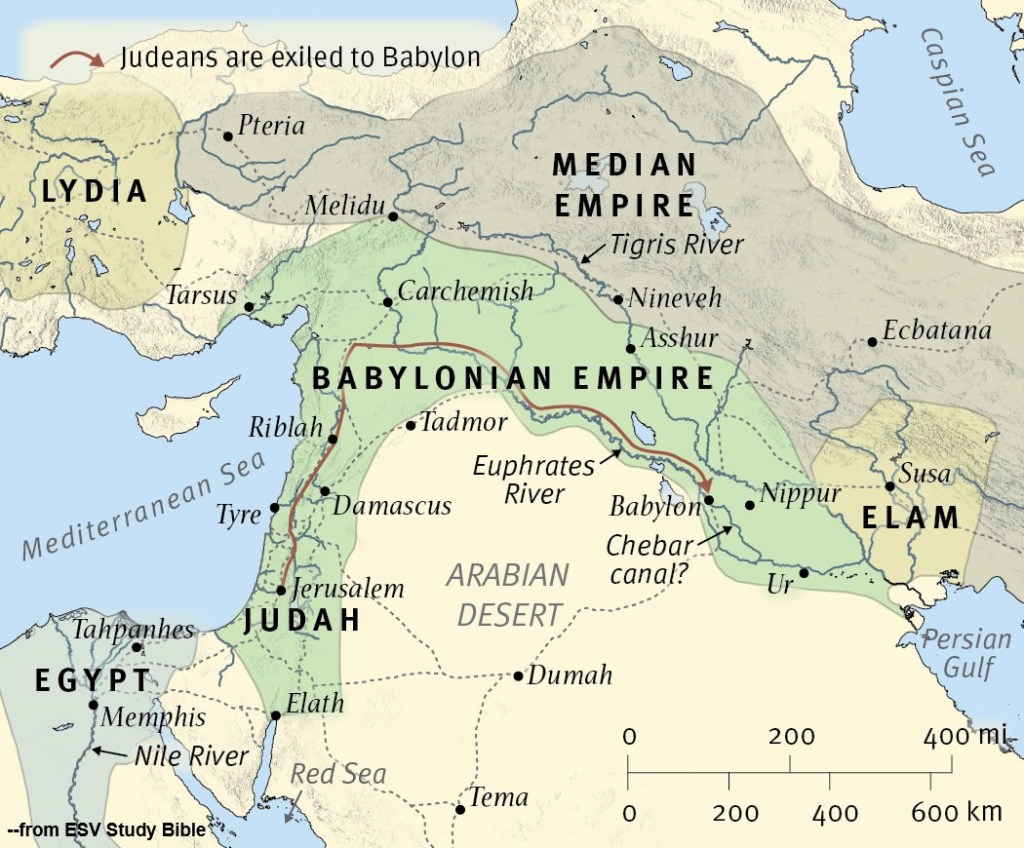
David’s Preserved Line — Much of the story in this chapter about Jerusalem’s fall has been read before. Most of Judah’s leaders were killed, the walls of Jerusalem were broken down, its major houses burned, and some of the poorer people were allowed to stay under the leadership of the appointed governor, Gedaliah. The rest were led on the long trip to Babylon, which was about 550 direct miles (885 km) across the desert, but almost 900 miles (1,450km) along the normal route through the Fertile Crescent (see map). This is why the Bible often refers to the army of Babylon as coming from the north, even though Babylon is primarily east of Jerusalem. The new information we read about in this story is the freedom granted to Jehoiachin, the former king of Judah (vv. 27-30). As soon as Nebuchadnezzar’s son, Evil-merodach, became king of Babylon, he released Jehoiachin from his 25-year imprisonment. In spite of his evil-sounding name, he “graciously freed Jehoiachin … [and] he spoke kindly to him” (vv. 27-28), elevating him to a position of honor for the rest of his life. This was part of God’s plan to preserve descendants of David to accomplish His promise of bringing the Messiah through David’s line.
ACCOUNTABILITY FINAL DAY! (see below)
ACCOUNTABILITY FINAL DAY! If you have not yet reported for this month,
please let me know your reading status today at this UNLINKED address: accbibleread@gmail.com or go to the “Contact” link on the homepage.
XXX
December 1, Tuesday
Reading B335 — 2 Chron. 36 — There Was No Remedy Audio: 2 Chron. 36 (ESV)
An audio recording of the following comments is available below:
God’s Rest — This final chapter of 2 Chronicles hurries through the reigns of the last four wicked kings of Judah and the period of exile in Babylon. It was as if the priestly recorders of this punishing history wanted to forget about it and move on to the new post-exilic life God provided for His people back in the Promised Land. Some of us Christians also need to put behind us some things in our sinful past that have been forgiven, so that we can more positively grow and enjoy our restored relationship with Jesus. It was interesting to me to read about Israel’s land during the 70 years that most of its people were in exile. It says that “the land had enjoyed its Sabbaths” (v. 21). It was as if even the land had to recover from the sinful practices that had gone on in it for so many years before. It was a period of rest for the land. There is also a sense of rest for us that follows repentance because sin produces stress. God has one final rest waiting for us in heaven that He called “my rest” in Psalm 95:11. The writer of Hebrews picked up that expression and challenged us with this: “Let us therefore strive to enter that rest, so that no one may fall by the same sort of disobedience” (Heb. 4:11).
December 2, Wednesday
Reading B336 — Habakkuk 1 — Might was Their God Audio: Habakkuk 1 (ESV)
An audio recording of the following comments is available below:
Relative Wickedness — Habakkuk was a frustrated prophet. He was disappointed that God was not punishing wicked people. Twice in this chapter, he charged God with being idle, first regarding the evil within his own country of Judah, asking, “why do you idly look at wrong?” (v. 3). He saw a general disregard for the Law of Moses and a perverted practice of injustice (v. 4). How did Habakkuk expect God to punish those wicked Judeans, with fire from heaven? God’s answer to His prophet’s question was completely unexpected, however: God was going to use the more wicked nation of Babylon to punish the less wicked people of Judah. Those Chaldeans were a “bitter and hasty nation, who … seize dwellings not their own … guilty men, whose might is their god” (vv. 6-7). This still-frustrated prophet then charged God with idleness a second time, asking, “why do you idly look at traitors and remain silent when the wicked swallows up the man more righteous than he?” (v. 13). God does punish evil but often not in our way or in our timing. I see another subtle lesson in this chapter for us, which is that we tend to consider other’s sins as worse than our own. When we are frustrated by someone else’s wickedness, we should ask ourselves, “Is there some way in which I am also like that in my relationship to God or others?”
December 3, Thursday
Reading B337 — Habakkuk 2 — Five Woes Audio: Habakkuk 2 (ESV)
An audio recording of the following comments is available below:
Slow But Sure — God’s promises are sure, but they often seem slow to us. God gave Habakkuk a promise that He would punish Babylon at “its appointed time … [but] if it seems slow, wait for it” (v. 3), which was followed by the statement that “the righteous shall live by his faith” (v. 4). It takes faith to wait. Since God is righteous and faithful, His promises will come true at His chosen, perfect time. This chapter gives five “woe” statements against Babylon, which are God’s charges against that nation’s sins. The first woe was about Babylon’s greed: “Woe to him who heaps up what is not his own” (v. 6). The wars fought by Babylon were somewhat like gang activity. They were basically: stealing from others through the use of superior force. The second woe was for the motive behind that greed, which was “to be safe from the reach of harm” (v. 9). They wanted to build a very secure Babylon that could not be conquered by other nations. The third woe was because of violence: “Woe to him who builds a town with blood” (v. 12). The fourth woe was because they shamed others. They gazed at the nakedness of the captives they led away in chains (v. 15). The fifth woe was from their idolatry: “Woe to him who says to a wooden thing, Awake” (v. 19). We Christians also sometimes have struggles with greed and with shaming others, sometimes even wanting to harm them. God hates those sins in us as much as He did in the Babylonians.
December 4, Friday
Reading B338 — Habakkuk 3 — Waiting Quietly Audio: Habakkuk 3 (ESV)
An audio recording of the following comments is available below:
Maturing Prayer — Do you ever have an attitude transition while praying to God? Habakkuk did. He began this chapter with a prayer in which he was telling God what he thought ought to be done. He told God to revive His work, make it known, and remember mercy (v. 2). Then, this prophet reviewed some of God’s work in the past when Israel was freed from slavery after the “pestilence and plague” in Egypt (v. 5) and when the “sun and moon stood still” (v. 11) after they entered the Promised Land. The prayer then turned to the punishment awaiting Judah from Babylon, and Habakkuk humbly agreed to wait for God’s timing in punishing that exiling nation: “I will quietly wait for the day of trouble to come upon people who invade us” (v. 16). After all of this, Habakkuk’s prayer turned to absolute trust in God’s goodness and timing. Even during Judah’s punishment period, Habakkuk resolved that “yet I will rejoice in the LORD; I will take joy in the God of my salvation. GOD, the Lord, is my strength” (vv. 18-19). That is really the attitude we ought to have at the beginning of our prayer times. Begin with trust and anticipate the joy you may not feel as you begin to pray!
December 5, Saturday
Sa Reading B339 — Jeremiah 41 — Gedaliah’s Murder Audio: Jeremiah 41 (ESV)
An audio recording of the following comments is available below:
Fleeing in Fear — We are back to Jeremiah’s story today, after a week-long detour. In chapter 40, the military leader, Johanan, had warned Governor Gedaliah that Ishmael intended to kill him. Today, we see that plan carried out by Ishmael, who was “of the royal family” (v. 1). His desire to continue the Davidic line of kings was likely his motive for killing the governor. He was deceptive and cowardly in his actions, taking advantage of Gedaliah’s hospitality. He was also deceptive in “weeping as he came” (v. 6), before murdering 70 pilgrims from the northern area of Israel who had come to worship God at the time of the annual Feast of Booths. When Johanan and the other military leaders heard about the massacre, they chased after Ishmael, who was fleeing, along with royal captives, to the safety of the Ammonites (v. 10). I love the picture of the next encounter. When the captives saw Johanan’s forces, “they rejoiced … turned around and came back” (vv. 13-14). The captors were easily identified as they fled the other way. After that, everyone was afraid of the Babylonians because the appointed governor had been killed, along with several Chaldean soldiers, and they set out to flee to the apparent safety of Egypt. We will read tomorrow that God advised otherwise.

