Save or print this page by clicking on “Download” below:
October 4, Sunday
Reading B277 — 2 Kings 20 — Hezekiah’s Prayer Audio: 2 Kings 20 (ESV)
An audio recording of the following comments is available below:
Pride and Selfishness — Like David, Hezekiah was a very good king; however, also like David, he had some personal faults. Hezekiah seems to have had a problem with pride and selfishness, which many of us struggle with as well. When he prayed, after Isaiah predicted his death, he based his prayer on his own righteousness: “please remember how I have walked before you in faithfulness and with a whole heart, and have done what is good in your sight” (v. 3). He was basically saying, “You owe me something better than this death sentence.” Have you ever pleaded with God based on what you have done? Hezekiah was not only proud of his accomplishments, but he was also proud of his wealth. When the envoy from Babylon visited him, “Hezekiah welcomed them, and he showed them all his treasure house, the silver, the gold, the spices, the precious oil, his armory, all that was found in his storehouses” (v. 13). There is no indication in the text that they had asked to see these things; he wanted to show off his wealth. A second fault of Hezekiah was selfishness. He was concerned mostly about himself. When God told him through Isaiah that later, all his wealth would go to Babylon and his sons would be made eunuchs there, Hezekiah selfishly thought, “Why not, if there will be peace and security in my days?” (v. 19). Like Hezekiah, many of us also have a deep core of selfishness, feeling that “It’s all about me.” Pride and selfishness are sin. They can often be hidden from others, but God knows our hearts, and we need to be honest in confession to Him.
October 5, Monday
Reading B279 — 2 Chron. 32 — Hezekiah’s Victories Audio: 2 Chron. 32 (ESV)
An audio recording of the following comments is available below:
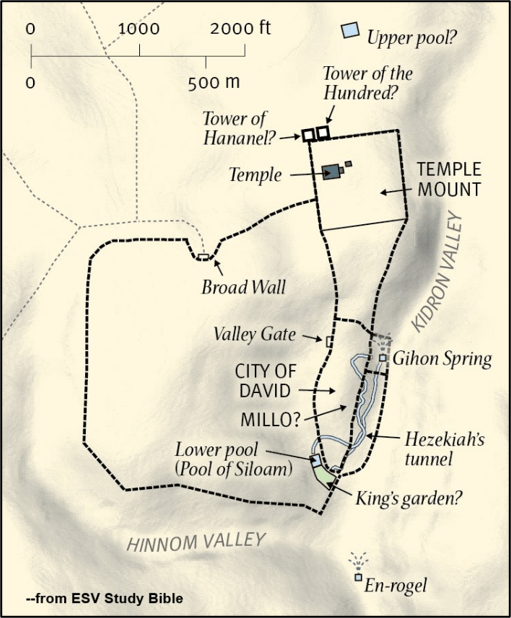
Divine Engineering — Much of today’s reading has already been covered in Isaiah and 2 Kings, so I would like to concentrate these comments on the engineering wonder of the tunnel that Hezekiah constructed between the upper Gihon Spring to the lower Pool of Siloam (see map). The difference in elevation was a single, one-foot (30 cm) drop, but the length of the tunnel was 1,750 feet (533 m) long, which is a third of a mile. To speed up the project, the tunnel was dug starting at both ends, but it had to meet somewhere in the middle, while maintaining the gradual grade of a one-inch drop for every 146 feet of length (1 cm per 18 m). That was an amazing accomplishment at a time when they didn’t have the kind of surveying instruments we have today. Just as the angel of Yahweh miraculously wiped out 185,000 Assyrian soldiers, so He guided Hezekiah’s workers through that long, winding tunnel.
October 6, Tuesday
Reading B278 — 2 Kings 21 — Manasseh and Amon (A) Audio: 2 Kings 21 (ESV)
An audio recording of the following comments is available below:
Levels of Evil — Manasseh was Judah’s worst king, reigning 55 years and leading his people into practices that God had forbidden. Three times, his evil ways were emphasized in this chapter, each one worse than the previous statement. First, he copied the pagan practices of other people groups: “he did what was evil in the sight of the LORD, according to the despicable practices of the nations whom the LORD drove out” (v. 2). These were nations whose local gods could not protect them from Yahweh, yet Manasseh chose to worship them. The second level of evil is shown by this statement: “He did much evil in the sight of the LORD” (v. 6)—not just evil but “much evil.” Both levels were evil in God’s sight, but this one was greater because Manasseh had set up “the carved image of Asherah … in the house … [where God said] I put my name” (v. 7). Asherah was a fertility goddess of the Canaanites, who was believed to have given birth to 70 other gods. She was supposedly a consort of other gods, so putting her image in the Jerusalem temple suggested that she was a mate of Yahweh. The third level of evil was that Manasseh led Judah “to do more evil than the nations … whom the LORD destroyed” (v. 9). Again, Judah did “more evil,” but here, they even “out sinned” their enemies. They didn’t look like God’s people anymore. They didn’t stand out in the crowd as being different. That is like many Christians today who are indistinguishable among their unbelieving friends, neighbors, and fellow workers. God tells us to “be separate from them … and touch no unclean thing” (2 Cor. 6:17). We must refuse to be like the world.
October 7, Wednesday
Reading B280 — 2 Chron. 33 — Manasseh and Amon (B) Audio: 2 Chron. 33 (ESV)
An audio recording of the following comments is available below:
Illuminating Repentance — This chapter in 2 Chronicles adds a very significant piece of history that was not given in yesterday’s reading in the parallel passage in 2 Kings 21. It involved the capture and removal of Manasseh to Babylon (v. 11) and his humble repentance and restoration there (vv. 12-13). The purpose of the account in 2 Kings was to show that Manasseh’s long and radical rejection of God was the ultimate cause of Judah’s deportation to Babylon, but 2 Chronicles’ addition showed that God was willing to postpone that exile because of Manasseh’s repentance. God often modifies His plans in response to man’s actions. Manasseh’s son, Amon, did not learn from his father’s return to Yahweh, however, but he stubbornly repeated the former idolatry of Manasseh and paid for it with his life two years later (v. 24). After Manasseh humbled himself and was allowed to return to Jerusalem, this was the conclusion of a lesson learned: “Then Manasseh knew that the LORD was God” (v. 13). God knows how to bring people to repentance, and sometimes it is a painful process. How much better it is to keep short accounts with God, confessing our sin as soon as we recognize that we have strayed. God’s forgiveness and cleansing will keep us from going down that long, painful road.
October 8, Thursday
Reading B281 — Nahum 1 — Who Can Stand? Audio: Nahum 1 (ESV)
An audio recording of the following comments is available below:
Almighty God — The Book of Nahum is a series of prophecies against Nineveh, the capital of the Assyrian Empire. The Assyrians had become very strong and spread their control over a very wide area. About 25 years before Nahum’s day, Assyria conquered the northern kingdom of Israel and dispersed its people. For 300 years, they were a widespread threat to many nations, including Judah. They were mighty, but Yahweh was stronger. He said, “Though they are at full strength and many, they will be cut down and pass away” (v. 12), and “No more shall your name be perpetuated” (v. 14). This predicted destruction of Nineveh provided great hope for Judah; it brought “good news … [and] peace” (v. 15). Judah could go back to worshiping God at their feasts, praising Him for His protection and deliverance. Sometimes we also run into troubles that are much too difficult for us. They seem insurmountable and hopeless. Don’t forget God in those times! He is our “savior in time of trouble” (Jer. 14:8) and “our salvation in the time of trouble” (Isa. 33:2).
October 9, Friday
Reading B282 — Nahum 2 — Desolation and Ruin Audio: Nahum 2 (ESV)
An audio recording of the following comments is available below:
Directing History — God shows Nahum the coming destruction of Nineveh as if it were an eye-witness account. This powerful city would fall in only three months by “the scatterer” (v. 1), a coalition of Medes and Babylonians in 612 B.C. They dammed up the Khosr River, which ran through the city, and then when “The river gates are opened; the palace melts away” (v. 6). Chaos resulted with the flooding; the inhabitants fled, and the city was plundered of its wealth (v. 9). The ultimate cause of Nineveh’s collapse was God’s plan to end the Assyrian persecution of Judah: “For the LORD is restoring the majesty of Jacob” (v. 2). An empire that had dominated the Near East for centuries quickly and dramatically fell under God’s direction. God directs history. He has plans for our day as well. He is directing the country you live in toward His overall plan. It is a good plan that is just, although it may be painful. Trust the Director!
October 10, Saturday
Reading B283 — Nahum 3 — Nineveh’s Ruin Audio: Nahum 3 (ESV)
An audio recording of the following comments is available below:
Fleeting Repentance — About 60 years earlier, Jonah went to Nineveh with God’s message of warning and they repented. Things changed since then, however, with immense growth in size and power. Now, Nahum was sent with God’s message of judgment, saying, “I am against you, declares the LORD of hosts … I will make you a spectacle … all who look at you will … say, ‘Wasted is Nineveh’” (vv. 5-7). The Ninevites apparently thought they were invincible. God reminded them that about 10 years after Jonah’s visit, they had conquered Thebes in southern Egypt, a much more secure city that was essentially surrounded by the protection of the mighty Nile River. Nineveh was much more vulnerable, however, with a river running right through the city (v. 8). In God’s sight, Nineveh’s “princes are like grasshoppers … [and their] nobles slumber” (vv. 17-18). God’s judgment would fall upon them because of their “unceasing evil” (v. 19). The conquerors would become conquered because they didn’t maintain their repentance. Nineveh’s story is a lesson for us today: maintain a humble, repentant attitude toward God.

