Save or print this page by clicking on “Download” below:
November 8, Sunday
Reading B312 — Jeremiah 22 — Last-Chance Call Audio: Jeremiah 22 (ESV)
An audio recording of the following comments is available below:
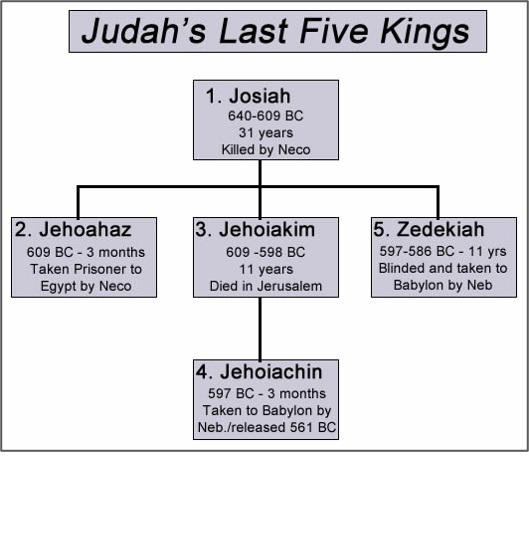
Basic Obedience — Again, God gave a last-chance call to Judah’s king, still wanting to cancel judgment. These two choices were offered: “if you indeed obey … then” your kings will continue to reign (v. 4), or “if you will not obey … desolation” (v. 5). What they should obey was simple: “Do justice and righteousness, and deliver” the oppressed (v. 3). God repeated these three positive principles in verses 15-16, showing them as evidence that one knows God. The same kind of emphasis on obedience remains for the Christian today. We have been released from the requirements of the OT ceremonial laws, but the NT is filled with commands that God requires of us. Several of Judah’s last kings were mentioned in this chapter, which can be confusing, especially since Jeremiah referred to two of them with alternate names: “Shallum” for Jehoahaz (v. 11) and “Coniah” for Jehoiachin (v. 24), each of them reigning for only three months. Attached is a diagram (from generation.com), showing the numbered order and family relationship of the last five kings of Judah.
November 9, Monday
Reading B313 — Jeremiah 23 — The Righteous Branch Audio: Jeremiah 23 (ESV)
An audio recording of the following comments is available below:
The Heavy Message — God was fed up with the leaders of Judah, declaring, “Woe to the shepherds who destroy and scatter the sheep … [and] have not attended to them” (vv. 1-2). They had spoken “visions of their own minds” (v. 16), saying to those who refused to listen to God’s words, “It shall be well with you” (v. 17). Instead of warning the wicked, they assured them of false security. They were prophesying “lying dreams” (v. 32). In the last eight verses of the chapter, God told Jeremiah that if any of these prophets or priests asks him, “’What is the burden of the LORD?’ you shall say to them, ‘You are the burden’” (v. 33). There is a play on words here, with the Hebrew word for “burden” (ESV) being used eight times in this paragraph. It is used mostly in the OT with the idea of a “burden” one carries. However, it is also often translated “oracle” or “prophecy” (e.g., 11 times in the ESV in Isaiah alone). It seems likely to me that the play on words here means something like this: “You ask, ‘What is the oracle of the LORD?’; I answer, ‘You are the burden!’” This is similar to the meaning the New English Translation suggests with, “Jeremiah, when one of these people, or a prophet, or a priest asks you, ‘What burdensome message do you have from the LORD?’ Tell them, ‘You are the burden, and I will cast you away.” God’s message always seems too heavy to bear for those who desire to sin. If we are willing to obey it, however, Jesus will help us carry what seems heavy to us.
November 10, Tuesday
Reading B314 — Jeremiah 24 — Baskets of Figs Audio: Jeremiah 24 (ESV)
An audio recording of the following comments is available below:
Wholehearted Repentance — God gave this vision of the two baskets of figs to Jeremiah after King Jeconiah (also known as Coniah and Jehoiachin) and many of the prominent and useful Judeans were included in an early wave of exiles to Babylon (v. 1). The vision of the figs was given to illustrate the separation and future of Judah into two groups: those who would stay in the Promised Land or flee to Egypt, and those who would be exiled to Babylon. The exiles would experience the 70 years of punishment for their sins of distancing themselves from Yahweh, and then they would be forgiven and restored for a new start in their own land again. They were the “good figs” with a positive future. God said that after the exile was finished, “I will give them a heart to know that I am the LORD … for they shall return to me with their whole heart” (v. 7). Sometimes Christians also go through a time of painful discipline because of drifting away from serving the Lord, but there is hope for them as well. God can use discipline to change hearts. They can come to realize the emptiness of their waywardness and turn back in humble repentance to their Savior. They are given a new start after learning a painful lesson.
November 11, Wednesday
Reading B315 — Jeremiah 25 — The Cup of Wrath Audio: Jeremiah 25 (ESV)
An audio recording of the following comments is available below:
Widespread Justice — God’s control over all the earth is emphasized in this chapter. Beginning with His own people, He would bring judgment for sin, especially idolatry (vv. 6, 7, 14). To Judah, God would bring His punishing tool, Nebuchadnezzar from Babylon, a man whom the Lord calls, “my servant” (v. 9). We will see later that this king comes to some level of recognition and trust in Yahweh through the influence of Daniel. God’s widespread control and judgment is shown by making all the nations drink the cup of His wrath (v. 15), naming 18 of them (vv. 17-26) and emphasizing that it applied to “all the inhabitants of the earth … [and] all flesh … from one end of the earth to the other” (vv. 30, 31, 33). This is a reminder of the End Time judgment of all people. Because of the perfect justice of God, all sin must be punished. Jesus paid that penalty for all those who would believe in Him, but most have not and will not. God’s perfect love cancelled out His perfect justice for us Christians. Thank Him for His grace!
November 12, Thursday
Reading B316 — Jeremiah 26 — Jeremiah on Trial Audio: Jeremiah 26 (ESV)
An audio recording of the following comments is available below:
Trusting Through Questions — Sometimes obeying God will get us in trouble with people. That was the case with Jeremiah. As God’s prophet, he was told exactly what to say to the people in the temple area. It was a message of repentance with the hope that each one “may … listen, and … turn from his evil way” (v. 3). However, they didn’t like what Jeremiah said about the consequences of their disobedience, declaring, “You shall die!” (v. 8). He was then brought to trial before the city officials, and thankfully, they were wiser than the crowd. In his defense, one elder brought up the example of the earlier prophet, Micah, who proclaimed a similar message. At that time, King Hezekiah responded positively by turning to the Lord. Another otherwise unknown prophet, Uriah, was giving the same warning as Jeremiah, but he was killed by the current king, Jehoiakim (vv. 20, 23). What saved Jeremiah from a similar fate was the influential leader, Ahikam (v. 24), about whom we will read more later. Why did God save Jeremiah but not Uriah? We don’t know because it was part of God’s perfect, but hidden, plan. We face similar questions of fairness today. Why does God rescue some believers but let others go through tragedy? We don’t know, but we do know that God is perfectly good and wise, so we must trust His judgment.
November 13, Friday
Reading B317 — Jeremiah 27 — Babylon’s Yoke Audio: Jeremiah 27 (ESV)
An audio recording of the following comments is available below:
Which Prophet? — There was a running competition between prophets throughout this chapter. Jeremiah was saying that Judah must surrender to Babylon in order to live, and the false prophets were declaring that disaster would not fall on Jerusalem from Nebuchadnezzar. Four times, Jeremiah warned about the other prophets, saying, “Do not listen” (vv. 9, 14, 16, 17). Which prophets should the people listen to, especially when Jeremiah’s instruction to surrender to Babylon did not sound good to them? Who was right? These confused people did have a strong reason to believe Jeremiah, however, because he had a proven record. His earlier prophecy had come true. Two chapters earlier (25:9), he had prophesied that God would bring Nebuchadnezzar against Judah, and it happened. His warning was delivered in 606 B.C., and Babylon carried off the first wave of exiles the following year. Judah did have a clue, but they were ignoring it. About eight years later, the surrounding nations’ envoys came to Jerusalem, apparently trying to figure out what to do about Babylon (27:3). What should we do when we come to a difficult decision? We should go to the proven record: the Bible. God has given us a history of the wisdom of the directions He gave in the past. When we are puzzled about decisions we have to make, we need to search the Scripture for God’s direction.
November 14, Saturday
Reading B318 — Jeremiah 28 — Hananiah’s Deception Audio: Jeremiah 28 (ESV)
An audio recording of the following comments is available below:
Peace in Repentance — The general prophetic competition of yesterday’s chapter becomes more personal in today’s reading. Hananiah contradicted Jeremiah’s prophecy of “surrender or destruction” with his own “prediction of peace,” saying that the exiles and temple vessels would be returned within two years (v. 3). Did God change His mind? Jeremiah didn’t seem to know because he merely replied, “Amen! May the LORD do so” (v. 6). When Hananiah broke the wooden yoke Jeremiah wore, the only further reaction of God’s prophet was to walk away (v. 11). He had no word from the Lord. Later, however, God spoke to Jeremiah, revealing that the original prophecy still held true and that Hananiah would soon die for his presumptuous rebellion against God. Two months later, he was dead. Hananiah was predicting peace, but peace would come only through repentance and surrender. Judah had not yet learned that lesson. Peace still has the same connection today. If we find ourselves in a state of unrest, we should examine ourselves in case we are in some way causing a problem by rebelling against God.

