Save or print this page by clicking on “Download” below:
June 14, Sunday
Reading B165 — 2 Kings 14 — Amaziah the King (A) Audio: 2 Kings 14 (ESV)
An audio recording of the following comments is available below:
Good and Bad — King Amaziah ruled in Judah for over half of his life. He had a good side and a bad side. The “good” was that he was diligent in following the law of Moses (Deut. 24:16) by not being willing to put to death the whole family of each of the two servants who had killed his father, Joash (Jehoash). In that regard, the summary was that “he did what was right in the eyes of the LORD” (v 3). Immediately after a victory over the neighboring Edomites, however, he showed his other side: pride. He challenged Israel’s king, Jehoash (Joash) to fight, but that northern king showed great restraint, saying, “your heart has lifted you up. Be content with your glory, and stay at home, for why should you provoke trouble so that you fall…?” (v. 10). But in pride, “Amaziah would not listen” (v. 11), so he and Judah were soundly beaten. This proud king was later assassinated, not by Israel’s king, but by his own people (v. 19). We are to live not only obediently but also humbly. Do what is right, but also do what is wise!
June 15, Monday
Reading B165 — 2 Chron. 25 — Amaziah the King (B) Audio: 2 Chron. 25 (ESV)
An audio recording of the following comments is available below:
Divided Worship — This chapter provides some important details that we did not read in yesterday’s account from 2 Kings 14. For one, Amaziah “did what was right … yet not with a whole heart” (v. 2), which was later seen when he captured and worshiped the gods of the Edomites, brought them home, and worshiped them (v. 14). God sent a prophet to ask the king this very logical question: “Why have you sought the gods of a people who did not deliver their own people from your hand?” (v. 15). Judah’s later battle with Israel ended in defeat “because they had sought the gods of Edom” (v. 20). We also learn here that Judah had a substantial army of 300,000 men and that they hired 100,000 Israelite soldiers, intending that they would help them fight Edom. When dismissed, however, these mercenary warriors raided some of Judah’s cities, killing 3,000 people (v. 13). That was a high price to pay because Amaziah was not willing to serve God “with a whole heart” (v. 2). Hopefully, you are not splitting your worship between God and some lesser god like money or prestige that cannot bring you lasting satisfaction.
June 16, Tuesday
Reading B167 — Jonah 1 — Jonah Flees God Audio: Jonah 1 (ESV)
An audio recording of the following comments is available below:
Fear or Flee? — This fantastic story of Jonah is a real event, confirmed by Jesus when He said, “For just as Jonah was three days and three nights in the belly of the great fish, so will the Son of Man be three days and three nights in the heart of the earth” (Matt. 12:40). The emphasis of this first chapter of Jonah is that he tried to flee from God. As a prophet of God, he received a clear command: “Arise, go to Nineveh … and call out against it, for their evil has come up before me” (Jonah 1:2). Although he told the pagan sailors, “I fear the LORD, the God of heaven, who made the sea” (v. 9), he was unwilling to obey Him. Fearing God does not include fleeing from Him. The sailors seemed to have more real and respectful fear of Yahweh. After learning that Jonah’s God “made the sea … the men were exceedingly afraid” (vv. 9-10). Then, after the sea miraculously calmed, “the men feared the LORD exceedingly” (v. 16). With this awareness of the power of Yahweh, they responded by worshiping Him with sacrifices and making promises. We should also fear the Lord in a positive way by worshiping Him. He is the Creator, who controls more than the sea; He also saved us from eternal spiritual death.
June 17, Wednesday
Reading B168 — Jonah 2 — Jonah’s Prayer Audio: Jonah 2 (ESV)
An audio recording of the following comments is available below:
The Hand of God — Jonah’s prayer reviewed his near-drowning experience. He also prayed earlier as he was sinking: “I called out to the LORD, out of my distress, and he answered me” (v. 2). Notice how Jonah acknowledged the hand of God throughout this whole experience. He said, “you cast me into the deep … all your waves and your billows passed over me” (v. 3, emphasis added). All this involved God’s discipline, grace, and direction. He wasn’t finished with Jonah. God’s hand was also evident when the fish swallowed the prophet, and he prayed, “you brought up my life from the pit, O LORD my God” (v. 6). God saved Jonah both by having the fish swallow him and also by vomiting him on the land on the third day. Jonah’s conclusion was that “Salvation belongs to the LORD!” (v. 9). God is also working in our lives much more than we probably realize. Do we see our troubles as likely being His waves and billows? Do we see our “close calls” or near-death experiences as being His salvation? Peter tells us to “Humble yourselves, therefore, under the mighty hand of God so that at the proper time he may exalt you” (1 Peter 5:6). Part of being humble comes from recognizing God’s hand at work.
June 18, Thursday
Reading B169 — Jonah 3 — Nineveh Gets the Message Audio: Jonah 3 (ESV)
An audio recording of the following comments is available below:
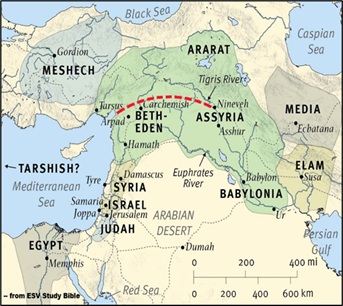
Outdone by Others — God did not give up on Jonah. When He called this prophet the first time, he ran away. God rescued him from drowning to give him a second chance. The words of God’s second command were identical to what He said earlier: “Arise, go to Nineveh, that great city, and call out against it” (v. 3:2; cf. 1:2). From the sandy beach, this smelly and probably bleached prophet, trudged at least 400 miles (600 km) to Nineveh (see map). Jonah’s still somewhat reluctant obedience contrasted with Nineveh’s immediate response. Those people responded instantly and urgently: “And the people of Nineveh believed God” (3:5). (The word “believe” here is placed in an emphatic position in the Hebrew sentence.) The pagan Ninevites responded in faith like the pagan sailors did, while Jonah was half-heartedly obeying God. It should be embarrassing to have our own converts more enthusiastically willing to serve God than we are. Tomorrow, we will see a merciful and patient God teach Jonah an important lesson about his attitude.
xxx
June 19, Friday
Reading B170 — Jonah 4 — Hoping for Disaster Audio: Jonah 4 (ESV)
An audio recording of the following comments is available below:
Hindering Emotions — Even more than Elijah, Jonah struggled with his emotions. This chapter refers five times to Jonah’s anger. Strangely, he was basically angry about God’s character of being “slow to anger” (v. 2). The chapter begins with this statement: “But it displeased Jonah exceedingly” (v. 1). What displeased him? The answer is in the last verse of the previous chapter: “God relented of the disaster … and he did not do it” (3:10). Jonah didn’t want God to spare Nineveh, and he hoped that He wouldn’t. He sat in his booth outside the city and watched “till he should see what would become of the city” (v. 5). It seems that he was infected with the long-held Jewish prejudice against anyone who was not a Jew. Here, God stepped in to teach Jonah a lesson. Whereas God had earlier “appointed a great fish” (1:17), now “God appointed a plant … appointed a worm … [and] appointed a scorching east wind” (4:6-8). God showed Jonah that although he didn’t pity the Ninevites, he was sorry about the dying plant (vv. 10-11). Jonah struggled with selfishness, too. How about you? Do you struggle with anger and selfishness? Are you hindering what God wants to do through you because of these negative attitudes? It is time for obedience—full, willing, and enthusiastic obedience. Our Nineveh is waiting for our message.
June 20, Saturday
Reading B171 — 2 Kings 15 — Israel’s Seven Last Kings Audio: 2 Kings 15 (ESV)
An audio recording of the following comments is available below:
Stretching Mercy — Judah’s King Azariah (v. 1) was also called Uzziah four times in this chapter, which adds some confusion in reading the story. It is also puzzling that although he was king in Judah for 52 years (v. 2), he wasn’t acting as king for all that time because of becoming a leper and having to be isolated. After Azariah got leprosy, his son, Jotham, “was over the household, governing the people of the land” (v. 5). Tomorrow, we will read the story about the reason for his getting leprosy. Most of the rest of this chapter is about the last seven kings of the crumbling northern nation of Israel. After Zechariah’s 41-year reign, the next kings reigned for 6 months, 1 month, 10 years, 2 years, 20 years, and 9 years. It is amazing that God tolerated their apostasy for so long, but they were His chosen people, and our merciful God loved them. Remember that when you fall into some temporary sin. If you are a Christian, you have been chosen by the same loving and merciful God. Time ran out for Israel, however, and they fell under the judgment of God.

