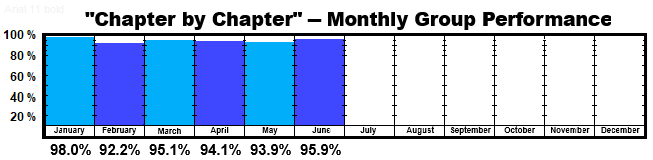
Save or print this page by clicking on “Download” below:
June 28, Sunday————————–ACCOUNTABILITY TIME!
Reading B179 — Isaiah 8 — Judah is Spared Audio: Isaiah 8 (ESV)
An audio recording of the following comments is available below:
Waiting in Hope — The first and partial fulfillment of the prophecy of the promised child read about in yesterday’s chapter, occurs with the birth of Isaiah’s son, Maher-shalal-hash-baz (the longest name in the Bible—v. 3). Before he could speak clearly, the Assyrians would wipe out Syria and the northern kingdom of Israel (v. 4). Judah would escape this “flood” of Assyrians because it would rise only up to their necks (v. 8). God would leave a remnant, sparing Judah temporarily while their brothers in Israel were dispersed into other countries. Isaiah was part of that faithful remnant who would not “walk in the way of this people” (v. 11) but would honor Yahweh as holy (v. 13) and “wait for the LORD” (v. 17), while society crumbled around them. There are many ways in which we also wait for God while our culture deteriorates. Even when it looks hopeless, we can wait and pray. Even as a minority, we wait and we trust in the Lord, who is our only trustworthy hope.
ACCOUNTABILITY TIME! If you are up to date in your reading as of today,
please let me know at accbibleread@gmail.com.
XXX
June 29, Monday——————–ACCOUNTABILITY REMINDER
Reading B180 — Amos 1 — Amos, Prophet of Judgment Audio: Amos 1 (ESV)
An audio recording of the following comments is available below:
Coming Judgment — Since the prophet Amos was a contemporary of Isaiah, we will read his eight chapters at this point. Amos was not primarily a prophet but a shepherd (v. 1). He came from the town of Tekoa in Judah, but his message was primarily aimed at and delivered to Israel. His prophecies were judgment statements against Judah and the nations surrounding it, including Israel. It was significant that he delivered his prophecies against Israel at Bethel, one of the two places Jeroboam had placed a golden calf (7:10-13). The nations targeted in this chapter (seen on the attached map from the ESV Study Bible) were Syria, with its capital at Damascus (1:3); Philistia, listing four of its five primary cities (vv. 6-8); Tyre, the northern capital that governed shipping to the countries of the eastern Mediterranean Sea (vv. 9-10); Edom, the descendants of Esau located SE of Judah; and Ammon, which was NE of the Dead Sea (vv. 13-15). These judgment statements spill over into the next chapter and expand in chapters 3-6. Amos’ message was not a pleasant one because it carried God’s final rebuke to nations who rejected their Creator. God’s punishment for sin is strong because sin is strong. If we more fully understood the gravity of sin, we would have a greater understanding of God’s judgment.

ACCOUNTABILITY REMINDER. If you are up to date in your reading as of today,
but did not report yesterday, please let me know at accbibleread@gmail.com.
XXX
June 30, Tuesday——————–ACCOUNTABILITY FINAL DAY
Reading B181 — Amos 2 — Israel’s Sins Audio: Amos 2 (ESV)
An audio recording of the following comments is available below:
Judgment for Sins — Amos’ prophecies against nations continue in this chapter, repeatedly using the literary form, “For three transgressions … and for four,” ending with the primary target of Israel. This northern nation of God’s chosen people was about to come to an end, and four reasons for their punishment were given here. First, they took advantage of the poor (“…because they sell the righteous for silver”—v. 6). For their own material well-being, they created a financial crisis for others. Second, they were guilty of sexual sin (“…a man and his father go in to the same girl”—v. 7). They were putting pleasure before purity. Third, they were dishonoring God (“…they lay themselves down beside every altar on garments taken in pledge”—v. 8). They desecrated their places of worship, whether dedicated to Yahweh or to their false gods. Finally, they forced others away from serving the one true God, making committed Nazarites drink wine and prophets stop prophesying (v. 12). Israel well deserved the punishment that was awaiting them. Thankfully, in His grace, God provided Himself as the penalty for our sins through the death of Jesus on the cross. We don’t face an eternal punishment but a grateful closeness to God forever.
ACCOUNTABILITY FINAL DAY! If you have not yet reported for this month,
please let me know your reading status today at accbibleread@gmail.com.
XXX
July 1, Wednesday
Reading B182 — Amos 3 — Israel’s Judgment Audio: Amos 3 (ESV)
An audio recording of the following comments is available below:
A Rescued Remnant — Amos’ prophecies against Israel begin in earnest in this chapter and extends for three more. Although God had chosen Israel, they had rejected Him, so He was obliged to punish them (v. 2). To be chosen by God carries responsibilities, as it does for us today. We should be willing to obey the One who has chosen us to be part of His family. Israel’s capital city of Samaria controlled the major route from Mesopotamia in the northeast to Egypt in the southwest. If Samaria fell to the army of Assyrians, these conquerors would control the full length of the highway. Samaria was strategic, but it was doomed because of its sins. They had drifted this far from the Law of God: “They do not know how to do right” (v. 10). Only a few of the Israelites would be “rescued” by God as a remnant of His people. One of the descendants of those people was the woman at the well whom Jesus encountered. Like her ancestors, her theology and worship practices were greatly distorted, but Jesus brought her to an understanding of the truth.
July 2, Thursday
Reading B183 — Amos 4 — You Did Not Return to Me Audio: Amos 4 (ESV)
An audio recording of the following comments is available below:
Being Prepared — In some ways, Israel considered itself to be satisfied. God called those people “cows of Bashan” (v. 1a), a place of rich pastureland near the Sea of Galilee. Many had grown fat with plenty while oppressing the poor (v. 1b). They were experiencing plenty without gratitude. They also seemed satisfied with their worship centered around the golden calves at Bethel and Dan. God said it was something “you love to do” (v. 5), yet it was considered to be a “transgression” to God (v. 4). They were worshiping without righteousness. God had reached out to them repeatedly with both punishment and pity (v. 11), but they refused to respond positively. Five times God said, “yet you did not return to me” (vv. 6, 8-11). So, they were told that the axe would fall on them, using this dreadful expression: “prepare to meet your God, O Israel!” (v. 12). It is a joy for an obedient Christian to look forward to facing God, but that is not true for a rebellious sinner. I attended seminary with a fellow who had been raised in a church but was living a questionable life in his youth. One night, he and 3-4 of his friends from church were driving fast on a winding country road when suddenly the car’s headlights went out. Before they could stop, they went off the road into a ditch. Just as the car stopped, the headlights flashed on again and shone brightly on a billboard sign in front of them that said, “Prepare to meet your God!” All the boys began to cry, and they turned their hearts back to the Lord.
July 3, Friday
Reading B184 — Amos 5 — Seek Good to Live Audio: Amos 5 (ESV)
An audio recording of the following comments is available below:
Late Hope — The people of the northern kingdom of Israel were living in delusion. They thought that they were pleasing God by worshiping Him in connection with the golden calf in Bethel (vv. 5-6). God’s response was one of disgust. He said, “I hate, I despise your feasts … your solemn assemblies … [and] your songs” (vv. 21-23). Their hearts were not changed, and they worshiped with a desire to continue in their sins. There are many people in our churches today who have similar attitudes. We need to worship God not only in our prayers and songs but also in our obedience. God was fed up with Israel’s continued disobedience and declared judgment on them. He called them, “Fallen, no more to rise” (v. 2), and promised that “I will send you into exile beyond Damascus” (v. 27). What struck me was that, in spite of this severe judgment, God offered hope for repentance. He said, “Seek me and live … Seek the LORD and live … Seek good … that you may live” (vv. 4, 6, 14). Even at this late hour, there was time to repent and be forgiven. God offered, but He knew they would not obey. He would leave a remnant, however (v. 15). One-tenth of the people would be allowed to stay on their destroyed land (v. 3).
July 4, Saturday
Reading B185 — Amos 6 — Woes to Judah and Israel Audio: Amos 6 (ESV)
An audio recording of the following comments is available below:
False Priorities — Both Judah and Israel (“Zion, and … Samaria”—v. 1) fall under rebuke by God in this chapter. The predicted judgment was coming because of four primary, sinful attitudes and actions. First was their misplaced sense of security: “those who feel secure on the mountain of Samaria” (v. 1). Although other nations had already fallen around them, they thought that, as God’s chosen people, they would be protected no matter what they did. The second reason for judgment was their focus on luxury, basking in their ivory beds, tender meat, musical entertainment, and a lack of restraint from wine (vv. 4-6). That was a self-focused life. The third spiritual problem was their pride. God said, “I abhor the pride of Jacob” (v. 8). The last stated reason for punishment was a national lack of integrity: “you have turned justice into poison and the fruit of righteousness into wormwood” (v. 12). These same four threats are problems in our day as well. We may feel safe because of a national history of peace, but God is the ultimate source of our protection. We get obsessed with striving for and enjoying the luxury of houses, cars, and leisure. We take credit in pride for things we have accomplished as if we did it without God’s help and approval. We allow dishonesty to creep into our dealings with others. God is looking for well-rounded purity from us and for dependence on Him.

