Save or print this page by clicking on “Download” below:
May 17, Sunday
Reading B137 — 1 Kings 17 — Feeding Elijah Audio: 1 Kings 17 (ESV)
An audio recording of the following comments is available below:
God’s Control — Elijah was bold and courageous. He came to Israel’s King Ahab with the pronouncement of no rain “except by my word” (v. 1). God can control the weather. Elijah’s message was a seed planted in advance about what God planned to do in the future. Then, God told him to run away and hide himself, saying that “I have commanded the ravens to feed you” (v. 4). God can control birds as He earlier demonstrated by bringing quail and manna to feed His people in the wilderness (Exodus 16:12). God can even control a starving widow and her son who believed in other gods, saying, “I have commanded a widow there to feed you” (1 Kings 17:9). That God was already working in her heart is evident by her willingness to feed this stranger, Elijah, before following her natural instincts to feed her only son his last meal. Then, bold Elijah told her in verses 13-14, “Do not fear … [because] the LORD, the God of Israel” would sustain her meager supply of flour and oil. That miracle happened day after day, but she was apparently not completely convinced to follow Yahweh instead of Baal. It was not until after her son died and Elijah raised him from the dead that she exclaimed, “Now I know that you are a man of God, and that the word of the LORD in your mouth is truth” (v. 24). The world around us is also very slow to recognize and embrace God’s sovereignty, but we must be bold and faithful in declaring His greatness.
May 18, Monday
Reading B138 — 1 Kings 18 — Challenging 450 Prophets Audio: 1 Kings 18 (ESV)
An audio recording of the following comments is available below:
Standing Alone — Yesterday, we read that Elijah told King Ahab that there would be no rain “these years, except by my word” (17:1). In today’s reading, God told Elijah during the third year, “Go, show yourself to Ahab, and I will send rain upon the earth” (18:1). Over two years of drought for Israel and hiding for Elijah set up this powerful and public demonstration of the absolute power of Yahweh. Elijah first revealed himself to the prophet Obadiah, and then to Ahab. It is interesting that the king had to go to where Elijah was waiting for him (v. 16); Ahab was desperate. He was the real “troubler of Israel” (v. 17) because he had “abandoned the commandments of the LORD and followed the Baals” (v. 18). The crowd that gathered on Mount Carmel was “limping between two different opinions” (v. 21), Yahweh and Baal. There is only one real God, and He is jealous about not wanting to share that position with any supposed gods. He wants us to also be insistent about that uniqueness. There are not “many ways to heaven,” as the world around us wants to believe. There is one way and one God. Jesus said, “I am the way, and the truth, and the life. No one comes to the Father except through me” (John 14:6). We are in the cultural minority, like Elijah was. We also need to stand up like Elijah did.
May 19, Tuesday
Reading B139 — 1 Kings 19 — Elijah Flees Audio: 1 Kings 19 (ESV)
An audio recording of the following comments is available below:
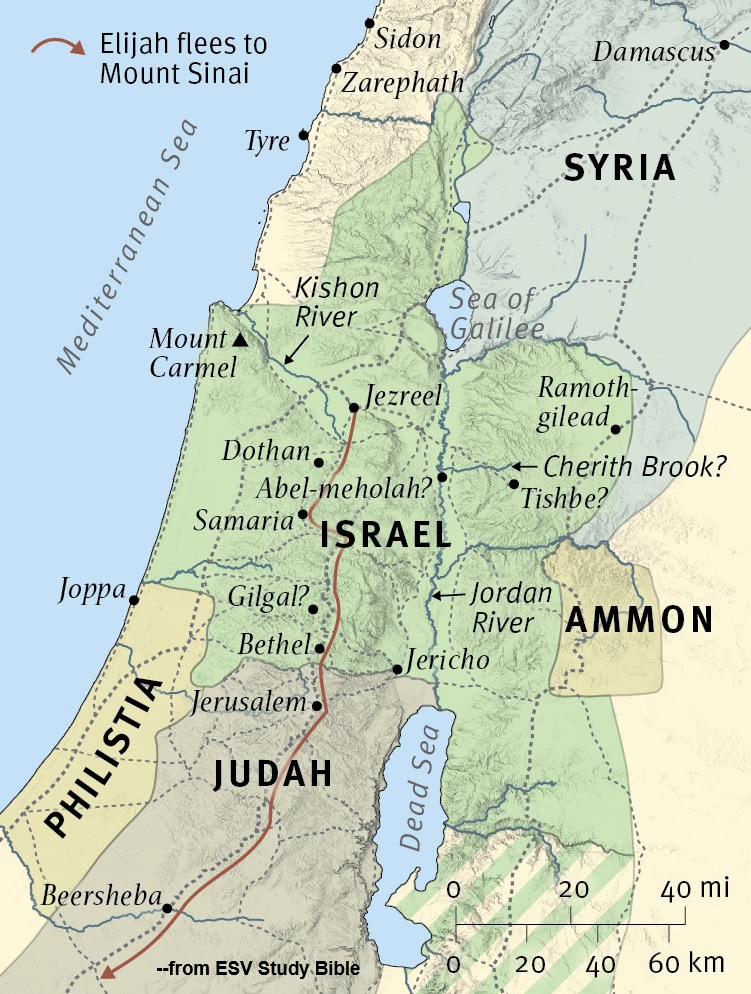
Obeying God — Elijah’s mountain-top experience at Mount Carmel deteriorated quickly into fear as he ran from the threats of Jezebel. Those up-and-down swings are sometimes our experience as well. God had sent Elijah to Mt. Carmel, but He did not send him 120 miles (193 km) south to Beersheba (see map) or another 250 miles (400 km) south to Mt. Horeb (or Mt. Sinai). That is why God asked him twice, “What are you doing here, Elijah?” (vv. 9, 13). He was both depressed and out of the will of God. Elijah also responded twice with this same self-centered statement: “I, even I only, am left, and they seek my life…” (vv. 10, 14). God’s response was simple: “Go, return to the wilderness of Damascus” (v. 15), even further north than Jezreel, from which he had fled. It was a command involving both location and ministry. He was to anoint Elisha and new kings, for Syria and Israel. There is no later record of Elijah even meeting those two kings, let alone anointing them. Could a lack of obedience be involved there as well? Sometimes it is hard to know where you ought to be and what you ought to do, but we are responsible for what we know God has plainly told us to do. Be zealous for obedience!
XXX
May 20, Wednesday
Reading B140 — 1 Kings 20 — Proud Ben-hadad Falls Audio: 1 Kings 20 (ESV)
An audio recording of the following comments is available below:
Only One Hero — There are no heroes in this story, except God. The king of Syria was proud and demanding, but he ended up begging for his life: “Please let me live” (v. 32). Ahab’s prior warning to Ben-hadad about his pride is priceless: “Let not him who straps on his armor boast himself as he who takes it off” (v. 11). Although the king of Israel got the victory over Syria, he was rebuked by God’s prophet and “went to his house vexed and sullen” (v. 43). The prophets of God were not heroes either. They weren’t even named, e.g., “a prophet came near to Ahab” (v. 13; cf. vv. 22, 28, 35) to give him God’s promise of victory over Syria. Ahab was sitting on the fence spiritually, not being convinced that Yahweh was the only God. God said that this victory would be given to him so “you shall know that I am the LORD” (v. 13). The Syrians thought that Israel’s “gods are the gods of the hills” (v. 23), but Yahweh would prove that He was not limited, saying again, “you shall know that I am the LORD” (v. 28). We are not the hero of our life’s story either. God saved us by His love and mercy, not because of our accomplishments, but because of our faith and our surrender to Him. “For by grace you have been saved through faith. And this is not your own doing; it is the gift of God, not a result of works, so that no one may boast” (Eph. 2:8-9). God alone is our hero.
May 21, Thursday
Reading B141 — 1 Kings 21 — Naboth’s Vineyard Audio: 1 Kings 21 (ESV)
An audio recording of the following comments is available below:
Ahab’s Judgment — Samaria was the name of both the central area of the northern tribes of Israel and its capital city. Jezreel was a city in the northern part of that area where King Ahab had a secondary palace. We have another glimpse in this story of the emotional extremes of this king. After Naboth refused Ahab’s offer to purchase his vineyard for use as a vegetable garden (v. 2), “Ahab went into his house vexed and sullen” (v. 4), the exact statement made about him in yesterday’s reading after he was rebuked by a prophet for sparing the life of Syria’s King Ben-hadad. Jezebel responded to Ahab’s dejection with her evil plan to have Naboth killed. That she was the primary evil behind Ahab is shown in this evaluation: “There was none who sold himself to do what was evil in the sight of the LORD like Ahab, whom Jezebel his wife incited” (v. 25). They were equally evil because he “sold himself to do … evil” and she “incited” him. Then, refreshed Elijah was sent to pronounce judgment on Ahab and Jezebel because God said, “you [have] killed and also taken possession” (v. 19). Their team plot resulted in joint judgment. When emotional Ahab “heard those words, he … went about dejectedly … [and] humbled himself before” God (vv. 27-28). God responded by showing mercy to Ahab, postponing judgment on his household until after his death. Mercy to the wicked. What grace! We are in a similar place with regard to sin. God had mercy to save us from the sins of our past, a step I took 65 years ago today. After conversion, He continuously gives us grace by forgiving our subsequent sins. What a Savior!
May 22 Friday
Reading B142 — 1 Kings 22 — Ahab’s Death (A) Audio: 1 Kings 22 (ESV)
An audio recording of the following comments is available below:
Living Rightly and Wisely — Judah’s King Jehoshaphat was good but not always wise. One good action was that he made peace with Israel’s King Ahab, which Jehoshaphat’s father, Asa, could not accomplish. Another good thing he did in this story was to ask for the message of a true prophet of Yahweh, because he was suspicious of the 400 false prophets (vv. 5, 7) who told Ahab only what he wanted to hear (v. 13). Where Jehoshaphat failed in this story was in not heeding the warning given by God’s prophet, Micaiah. He not only agreed to go with Ahab into the doomed battle, but he also agreed to wear his royal robe while Ahab disguised himself (v. 30). It was only by God’s protection that he did not also die in that battle. The lesson for us from this story is that we must not only obey what God’s Word tells us to do, but that we must also take its warnings seriously. Paul warns us not to be sucked into false teaching (Gal. 1:6-9), to fall into sexual immorality, test Christ’s boundaries, or become grumblers (1 Cor. 10:8-10). The writer of Hebrews warns us not to let our hearts “be hardened by the deceitfulness of sin” (3:13). Be wise! Be consistent!
May 23, Saturday
Reading B143 — 2 Chron. 18 — Ahab’s Death (B) Audio: 2 Chron. 18 (ESV)
An audio recording of the following comments is available below:
A Cry in Panic — Today’s reading is almost the same as what we read yesterday from 1 Kings 22, but there are a few important differences. We learn today that part of Jehoshaphat’s political connection with Ahab involved a marriage alliance (v. 1). Jehoshaphat’s son married the daughter of Ahab and Jezebel, which resulted in many later problems for Judah. A second difference is an important addition made to the statement that when the Syrians saw Jehoshaphat in his royal robes and concluded that it was Ahab, “Jehoshaphat cried out” (1 Kings 22:32). Only in today’s reading do we learn that his cry was to God and that “…the LORD helped him; God drew them away from him” (2 Chron. 18:31). Maybe his words were only, “Yahweh, help me!” Despite his foolish decision to go with Ahab into battle after hearing God’s message of warning through the prophet Micaiah, Jehoshaphat was rescued by God. That should be a comforting reminder for us. We sometimes make foolish and even sinful decisions, but our God of mercy loves us. When you get into self-caused trouble, don’t forget to cry out to God! He loves you, anyway.

