
Save or print this page by clicking on “Download” below:
July 20, Sunday
Reading A201 — Joshua 7 — Achan’s Theft Audio: Joshua 7 (ESV)
An audio recording of the following comments is available below:
Exceptional Sin? — This chapter begins with the collective guilt of the whole people of God (“Israel broke faith…”—v. 1), although it was only Achan who had sinned. Later, God told Joshua, “Israel has sinned … they have transgressed … they have taken … they have stolen and lied … the people of Israel cannot stand…” (vv. 11-12). Again, it was corporate guilt. The sin of one man brought blame on the whole nation and caused 36 soldiers to be killed (v. 5). The temptation for Achan was strong because the silver and gold alone would be valued today at over $57,000 (3.2 million PHP). There is a widespread feeling today that one’s sin can be made an exception “if it doesn’t hurt anyone else.” It was not true for Achan, and it is often not true for us either. The sin of one member of a family may well bring trouble to the whole family, and the sin of one member of a church may also bring pain and obstruction for a whole church. Thankfully, Achan openly admitted his sin (v. 20), so only he, his family, and his animals were punished by death (v. 24). Sin is a very serious thing with God, and we must not excuse it or tolerate it in our lives, our family, or our church.
July 21, Monday
Reading A202 — Joshua 8 — The Fall of Ai Audio: Joshua 8 (ESV)
An audio recording of the following comments is available below:
Using Failure — Israel’s first, over-confident attempt to conquer the city of Ai ended in failure because it was pursued without God’s direction as a consequence of Achan’s sin. Now that Achan had confessed and was punished, God ordered the successful defeat of that city, which was accomplished by His strategic plan. What made it work? It was the failure of the first attack. Israel had fled from the men of Ai. The subsequent plan to have the main part of Joshua’s army pretend to flee as before completely fooled the king of Ai. Here, “Ai” does not stand for Artificial Intelligence but may represent Ambush Ignorance. God used a previous failure to bring a future victory. He still does that today. Paul wrote that “for those who love God all things work together for good” (Rom. 8:28, emphasis added). We don’t have to be crushed by our sins and failures. Rather, confess them and let God use His divine intelligence to benefit us and others in the future!
July 22, Tuesday
Reading A203 — Joshua 9 — Gibeon’s Deceivers Audio: Joshua 9 (ESV)
An audio recording of the following comments is available below:
Decision Dilemma — The inhabitants of the city of Gibeon were Hivites (v. 7), and Hivites were among the people groups of the Promised Land that God had commanded that “you must devote them to complete destruction. You shall make no covenant with them” (Deut. 7:2). Joshua’s first mistake was that he “did not ask counsel from the LORD” (Josh. 9:14). The Gibeonite’s successful deception and Joshua’s covenant could have been avoided if God’s direction had been sought first. How many disappointing situations and consequences in life could we have avoided if we had gone to God first? Being deceived by their cunning and multiple lies, Joshua made a formal covenant with those Hivites. Because he had “sworn to them by the LORD, the God of Israel” (vv. 18, 19), he felt obligated to keep the covenant, although God had provided a way out of a rashly made oath through offering a sacrifice (Lev. 5:4-6). It was a hard decision. Was it a good one?
July 23, Wednesday
Reading A204 — Joshua 10 — Kings Rise and Fall Audio: Joshua 10 (ESV)
An audio recording of the following comments is available below:
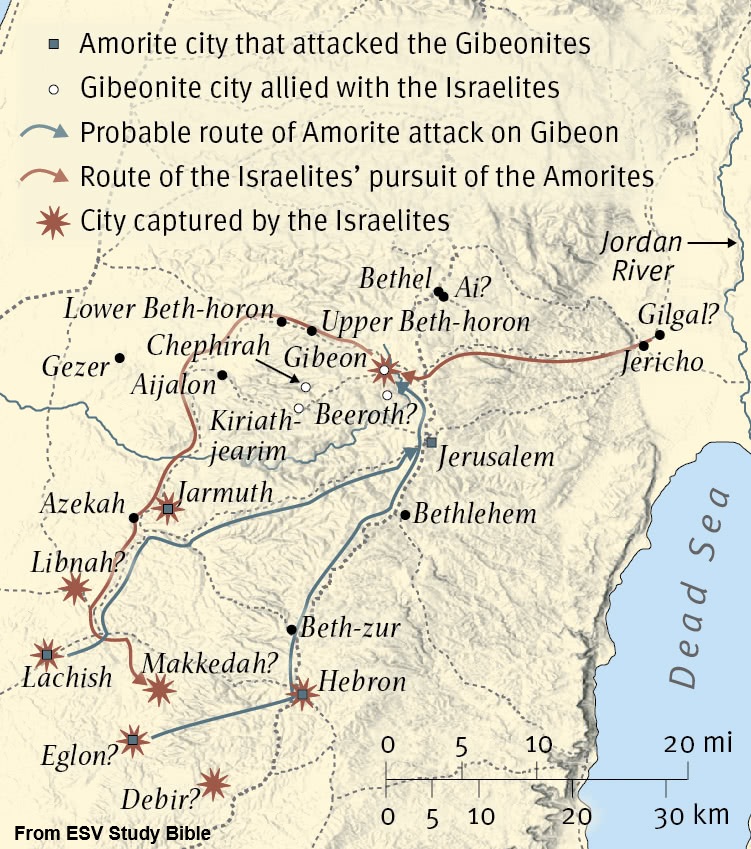
Rewards of Revenge — This chapter features two military campaigns. The first one was to defend Gibeon, the city that tricked Joshua into a covenant of not conquering them. They were being attacked by a coalition of the armies of five Amorite kings led by the king of Jerusalem, who was motivated by revenge because Gibeon had secured peace from Joshua (v. 4). If I were Joshua, I think I would have ignored Gibeon’s cry for help and let them be wiped out—no more covenant to worry about! God had a different plan, of course. He wanted to wipe out the armies of five cities that were doomed to disaster. God would contribute general panic, huge hailstones (v. 10), and an answer to Joshua’s prayer to make the sun stand still for a whole day to prolong the time to fight (v. 13). Again, if I were Joshua, I might not have asked for more fighting time, since his army had not only already fought for many hours but had also missed a night’s sleep while marching uphill for 15 miles (24 km) in the dark. God agreed with Joshua, however, and a mighty victory resulted. The second military campaign was to essentially conquer and gain control of the area south of Jerusalem (see the map). As God had commanded (v. 40), these seven cities were wiped out so that there were “none left” (v. 28; cf. vv. 30, 32, 33, 35, 37, 39, and 40). All of that was started by a king who sought revenge. Beware when you feel like you want to “get even” with someone! It might backfire.
July 24, Thursday
Reading A205 — Joshua 11-12 — The Conquest Concludes Audio: Joshua 11-12 (ESV)
An audio recording of the following comments is available below:
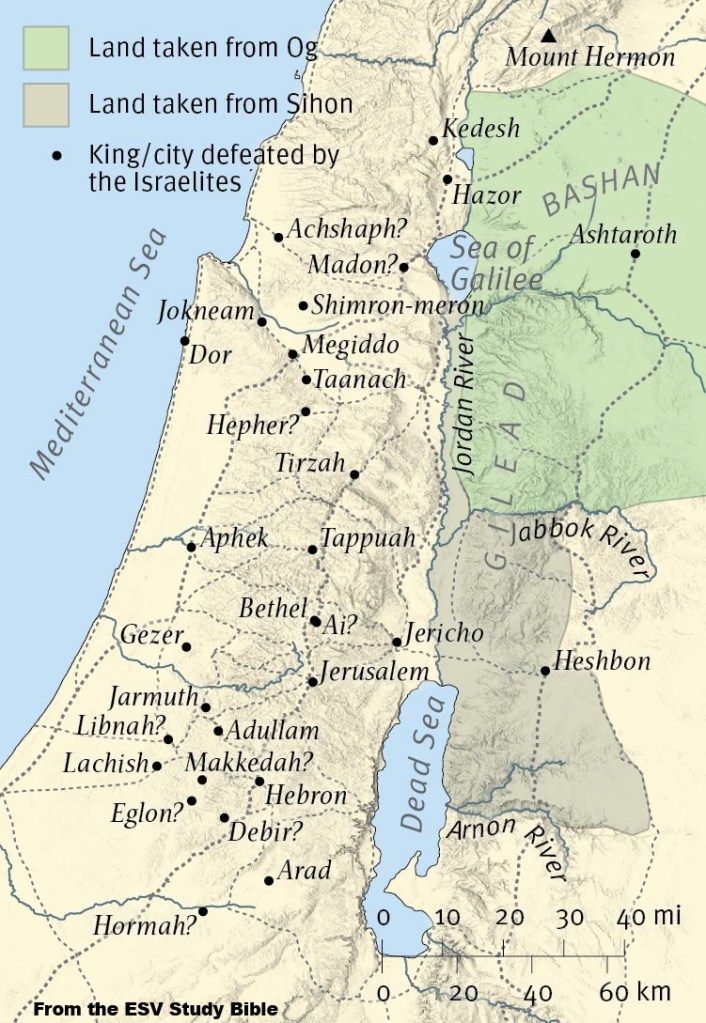
Taking the Land — These two chapters basically wrap up the conquering phase of Israel’s taking over the land given to them by Yahweh. Like the previous fight against the Jerusalem coalition, the main battle here was started by a collection of many cities formed by the king of Hazor. They may have outnumbered Israel’s army, but God promised victory, saying “tomorrow at this time I will give over all of them, slain, to Israel” (11:6). Joshua struck quickly and killed them all (vv. 7-8). Then he went to the important city of Hazor, whose king had started the war, conquered it and its king, and plundered and burned it (vv. 10-14). After that, “Joshua made war a long time with all those kings” of the coalition (v. 18) until their cities were also taken (see the map). God’s part in all this fighting was revealed at this point: “For it was the LORD’s doing to harden their hearts that they should come against Israel in battle” (v. 20). Then, to face the 10 spies’ fear of the giant Anakim people who made them seem like “grasshoppers” (Num. 13:33), Joshua also killed almost all of them (Josh. 11:21-22). Chapter 12 summarizes the territories taken by Moses and Joshua, obtaining victory over 31 kings (12:24). The rest of the book of Joshua is concerned mostly with settling the Jews in their newly acquired territories.
July 25, Friday
Reading A206 — Joshua 13 — Joshua’s Old Age Audio: Joshua 13 (ESV)
An audio recording of the following comments is available below:
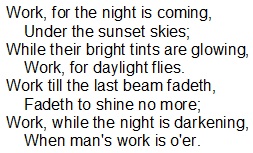
Much Remains — This book opened with a statement about the death of Moses. Chapter 13 begins with the aged condition of Joshua, who was “old and advanced in years” (v. 1a). We will find out in chapter 24 that he was 110 years old when he died, so he was probably in his late 80s in our reading for today. How would you advise a faithful and successful leader when he was almost 90 years old? Most would say, “Retire, and relax!” Most corporations in America have set a mandatory retirement age of 72. That was not God’s plan for Moses or for Joshua, however. In Joshua’s late 80s, God told him, “there remains yet very much land to possess” (v. 1b). At the end of this first paragraph, Joshua was told, “…allot the land to Israel … as I have commanded you. …Now therefore divide this land…” (vv. 6-7). You might be beyond your corporation’s retirement age, but God doesn’t have a retirement age for His servants. He has gifted us to be involved in some kind of ministry, and He expects us to continue doing it until we cannot do it anymore. This hit home to me because in two months, I will hit the 88-year milestone, just about Joshua’s age when God challenged him to continue to serve Him. Work, for the night is coming! That is the theme of John 9:4: “We must work the works of him who sent me while it is day; night is coming, when no one can work.” It is also the theme of Annie Coghill’s hymn:
July 26, Saturday
Reading A207 — Joshua 14 — Caleb’s Inheritance Audio: Joshua 14 (ESV)
An audio recording of the following comments is available below:
Faithful Follower — Caleb was another faithful old man. Like Joshua, he was one of only two living spies who gave a good report 40 years earlier about taking the Promised Land. In today’s reading, Caleb was honored and rewarded by receiving the city of Hebron and its surrounding villages and fields, located about 20 miles (32 km) south of Jerusalem. That honor was given when he was 85 years old (v. 10), but he wasn’t rewarded because of his age. Two reasons are given in this text. First, Moses had promised it to him with a sworn oath: “to him and to his children I will give the land on which he has trodden, because he has wholly followed the LORD!” (Deut. 1:36). The second reason is contained in that same statement: “… because he has wholly followed the LORD” (Josh. 14:9). The same thing is repeated in verses 8 and 14. That he was known for wholly following Yahweh suggests both the sincerity and depth of his commitment to God and the long-term faithfulness of his love and service. It would be great to have this carved on our tombstone: “He wholly followed the LORD.”
 accbibleread.com
As long as God is with us be a faithful servant unto Him follow God no matter what.
LikeLike