Save or print this page by clicking on “Download” below:
June 1, Sunday
Reading A152 — Numbers 14 — Refusing to Go Audio: Numbers 14 (ESV)
An audio recording of the following comments is available below:
Slow Learners — Israel seemed to be perpetual grumblers, and they didn’t learn from God’s discipline. After hearing the majority report from the spies, they grumbled and suggested choosing a new leader who would take them back to Egypt (v. 4). In response, for the second time, God threatened to annihilate them and start over again with Moses (see Ex. 32:10). As before, Moses pleaded and reasoned with God for Israel’s forgiveness. God agreed and said, “I have pardoned, according to your word. But…” (vv. 20-21). That “but” included the verdict that none of the disobedient grumblers “shall see the land” (v. 23). Although God pardoned, He didn’t remove the punishment. Israel would keep their status of being God’s chosen people, but His land-promise would be postponed for 40 years. Perhaps their children would learn the lessons that the parents failed. We are also in God’s faith-training school. How are our grades? Are we failing? What are our children and grandchildren learning from our performance? Never stop growing up!
June 2, Monday
Reading A153 — Numbers 15 — Rules for Canaan Audio: Numbers 15 (ESV)
An audio recording of the following comments is available below:
Reminded to Obey — Israel had failed miserably in refusing to begin to enter the Promised Land. God’s resulting punishment was that everyone 20 years old and older (except for Joshua and Caleb) would die in the wilderness. Yet in this chapter of laws, God twice begins major sections by saying, “When you come into the land you are to inhabit, which I am giving you…” (v. 2, cf. v. 18). He was speaking primarily for the benefit of the teenagers and younger. Their parents must have felt rebuked. The large quantities of flour, oil, and wine required for the future sacrifices were indications that the land would produce for them abundant harvests. The parents must have felt great sorrow for what they would miss because of their sin. Then, God commanded all of them to wear tassels on their garments “to look at and remember all the commandments of the LORD, to do them…” (v.39). The parents would look at them in sadness, being reminded that “the wages of sin is death” (Rom. 6:23). The children would look at them as a warning that obedience is of vital importance to God. Do you have a physical reminder that you wear or that you see often in your house to help you keep obedience as a high priority in your life? We need to be reminded often.
June 3, Tuesday
Reading A154 — Numbers 16 — Korah’s Rebellion Audio: Numbers 16 (ESV)
An audio recording of the following comments is available below:
Exalt Yourselves? — Korah was already in a privileged position: He was a Levite, the tribe chosen by God to be the spiritual leaders for all Israel. He was also of the clan of Kohath, the clan God chose for the privilege of carrying the holy furnishings of the tabernacle from place to place. He was not satisfied with that, however. He also wanted to have the privileges of the priesthood (v. 10). He asked Moses and Aaron, “Why then do you exalt yourselves above the assembly of the LORD?” (v. 3). It was not Moses and Aaron who were trying to exalt themselves, it was Korah and his followers. They had already made censers in anticipation of serving as priests. It didn’t end well for them. They were not satisfied where God had placed them, and they envied the positions of others. That should serve as a caution for us as well. Maybe if we put more effort into serving with quality, enthusiasm, and gratitude in the ministry we have at present, God would elevate us to a ministry that seems to be more attractive to us. Jesus said, “Whoever exalts himself will be humbled, and whoever humbles himself will be exalted” (Matt. 23:12).
June 4, Wednesday
Reading A155 — Numbers 17-18 — Aaron’s Budding Rod Audio: Numbers 17-18 (ESV)
An audio recording of the following comments is available below:
Lesson Reminders — Following directly after Korah’s rebellion, the budding of Aaron’s rod was intended to put an end to the grumbling of the people about the privileged position of priests (17:10). It was a miraculous demonstration. These staffs were long-dead pieces of wood. Aaron’s staff was probably the same one he used during the plagues in Egypt at least three years earlier when it temporarily turned into a snake. After the staffs of the 12 tribes spent one night in the tent of meeting, Aaron’s rod not only budded, but it “produced blossoms, and it bore ripe almonds” (v. 8). Case closed. The brothers, Moses and Aaron, did not invent this hierarchy of privilege; God was the designer, and he proved it with a miraculously budding stick of wood. It was kept “before the testimony, to be kept as a sign for the rebels” (v. 10). We need reminders of God’s lessons, His plans, and His promises. Chapter 18 then summarizes the duties, responsibilities, and income of the Levites and the priests.
June 5, Thursday
Reading A156 — Numbers 19 — Water for Impurity Audio: Numbers 19 (ESV)
An audio recording of the following comments is available below:
From Death to Life — Extreme opposites are holiness versus sin, and life versus death. To keep them separate, God instituted a cleansing process for Israel to follow, involving special ashes mixed with clean water. The ashes were from a specially selected red heifer (young cow). The color seems to be symbolically significant in connection with the heifer’s hide and blood, the red cedarwood, and the scarlet yarn that were put in the fire (v. 6). These ashes were “kept for the water for impurity for the congregation” (v. 9), used many times in a cleansing ceremony for any person who came into contact with a dead body (v. 11, 14, 16). This cleansing rite is referred to in Hebrews 9:13: “…and the sprinkling of defiled persons with the ashes of a heifer, sanctify for the purification of the flesh.” In the next verse, however, it is contrasted with the single and lasting sacrifice of Jesus: “…how much more will the blood of Christ, who through the eternal Spirit offered himself without blemish to God, purify our conscience from dead works to serve the living God.” We are now cleansed from sin, not by ash-water, but by faith in the shed blood of the Messiah.
June 6, Friday
Reading A157 — Numbers 20 — Miriam and Aaron Die Audio: Numbers 20 (ESV)
An audio recording of the following comments is available below:
Honoring Obedience — We jump ahead nearly 40 years in this chapter. We will learn later that Aaron died in the 40th year after the Exodus, when he was 123 years old (Num. 33:38-39). Almost all of those older Israelites had died, but the younger ones were carrying on the complaining tradition against Moses and Aaron about being in the wilderness and not having water. They asked, “Why have you brought … [us] into this wilderness, that we should die here…?” (v. 4), when it was obviously God who was leading them with the hovering cloud. When their fathers had complained about the lack of water, God told Moses to strike a rock with his staff, which supplied abundant water (Ex. 17:6). This time, God told Moses to “tell the rock … to yield its water” (Num. 20:8), but instead, Moses struck the rock twice. That might seem like a minor mistake to us, but it was a huge expression of disobedience to God. The Lord said, “you did not believe in me, to uphold me as holy in the eyes of the people … you rebelled against my command” (v. 24). Our obedience is very important to God, especially when people are looking up to us as spiritual leaders. When we obey God, we honor Him.
June 7, Saturday
Reading A158 — Numbers 21 — Heading for the Jordan Audio: Numbers 21 (ESV)
An audio recording of the following comments is available below:
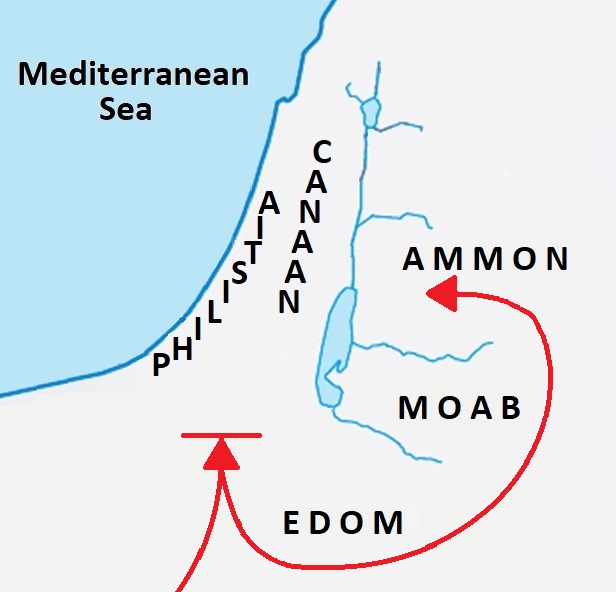
Painful Plan — God’s original plan was for Israel to enter the Promised Land from the south, but the 10 spies influenced the people to reject that plan, and they spent the next 40 years in the wilderness south of Canaan. Plan B was then to enter the land from the east, crossing the Jordan River. To do that, however, they had to first go east and north around the Dead Sea, which was through land occupied by descendants of Esau (Edom) and the sons of Lot’s daughters (Moab and Ammon). They were opposed and threatened all the way, had to skirt around to the east of Edom and Moab (v. 4), and then fight with the Amorites near the territory of Ammon in self-defense (v. 23). Before they got there, however, Israel had another foolish quarrel with God. They were impatient with their progress and were tired of searching for water and eating manna. They even dared to tell God that the manna He had provided for them for 40 years was “worthless food” (v. 5). For that, God sent poisonous snakes that killed many of them. They then wisely confessed their sinful and foolish talk against God, telling Moses, “We have sinned, for we have spoken against the LORD and against you” (v. 7). The circumstances God leads us through are often filled with hardships of one kind or another, many of them caused by our own sin and foolishness. We are to learn our lessons and keep on going because His plan is always good for us.


lesson learned, we as a Christian should always trust and obey God, because His will is the best for us.
LikeLike