
Save or print this page by clicking on “Download” below:
May 18, Sunday
Reading A138 — Leviticus 26 — Blessings and Punishments Audio: Leviticus 26 (ESV)
An audio recording of the following comments is available below:
Ignoring Discipline — Six times in this chapter, the “if … then” combination is used to emphasize the rewards of obedience and the penalties of rebellion. It begins and ends positively, with the blessings of obedience (vv. 3-4) and humble confession of sin (vv. 40, 42). The same principle is true for us today. God responds to our obedience with His favor because we are acting in the way that He designed for our benefit. Confessing our sin in humility brings us back into that peaceful relationship with God that pleases both of us. Between these two positive passages, however, Israel was warned of four devastating consequences for continuing in their sin. The first step of God’s discipline was that they would be thrown into panic if they refused to turn back to God (vv. 14, 16). If they ignored God’s correction, it would get worse: their land would fail to produce crops needed to sustain them. If they still continued in their sinful ways, God would bring the sword of enemies into their Promised Land (vv. 23-24). Finally, ignoring even God’s discipline, they would end up being conquered by other nations and removed from their own land. How do we respond to God’s discipline? Do we even recognize it? When troubles come into our lives, it would be a good time to evaluate our relationship with the Lord. Have we been walking closely with Him in obedience? We should not ignore discipline because it is for our own good.
May 19, Monday
Reading A139 — Leviticus 27 — Giving to God Audio: Leviticus 27 (ESV)
An audio recording of the following comments is available below:
Supporting God’s Work — Financial support for the service provided by the priests and Levites to the tabernacle ministry was contributed by people from all the tribes of Israel. Some of the ways this happened is summarized in this final chapter of Leviticus. Some person might make “a special vow” (v. 2), deciding to devote himself to the service of God in the sanctuary, but because he was not a Levite and was restricted as to where he could go within the tabernacle enclosure, he would give his value in silver to the Lord in substitute for his service. Similar contributions could be made with the price of an animal (v. 9), a house (v. 14), or crops from a portion of their farming land (v. 16). Two practical questions came to my mind as I read this chapter. One was that there didn’t seem to be inflation for those ancient economies. A shekel in Moses’ time had the same purchasing power in Jesus’ time. The daily wage and the cost of a slave never changed. How was that maintained? Why can’t we do that today? The second question was about how much mathematics had to be used by the priests in evaluating the worth of a poor man (v. 8), an unclean animal (v. 12), a house (v. 14), and a crop value that depended on how many years it was before the next Jubilee (v. 18, 23). These promises or vows to give was support for the priests. It is much less complicated for us today, but the principle is the same: We give to the Lord, but its purpose is to support those who lead in our churches. We should give generously, gladly, and worshipfully.
May 20, Tuesday
Reading A140 — Numbers 1 — Numbering Israel’s Army Audio: Numbers 1 (ESV)
An audio recording of the following comments is available below:
God’s Choices — It didn’t take long to understand why this fourth book of the Torah (or Pentateuch) was named “Numbers.” The first chapter features the census of all the men of fighting age. It suggests that Israel is just about to invade Canaan, which was God’s plan. Because of their cowardice, however, that invasion would be delayed for another 40 years. The army of 603,550 men would likely mean that the whole congregation of Israel numbered over 2 million people. The people did not choose their tribal leaders here, but it was God who told Moses, “…these are the names of the men who shall assist you…” (v. 5). Judah was the largest tribe, emphasizing their role of leadership. We will read tomorrow that Judah was chosen as the first of four parts of Israel to camp around the tabernacle and the first group to start out on their next journey (2:3-9). If the numbers were a measure of importance, Joseph would be second. His tribe, composed of the tribes of his sons, Ephraim and Manasseh, totaled 72,700 men (vv. 32-35), compared to the 74,600 men of Judah (v. 27). Judah was chosen to be the leader, and Levi was chosen to be exempt from war. Did the other tribes think that was unfair? Do other people sometimes get privileges that pass you by? Probably. God makes choices that fit best into His perfect plan, and we are most fulfilled when we gladly do His will.
May 21, Wednesday
Reading A141 — Numbers 2 — Camping and Marching Audio: Numbers 2 (ESV)
An audio recording of the following comments is available below:
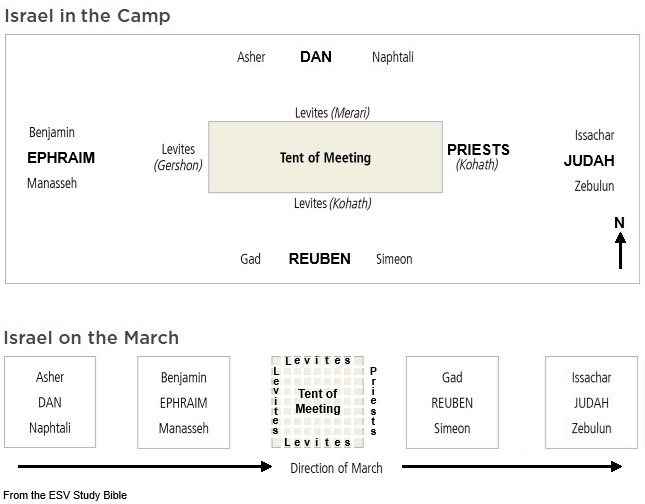
God’s Structured Presence — God organized the people of Israel carefully, both in how they camped and how they marched to their next place to live. The tabernacle, or tent of meeting, was always at the center, symbolizing the primary importance of God with His people. When they camped, the people surrounded the tabernacle with the Levites being the closest. When they marched, the Levites carried the parts of the tabernacle with six tribes going before them and six tribes following them. Since Jesus came to earth, God has been pleased to dwell in each believer’s heart. He always “camps out” and walks with us, wherever we are. We should put Him consciously at the center of our lives. I noticed something pleasingly ironic to me in the diagram below: The tribe of Benjamin camped on the West side of the tabernacle. I should take that as my life verse! 🙂 Another positive is that today is my spiritual birthday!
May 22, Thursday
Reading A142 — Numbers 3 — Guarding and Transporting Audio: Numbers 3 (ESV)
An audio recording of the following comments is available below:
Covered and Useful — After being very clear that the Levites were not to be counted in the earlier general census (1:47, 49; 2:33), God instructed Moses in this chapter, “List the sons of Levi, by fathers’ houses and by clans; every male from a month old and upward you shall list” (3:15). The reason for the first census was to determine how many men were available to make an army. The purpose for counting the Levites this time was to make sure that every firstborn male (who was claimed by God) was redeemed from death by either the “substitution” of a Levite or the payment of five shekels of money. Because of this requirement, another census had to be taken, counting all the firstborn males who had been born since Israel left Egypt, to make sure they were all “covered” as having been given to God. The firstborn cattle, goats, and sheep didn’t get off so easily; they had to be sacrificed. All the male Levites were assigned the tasks of guarding the priests, the tabernacle, and the whole congregation. They were also responsible to take down, transport, and set up the tabernacle complex when they moved to a new location. How about you? Do you feel “covered” in safety as someone who has been given to God? Jesus has covered us with His sacrificial blood so that we can securely belong to His family. Do you feel useful, having accepted a task to perform in the Lord’s work? The Holy Spirit has given each Christian a spiritual gift to be used in His work in addition to natural gifts and abilities that came at our physical birth.
May 23, Friday
Reading A143 — Numbers 4 — Moving Duties Audio: Numbers 4 (ESV)
An audio recording of the following comments is available below:
Dangerous Holiness — Because of the holiness of God, the process of taking down and transporting the tabernacle worship center was described in careful detail. The penalty for not treating the holy tabernacle furnishings properly was death (vv. 15, 19-20). Although the Kohathites were the premier Levite family, only the priests themselves, Aaron and his descendants, who were also Kohathites, were allowed to view or touch the holy things. The remaining Kohathites would carry the carefully covered holy furnishings by their poles or by the frames made especially for carrying them. Recognizing and respecting the holiness of God is emphasized in this chapter. In those days, physical things represented and symbolized the holiness of God. In our New Covenant age, the Holy Spirit lives within us and the emphasis has shifted significantly from the physical to the spiritual, from the external to the internal. The holiness of God has not changed, however, because He continues to remain just as holy. We should not approach God casually or flippantly in prayer. He is our Creator, our Savior, and our Lord. He is holy.
May 24, Saturday
Reading A144 — Numbers 5 — Separating the Unclean Audio: Numbers 5 (ESV)
An audio recording of the following comments is available below:
Suspected Adultery — The penalty for committing adultery in the OT was death for both persons. The situation in today’s chapter was only that of suspected adultery. The method of investigation and punishment seems complicated and puzzling. Verse 17 is the only place in the Bible where “holy water” is mentioned. Questions about where it came from and what made it holy are not answered. Dust from inside the tabernacle was placed into the water, but it was called “holy” before that. The dust did connect, however, with the holiness of God, and it involved Him closely in the verdict that would be made. Then, the “curses” (v. 23) that the woman’s body and womb would swell and her “thigh fall away” were written down and then washed off into the water, which made it bitter. When she drank the water, either nothing would happen, proving her innocence, or the written curses would happen to her, in addition to having “bitter pain” (v. 24) and apparently removing her ability to bear children in the future (v. 28). This reminded me of part of a verse my mother used to quote to me often: “…be sure your sin will find you out” (Numb. 32:23). The principle she supported was that you cannot get away with sin, even if it is done in secret. God is always watching, and He has a way of exposing it in some way in the future and applying a penalty to it. Even if you think you have escaped, it has put a nick in the core of your person. You have been marred in a way that will have lasting negative consequences.
 accbibleread.com
at Moses time sins committed are really exposed and that person will suffer consequences. Now still, though may covered but deep inside the individual suffers most it will manifest in his body. Depression, sickness or the body looks like zombi.
LikeLike