
Save or print this page by clicking on “Download” below:
May 11, Sunday
Reading A131 — Lev. 17-18 — Sacrificial and Sexual Sins Audio: Leviticus 17-18 (ESV)
An audio recording of the following comments is available below:
Judgment-Worthy Sins — These two chapters cover important sinful practices that God condemned, like offering “sacrifices to goat demons” (17:7) and eating blood that was intended to “make atonement” for people’s sins (v. 11). The primary sins in chapter 18 are sexually related, using the term “uncover nakedness” as a polite way to talk about sexual intercourse. God called homosexuality, “an abomination” (v. 22) and that having sex with an animal was “a perversion” (v. 23). Sometimes Christians think that it was unkind of God to allow Israel to enter the Promised Land to kill and take over the land of people who had lived there for centuries, but God gives the reason in this chapter: it was because of “these abominations” (vv. 27, 29). It was judgment against these kinds of terrible sins. God said that it was because “by all these the nations I am driving out before you have become unclean” (v. 24). We remember what happened earlier to Sodom and Gomorrah because of similar practices.
May 12, Monday
Reading A132 — Leviticus 19 — Describing Holiness Audio: Leviticus 19 (ESV)
An audio recording of the following comments is available below:
I Am the LORD — I noticed in the previous chapter that six times the statement, “I am the LORD,” was used. In today’s chapter, it is used 14 times. It is a declaration of absolute authority, normally placed at the end of commands. Yahweh rules! His commands must be obeyed, or serious consequences will result. Seven of the Ten Commandments are repeated in this chapter (vv. 3, 4, 11, 20). Obedience is demanded. Another emphasis in today’s reading is that of holiness. It is also commanded: “You shall be holy, for I the LORD your God am holy” (v. 2). Being holy is being separated as unique and different, as illustrated by not mixing breeds of cattle, sowing two kinds of seeds, or wearing a garment woven with two kinds of material (v. 19). For us, holiness is being like God—imitating Him, being set apart as dedicated and obedient to Him. When people watch us, they should see Jesus.
May 13, Tuesday
Reading A133 — Lev. 20-21 — Rules for People and Priests Audio: Leviticus 20-21 (ESV)
An audio recording of the following comments is available below:
Sin’s Consequences — Many of the sins condemned in chapter 18 are repeated in chapter 20, but now, the penalties for those sins are emphasized. The penalty for offering one’s child to the pagan god Molech was death (20:2). The same punishment was declared for cursing one’s father or mother (v. 9), committing adultery (v. 10), homosexuality (v. 13), having sex with an animal (v. 15), and attempting to communicate with the dead (v. 27). Paul later summarized that ultimately “the wages of sin is death,” but for the Christian, “the free gift of God is eternal life in Christ Jesus our Lord” (Rom. 6:23). As Christians, then, we are to live in holiness, acting in grateful response to being loved and forgiven by God. Our standards of living are much higher than those of most people around us. We are set apart by God to reflect His holiness. As chapter 21 shows, the OT priests had a similar position. Because of their position and relationship to God in worship, they were restricted in connection with people who died (21:1) and the women they could marry (vv. 7-8). The chief priests had even a higher standard regarding whom they could marry (vv. 10-15). Like the priests, we represent God to those who live around us. Be holy!
May 14, Wednesday
Reading A134 — Leviticus 22 — Holy Food Audio: Leviticus 22 (ESV)
An audio recording of the following comments is available below:
Holy Things — This chapter is a continuation of the previous one about what is to be recognized as holy by the priests. Twelve times in this chapter, God refers to food offered in sacrifice as being “holy things,” and twice it is said of this food, “I am the LORD who sanctifies them” (vv. 9, 16). Things become holy through being sanctified by God, i.e., being set apart for His purpose. Most Christians begin each meal with a prayer of thanksgiving to God for what they are about to eat, which is like “sanctifying” that food. In a sense, you set apart a certain time of the day to honor God, learn from Him, and fellowship with Him as you read the Bible and pray. Sanctified food and sanctified time are “holy things,” things intentionally set apart for God’s good purpose.
May 15, Thursday
Th Reading A135 — Leviticus 23 — Appointed Feasts Audio: Leviticus 23 (ESV)
An audio recording of the following comments is available below:
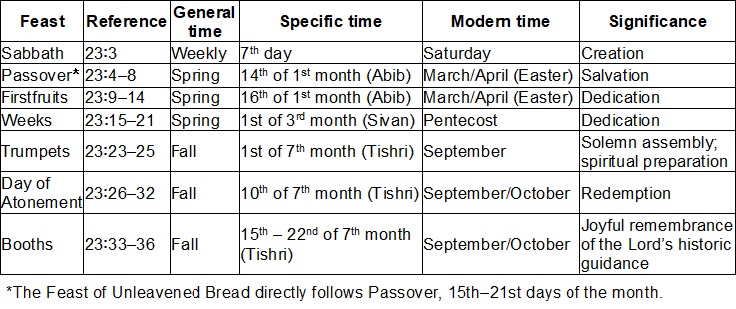
Rest and Worship — The table below (from the ESV Study Bible) summarizes information about the seven major God-appointed feasts featured in this chapter. Two activities are emphasized throughout the chapter, the first one called “a holy convocation.” This expression, used 11 times in today’s reading, is a call to gather for worship. Gathering for worship is what Christians have been doing every Sunday for 2,000 years. We get a sense of oneness when we join our hearts and voices in singing, praying, and learning together. The other “activity” emphasized in this chapter is that of “rest,” mentioned five times here. The day we set aside for worship of our Lord should also contain intentional rest. Our souls need worship and our bodies need rest.
May 16, Friday
Reading A136 — Leviticus 24 — Blaspheming the Name Audio: Leviticus 24 (ESV)
An audio recording of the following comments is available below:
Keeping God Holy — The first nine verses of this chapter emphasize the holiness of God. The careful and regular care of the golden lamp and the golden Table of Presence in the Holy Place showed respect for the holiness of God. The bread loaves were to be eaten only by priests in a holy place. They were perpetual activities that showed high respect for God. On the other hand, verses 10-16 show God’s attitude toward someone who dishonors Him by cursing His name, Yahweh. A bi-racial son got into a fight and blasphemed the name of God, breaking the third Commandment (Ex. 20:7). What should be done? No penalty for this sin had previously been given and the boy’s racial mixture complicated the decision, so God gave Moses the verdict—death by stoning. That is how holy the name of the Lord is. We hear His name being blasphemed frequently, and occasionally one even hears a Christian expressing the common exclamation contained in the abbreviation OMG. That is disrespecting God and dishonoring His name. It is not treating Him with the honor He deserves. Holy is the Lord!
May 17, Saturday
Reading A137 — Leviticus 25 — Sabbath and Jubilee Audio: Leviticus 25 (ESV)
An audio recording of the following comments is available below:
Rest and Renewal — We saw a summary of the festival calendar in chapter 23, but in today’s reading, we see the addition of a Sabbath for the land, and the year of Jubilee, celebrated every 50 years. Whereas the people were given a day of rest every seven days, the land was allowed to rest for one year every seven years. That seventh year was also a year of rest for the people because God miraculously provided a bountiful crop during the sixth year, so His people could also rest during that seventh year (v. 21). What God requires, God provides. It was an opportunity for people to trust God and for Him to demonstrate His love and power. The year of Jubilee was a start-over year. Every 50th year, basically a generation, families who had run into financial difficulties got to return to the ancestral property that they had sold to pay their debts. Salvation is like that in some ways. When people come to the end of years of failing to find satisfaction and success in life, they often turn to God, admitting their failure and asking for forgiveness. God redeems them (buys them) and brings them into a new kind of family, the family of God. It is a new start for them, not one that returns to what once was theirs, but one that discovers a new kind of life, eternal life.
 accbibleread.com
It is specified to rest on the 7th day and worship God. And also being a Christian we should be holy, because we were sanctified by the Lord Jesus. In everything we do, we should do it for the glory of God.
LikeLike
Was the year of Jubilee ever instituted?
I think I heard or read that it wasn’t.
LikeLike