Save or print this page by clicking on “Download” below:
March 22, Sunday
Reading B81 — Proverbs 21 — Turning Hearts Audio: Prov. 21 (ESV)
An audio recording of the following comments is available below:
Getting One’s Way — The idea of quarreling appears again in two verses of this chapter, but a different Hebrew word is used than the one in yesterday’s reading. The word used for today appears nine times in the OT, all of them in Proverbs and all of them in a negative context. Here, Solomon wrote, “It is better to live in a corner of the housetop than in a house shared with a quarrelsome wife” (v. 9), and “It is better to live in a desert land than with a quarrelsome and fretful woman” (v. 19). This is not just picking on women; it only provides examples to show that being quarrelsome is wrong and should be avoided. Quarreling should be avoided, especially in the home, because it is destructive and it is based on the selfish desire to get one’s own way. Another very different example of getting one’s own way is found in this chapter, but it is not selfish or sinful. It is when God gets His own way, which is always right and best. It comes in the first and last verses of this chapter. Solomon wrote, “The king’s heart is a stream of water in the hand of the LORD; he turns it wherever he will” (v. 1), and “The horse is made ready for the day of battle, but the victory belongs to the LORD” (v. 31). The Hand of History moves the hearts of kings and gives victory in battle. He is always good and always right, but we are not, so we must be very cautious about wanting control.
March 23, Monday
Reading B82 — Proverbs 22 — Child Dedication Audio: Prov. 22 (ESV)
An audio recording of the following comments is available below:
Hard Training — Two well-known proverbs about raising a child are presented in this chapter. Both have generated a lot of discussion and interpretation. Since I had some questions about this first verse, too, when I read it this morning, I decided that I would try to figure it out for good. It says, “Train up a child in the way he should go; even when he is old he will not depart from it” (v. 6). I discovered several things that I had not known before, but I am still left with uncertainties. First, I discovered that the Hebrew verb for “Train up” is used only five times in the OT, and in the four other places, it is always translated “dedicate” (for a house or a temple). In fact, two noun forms of the same Hebrew word are used 12 times in the OT, every one translated “dedication” (ESV). The second thing I learned was that the expression “the way he should go” is a rather interpretive translation of a single Hebrew word, which usually means simply “the way.” There is much speculation offered for what is meant by the word “way” here. At this point, I would say that it basically means that a child should be pointed to or dedicated toward a good direction. For the Christian, that would at least include following Jesus. The second child-raising proverb is, “Folly is bound up in the heart of a child, but the rod of discipline drives it far from him” (v. 15). I don’t have enough room left to discuss this one, except to say that it must not be ignored.
March 24, Tuesday
Reading B83 — Proverbs 23 — Thirty Sayings Audio: Prov. 23 (ESV)
An audio recording of the following comments is available below:
Milking Grandpa — After already writing over 20 chapters of proverbs, near the end of the previous chapter, Solomon made this statement: “Have I not written for you thirty sayings of counsel and knowledge…?” (22:20). Those summary sayings seem to introduce what followed, five of them at the end of chapter 22 and 25 of them through this chapter and the next. Some ideas are repeated from what we have read earlier. In today’s chapter, we see them focused on appetite (23:1-3), wealth (vv. 4-5), a deceptive host (vv. 6-8), speaking to a fool (v. 9), stealing property (vv. 10-11), applying instruction (v. 12), child discipline (vv. 13-14), pleased parents (vv. 15-16), envying sinners (vv. 17-18), shady associations (vv. 19-21), joy for parents (vv. 22-25), avoiding prostitutes (vv. 26-28), and warnings about drinking alcohol (vv. 29-35). These sayings are lessons learned in a wise and godly father’s life that he wants his son to learn early in life. I am an old man, but I am still learning many things that I wish I had learned many years ago when my children were growing up. If you are a young person, get close to your grandparents and seek their wisdom. Ask them to tell you about what they learned about certain kinds of situations that may concern you now. They probably have 30 sayings of their own. Milk them for wisdom!
March 25, Wednesday
Reading B84 — Proverbs 24 — Reacting to Evil Audio: Prov. 24 (ESV)
An audio recording of the following comments is available below:
Rescue the Perishing — The statement, “These also are sayings of the wise” (v. 23), shows that Solomon’s 30 sayings ended with verse 22. Quite a bit of today’s chapter deals with godly reactions toward wrongdoing. Twice we are told not to envy evil people (vv. 1, 19). How they may gain quick financial success might be attractive to us, but “the evil man has no future” (v. 20). When we see the later failure and punishment for their evil, we should “not rejoice, lest the LORD see it and be displeased, and turn away his anger from him” (vv. 17-18). We should not rejoice in his punishment because God doesn’t. He is merciful toward all, saying, “I have no pleasure in the death of the wicked, but that the wicked turn from his way and live” (Ezek. 33:11). The godly person should be grieved even when evil people are punished because they are lost forever, never really personally experiencing the love of God. This merciful attitude reminds me of how we Christians ought to be reacting against the widespread abortion of babies in America today. The pro-abortion Society of Family Planning reported that an estimated average of 98,630 babies were aborted each month in 2025, which totals 1,183,560 for the year. One of Solomon’s sayings instructs us (in a wider perspective): “Rescue those who are being taken away to death…” (v. 11). The next verse tells us that we cannot claim ignorance to support our inactivity: “If you say, ‘Behold, we did not know this,’ … Does not he who keeps watch over your soul know it…?” (v. 12). We must support those who are leading the current opposition to this deadly tragedy.
March 26, Thursday
Reading B85 — 1 Kings 5 — Buildings and Relationships Audio: 1 Kings 5 (ESV)
An audio recording of the following comments is available below:
Being Different — The cooperative relationship that King Hiram of Tyre had with David and Solomon was rather unique in those ancient, warring times. Because of David’s prior interactions with this northern king, “Hiram always loved David” (v. 1), and after seeing Solomon’s wisdom, “Hiram … rejoiced greatly and said, ‘Blessed be the LORD this day, who has given to David a wise son to be over this great people’” (v. 7). This Gentile king gave honor to Yahweh because of the qualities he saw in David and Solomon. That is the way our present-day attitudes, words, and actions ought to influence people around us. They should see that we are very different from what is “normal” in their surrounding environment. This can only happen, however, when we are very different because God has changed us thoroughly and we are sincerely striving to walk obediently and lovingly. The world around us sees many so-called Christians who are not genuinely different. They are not people whom Paul called out to “be separate from them … and touch no unclean thing” (2 Cor. 6:17). Our lives should stand out as being positively and attractively different.
March 27, Friday
Reading B86 — 1 Kings 6 — Solomon’s Temple (A) Audio: 1 Kings 6 (ESV)
An audio recording of the following comments is available below:
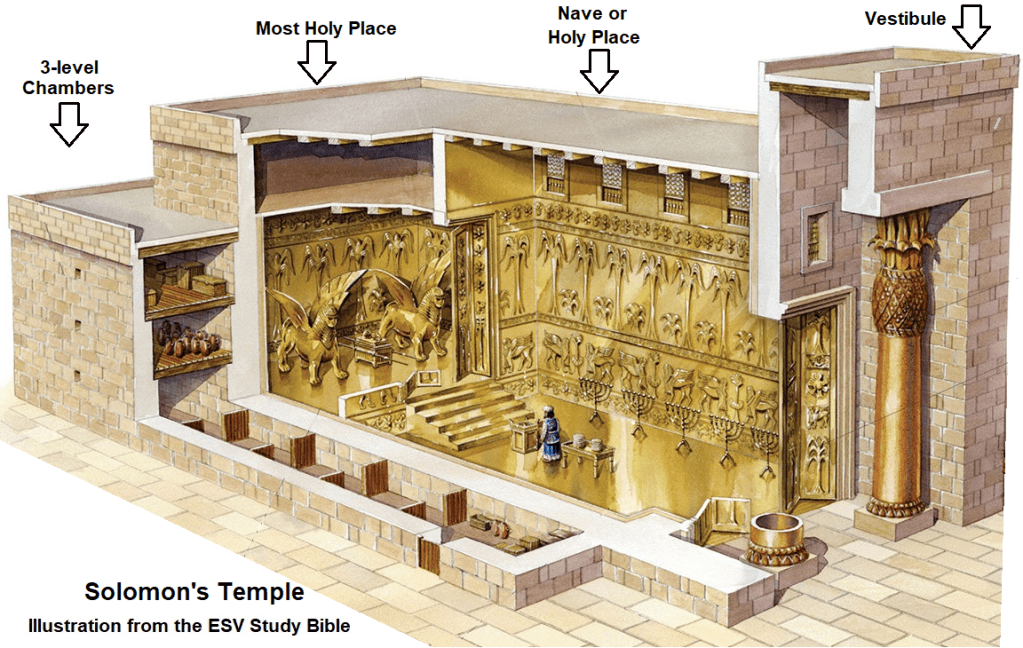
A Temple for Obedience — This chapter very clearly describes the size and construction of Solomon’s Temple. The drawing below is very helpful to visualize the text description. It was a magnificent building, especially on the inside, where everything was overlaid with gold. There was great reverence shown in its construction, having all the parts built outside the city and carried in for placement, using no metal tool to make noise in the construction of this holy building (v. 7). God also attached a spiritual importance to this building, saying that its continuing existence would depend on the obedience of its people (note the “if … then” expression in vv. 12-13). That temple was destroyed by King Nebuchadnezzar of Babylon 387 years after its completion because of Israel’s continuing blatant disobedience. In verse 1, there is a God-placed chronological stamp on this building, being started in 966 B.C., 480 years after Israel left Egypt in 1446 B.C.
March 28, Saturday
Reading B87 — 2 Chron. 2 — Solomon’s Request Audio: 2 Chron. 2 (ESV)
An audio recording of the following comments is available below:
Uncontainable Presence — This account of Solomon’s request for help from King Hiram of Tyre for building the temple is expanded from what we read two days ago in 1 Kings 5. Today’s account from 2 Chronicles 2 was written during the time of Ezra, probably 500 years later, after many more historical documents were available. In his letter to Hiram, Solomon emphasized the supreme greatness of Yahweh. Although this magnificent temple was to be built “for the name of the LORD my God” (v. 4), it could not contain God because “even highest heaven, cannot contain him” (v. 6a). God would dwell in this temple, but He could not be limited to that place because He is omni-present, everywhere present. God also dwells in my heart because I am a Christian, but He dwells in the hearts of every believer on this planet as well. His presence cannot be claimed exclusively. Notice also, Solomon’s humble statement: “Who am I to build a house for him…?” (v. 6b). One more interesting part of this chapter is the recruitment of Huram-abi as a super-able craftsman to lead the work in making the decorative elements for the inside of the temple (v. 13). Although his father was from Tyre, his mother was from Israel’s northern tribe of Dan (v. 14). You may remember that when Moses was about to build the portable tabernacle in the desert, God provided two very skillful men to lead the fine work needed for its design. One of them was Oholiab, who also came from that tribe of Dan (Ex. 31:1, 6).
 accbibleread.com