Save or print this page by clicking on “Download” below:
February 15, Sunday
Reading B46 — Psalm 94 — Facing Unfairness Audio: Psalm 94 (ESV)
An audio recording of the following comments is available below:
Godly Response to Injustice — The context of this psalm doesn’t seem to fit well during the rule of David and Solomon. The wicked rulers in this psalm “pour out their arrogant words … They crush your people, O LORD … they say, ‘The LORD does not see’” (vv. 5-7); and they “frame injustice by statute” (v. 20). It does seem to describe well some of the governments we see today, however. What should we do when our own government opposes godly people? We could respond like this psalmist did, asking for God to step in: “God of vengeance … shine forth! Rise up, O judge … repay to the proud what they deserve!” (vv. 1-2). In addition to prayer, we should remember what God has done for us personally in the past: “…your steadfast love, O LORD, held me up” (v. 18). Our request should also be accompanied with gratitude. Finally, we must trust for God to act sometime in the future: “He will bring back on them their iniquity” (v. 23). Don’t be anxious; just be faithful!
February 16, Monday
Reading B47 — Psalm 119:1-88 — The Word of God (A) Audio: Psalm 119 (ESV)
An audio recording of the following comments is available below:
Approaching God’s Word — Since this is the longest chapter in the Bible, we will read it in two parts. Psalm 119 is structured as an expanded acrostic, having 22 eight-verse stanzas, with each verse in a stanza beginning with the same letter of the Hebrew alphabet. If you ever wanted to memorize the Hebrew alphabet, here is your chance, since the title of each stanza is headed by the successive Hebrew letters. The theme of the whole psalm is the Word of God, expressed in many ways, like “laws … testimonies … ways … precepts … statutes … commandments … [and] rules” (vv. 1-7). All but five of the verses in the whole psalm mention God’s Word in one form or another, but five other verses mention it twice, balancing it out (cf. v. 16 and v. 84). It was interesting to me in today’s reading to see what it called us to do with respect to our relationship to the Word of God. The most frequently mentioned action is that we should “keep” His Word, 14 times in today’s reading. So, obedience seems to be God’s greatest concern for us as we encounter the message of the Bible. The next three concerns for us would be to “delight” in it (7 times), to “meditate” on it (6 times), and to encounter it with one’s “whole heart” (5 times). We read it every day. Do you feel that you are growing in your obedience to the commands you see? How about also delighting in it, meditating on it, and approaching it with your whole heart? We should approach God’s Word with a purpose of growing from it.
February 17, Tuesday
Reading B48 — 1 Kings 3 — Solomon’s Wisdom Audio: 1 Kings 3 (ESV)
An audio recording of the following comments is available below:
The Need for Wisdom — According to parts of this chapter, one might say that Solomon’s reign didn’t exactly begin well. Perhaps unknowingly, when he “made a marriage alliance” with the king of Egypt (v. 1), he was going against God’s previously expressed will: “You shall not intermarry with them” (Deut. 7:3). The Hebrew word for “intermarry” there, is the same word translated, “made a marriage alliance,” in today’s reading. The reason for this command was that accommodating false belief into marriage would result in compromising the faith of the mate who followed God (Deut. 7:4). This would, in fact, happen to Solomon in the future (1 Kings 11:7-8). Solomon also compromised by tolerating the worship of Yahweh in many “high places” (3:2-3). When the king went to sacrifice at Gibeon, the location of the tabernacle, God met him in a dramatic way. Solomon already showed wisdom in asking God for wisdom. He also showed humility, saying, “…I am but a little child. I do not know how …” (v. 7). God then gave him superb wisdom, and he demonstrated it to all by how he handled the case of the two prostitutes with one living baby. We should also pray for wisdom. Pray before we read His Word because we need His understanding! Pray before making decisions because we need His direction! We need God’s wisdom as much as Solomon did.
February 18, Wednesday
Reading B49 — 1 Kings 4 — Pinnacle of Wisdom Audio: 1 Kings 4 (ESV)
An audio recording of the following comments is available below:
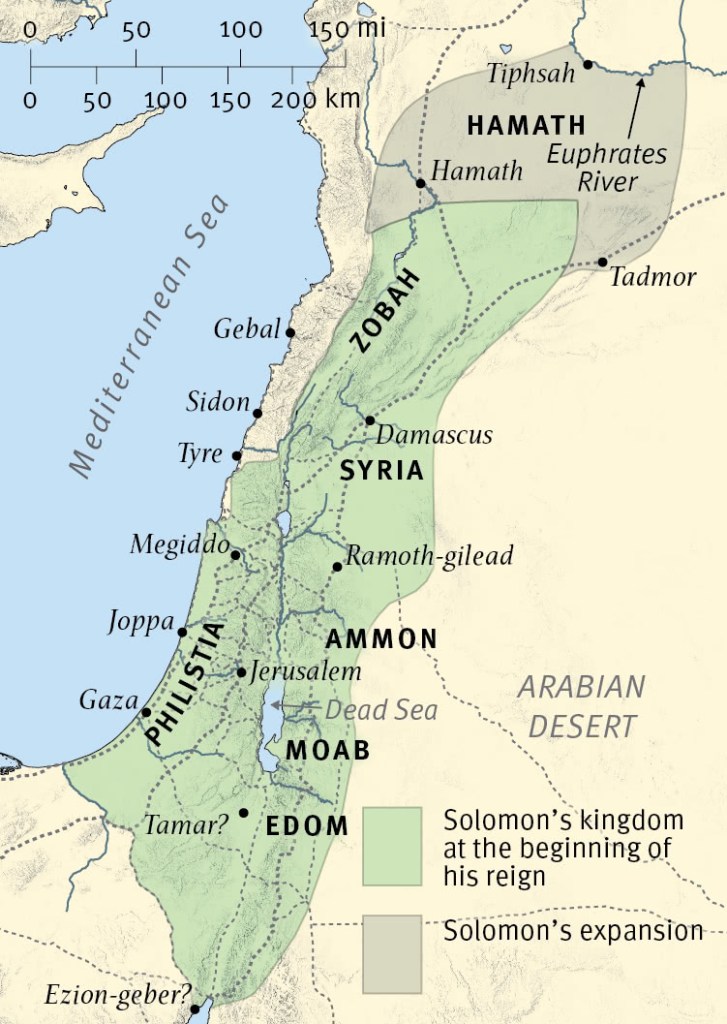
Google Solomon — More evidence of Solomon’s God-given wisdom is featured in this chapter. He had a carefully organized government. He must have had very many people included in what is considered “his household” (v. 7) to require daily the meat alone of 10 oxen, 20 cattle, and 100 sheep (v. 22). He also peacefully controlled many surrounding nations, most of which had been taken over by David (see map). It is significant that “Judah and Israel … were happy” (v. 20) because that would change when his son, Rehoboam, began his reign (cf. 1 Kings 12:4). In his second deviation from obeying the Mosaic Law, Solomon accumulated many horses. Deut. 17:16 said that Israel’s king “must not acquire many horses for himself.” Despite this sin, “God gave Solomon wisdom and understanding beyond measure, and breadth of mind … so that Solomon’s wisdom surpassed the wisdom of all the people of the east and all the wisdom of Egypt. For he was wiser than all other men … And people of all nations came to hear the wisdom of Solomon” (1 Kings 4:29-31, 34). That sounds a lot like what we have today with Google search. 🙂 Solomon was way ahead of his time!
February 19, Thursday
Reading B50 — 2 Chron. 1 — Seeking Wisdom First Audio: 2 Chron, 1 (ESV)
An audio recording of the following comments is available below:
What Should We Seek? — Part of this chapter repeats basically what we read two days ago from 1 Kings 3 about Solomon asking God for wisdom. There, we saw Solomon’s wisdom and humility in asking for wisdom to govern, but he also showed great unselfishness. God acknowledged that when He replied, “Because … you have not asked for possessions, wealth, [and] honor … I will also give you riches, possessions, and honor …” (2 Chron. 1:11-12). Be honest! What would you have asked for? Our sinful nature and our selfish culture scream for wealth and honor. Instead, the lifelong quest for today’s Christians should be learning how to put God first in our lives. Selfishness fights against that as does contentment and comfort. The immature Christian tends toward wanting things, while the more mature believer seeks relationship with God. Jesus told us to “seek first the kingdom of God and his righteousness, and all these things will be added to you” (Matt. 6:33, emphasis added). Put righteousness first!.
February 20, Friday
Reading B51 — Psalm 72 — The King of Kings Audio: Psalm 72 (ESV)
An audio recording of the following comments is available below:
Human or Divine King? — That question about the subject of this psalm could be answered, “yes,” for both kinds of kings. The title, “of Solomon,” could mean either that it was written by King Solomon, or that David wrote it about (“of”) his son. If a human king was in view, he would certainly be an ideal, godly king. He would rule with righteousness and justice from God (vv. 1-2). There is more, however, that doesn’t fit a human king. He will be feared and peace will abound as long as “the sun endures” (v. 5), and “… till the moon be no more!” (v. 7). He is eternal. We saw a map two days ago showing the extent of Solomon’s reign, which covered several nations surrounding Israel, but the king in this chapter will “have dominion from sea to sea … to the ends of the earth!” (v. 8). That never happened in Israel’s history, so it must refer to David’s final and eternal descendant, the Messiah, Jesus. In that still-future reign, “all kings fall down before him, all nations serve him!” (v. 11). The worldwide extent of the king’s reign described in v. 8 is repeated by Zechariah (9:10) just after saying that “your king is coming to you; righteous and having salvation is he, humble and mounted on a donkey, on a colt, the foal of a donkey” (Zech. 9:9), which was fulfilled by Jesus at the Triumphal Entry (Matt. 21:5). The ideal king is the Divine King.
February 21, Saturday
Reading B52 — Psalm 119:89-176 — The Word of God (B) Audio: Psa. 119 (ESV)
An audio recording of the following comments is available below:
Checking Commitment — I felt a bit convicted today as I read the second half of this psalm. So much of it talks about one’s constant and joyful attachment to God’s Word, and I am not always there. Nine times, the psalmist said that he “loves” God’s commandments and five times that he “delights” or “rejoices” in them. He says that God’s words are “sweeter than honey to my mouth” (v. 103). Our attitude toward the Bible ought to be one of delight, and I admit that sometimes my delight level is not as high as it should be. Occasionally it may feel a little more like drudgery than delight, which brings me to the second impact I received from today’s reading: discipline. The psalmist’s habit was to “rise before dawn … that I may meditate on your promise” (v. 147-148). Do we take time to meditate on what we read or do we just read it? Seven times a day he praised God for His “righteous rules” (v. 164). He said, “I have sworn an oath … to keep your righteous rules” (v. 106). How is your performance level in reading God’s Word every day? Are you having to read more toward the end of the month because that is our accountability time, and you have fallen behind? The purpose of accountability is to help us to become consistent, to become more disciplined in our meeting with God. The third category is depth. Are you reading so you can check a box or is your heart really into it? Several times, the psalmist speaks of the depth of reading and obeying God’s commands: “Your testimonies are wonderful; therefore my soul keeps them” (v. 129); and “… my heart stands in awe of your words” (v. 161).
 accbibleread.com