Save or print this page by clicking on “Download” below:
November 30, Sunday———–ACCOUNTABILITY FINAL DAY
Reading A334 — Psalm 100-101 — Righteous Praise Audio: Psalm 100-101
An audio recording of the following comments is available below:
Commitment to Holiness — The title of Psalm 100 says that it is “A Psalm for giving thanks.” Verse 4 reinforces it: “Enter his gates with thanksgiving … give thanks to him.” It is a psalm for worship. Psalm 101 is a psalm of commitment. It recognizes the importance of what holiness and genuineness brings to worship. We need to be worthy worshipers, serious about wanting to be authentic in how we live and how we relate to God. David provided five wise statements of advice to help us be righteous worshipers. First, we must know and concentrate on what is right. He said, “I will ponder the way that is blameless” (101:2a). For us, that source is the Word of God, which is not only the Torah that David had but also the rest of the OT and the NT. God has given us the way to walk, but we must learn it and meditate on it. Second, David followed that statement with, “I will walk with integrity of heart within my house” (101:2b). We often let down our guard within our own house, with the people who know us best. We must be the same kind of people whether in our church, our work, our school, or our house. We can do that when we have “integrity of heart,” i.e., we are genuine. Third, David said, “I will not set before my eyes anything that is worthless” (v. 3). That reminds me of what Job said: “I have made a covenant with my eyes; how then could I gaze at a virgin?” (Job 31:1). What do you allow your eyes to look at? What do you read or watch on television or on your phone? Make a covenant! Fourth, David follows in the next verse with, “I will know nothing of evil” (Ps. 101:4). That is the result of making a covenant with our eyes. If we refuse to look, we will fail to learn about what is evil in God’s sight, being “innocent as doves” as Jesus said (Matt. 10:16). David’s fifth statement of resolve is that “No one who practices deceit shall dwell in my house” (Ps. 101:7). He was willing to separate himself from the influence of those who are not willing to follow God’s way. If we want to worship righteously, we should make these five pieces of advice our guide, too.
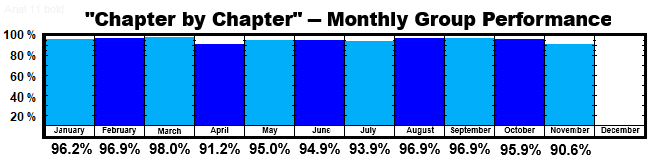
ACCOUNTABILITY FINAL DAY! If you have not yet reported for this month,
please let me know your reading status today at accbibleread@gmail.com.
December 1, Monday
Reading A335 — Psalm 105 — Remembering God Audio: Psalm 105 (ESV)
An audio recording of the following comments is available below:
Thankful History — Like Psalm 78, this is a historical psalm. I can imagine that it might have been used in training young Jewish boys to know about the account of God’s dealings with His people. It can be summed up with this statement at the beginning: “Oh give thanks to the LORD … Remember the wondrous works that he has done” (vv. 1, 5). It is a psalm of thanksgiving that is expressed with singing praises (v. 2) and with seeking God joyfully (v. 3). This historical psalm spotlights major events in Genesis and Exodus, starting with Abraham’s wandering family, then ending with God bringing about two million of Jacob’s descendants out of Egypt’s slavery into the Promised Land. To properly thank God, we also need to remember what He has done in the past, not only from the Bible, but also from events in our own life’s history. How did He lead you to repentance and faith? How did He bring you to your mate? How did He provide a church for you to fellowship with other believers? In addition to remembering the events, we also need to remember to thank God. It is so easy to forget that it was God who gave us these great things in our past. Remember them and remember to thank Him!
December 2, Tuesday
Reading A336 — Psalm 132 — Prayers and Promises Audio: Psalm 132 (ESV)
An audio recording of the following comments is available below:
Fulfilling Vows — This psalm may have been written during Solomon’s reign, but it looks back to his father’s preparation for building the temple, mentioning David’s name four times. Vows made by both David and God are featured in this psalm. David’s vow involved building the temple: “… he swore to the LORD … [that he would] find a dwelling place for the Mighty One” (vv. 2, 5). He would also collect a great amount of money and materials for Solomon to build it. God was in favor of building this temple: “For the LORD has chosen Zion; he has desired it for his dwelling place” (v. 13). God’s vow was even more aimed at David’s dynasty, that his son and “their sons also forever shall sit on your throne” (v. 12). What is God’s plan and desire for you? He has given you at least one spiritual gift for ministering to others. Have you discovered it and are using it? If not, are you serving in a variety of ways to see in what area God is using you most? He has a plan for each of us.
December 3, Wednesday
Reading A337 — 2 Samuel 7 — Palace and Throne I Audio: 2 Samuel 7 (ESV)
An audio recording of the following comments is available below:
A Change of House — There is a much-repeated contrast in this chapter between the literal and figurative use of the word “house.” It is mentioned 14 times in 29 verses. First, it is used of David’s literal house, the palace he built in Jerusalem (vv. 1-2). Second, it was used four times for a literal house for God to dwell in, i.e., a tent or a temple (vv. 5, 6, 7, 13). Third, the remaining eight times it is mentioned here, it refers to the figurative “house” of the eternal dynasty God promised to David. David had been feeling embarrassed that while he was living in an elaborate physical house, the ark of God over which the symbolic presence of God’s Spirit hovered, was under a tent made of cloth and animal skins. His solution was to build a physical building, a temple, to house the ark of the covenant. God would not allow David to build a literal house for Him, however, but He would build a figurative house for David, a kingdom that would last forever. That is just like God, isn’t it? He does far more good for us than we could ever do for Him. David’s kingdom is still going on today. Before Mary conceived the baby Jesus, the angel, Gabriel, came to her with this news about Him: “He will be great and will be called the Son of the Most High. And the Lord God will give to him the throne of his father David, and he will reign over the house of Jacob forever, and of his kingdom there will be no end” (Luke 1:32-33). What a trade! A perishable manmade house of wood and stone in exchange for a God-made eternal “house” made of people.
December 4, Thursday
Reading A338 — 1 Chron. 17 — Palace and Throne II Audio: 1 Chron. 17 (ESV)
An audio recording of the following comments is available below:
Courage to Pray — Today’s chapter is essentially the same as what we read yesterday from 2 Samuel 7. The establishment of David’s eternal kingdom and Solomon’s construction of God’s temple are the main features. One piece of this story that struck me in both versions was this comment at the end of David’s prayer: “For you, my God, have revealed to your servant that you will build a house for him. Therefore your servant has found courage to pray before you” (v. 25). Notice that David’s courage to pray is tied to God’s revelation of His promise to continue his kingdom. Why did it take courage for David to pray? It seems to me that it takes courage to pray with faith. Prayer without faith is often only a ritual. God had made a gigantic promise to David, and the king decided to believe it. So many times, Jesus rebuked His disciples for not having faith to believe Him. Later, His half-brother said that “the prayer of faith will save the one who is sick, and the Lord will raise him up.” (James 5:15). It takes courage to have that kind of faith. David knew he would not see the fulfillment of God’s promise, but he was willing to believe it anyway. Oswald Chambers wrote, “In the natural realm, prayer is not practical but absurd. We have to realize that prayer is foolish from the commonsense point of view.” A prayer of faith takes courage.
December 5, Friday
Reading A339 — Psalm 25 — Knowing God’s Ways Audio: Psalm 25 (ESV)
An audio recording of the following comments is available below:
Waiting for Rescue — This psalm of David is in the form of an acrostic, each verse beginning with successive letters of the Hebrew alphabet. It opens and closes with the connected ideas of not being ashamed (four times) and of waiting for God (three times). The subject of shame is focused on being attacked and overcome in some way by enemies: “… let me not be put to shame; let not my enemies exult over me” (v. 2). At the end, David prayed, “Let me not be put to shame, for I take refuge in you” (v. 20). God is our hope, so we wait for His protection and rescue from troubles in life. There is one other object of our waiting mentioned here, which is waiting to be taught by God. David prayed, “Make me to know your ways, O LORD; teach me your paths. Lead me in your truth and teach me … for you I wait all the day long” (vv. 4-5). Learning is something we should be doing while we are waiting. We might learn that one reason we are being attacked is because of some fault of our own or God may convict us that we are being proud or judgmental in a troubled relationship. We may learn to be patient and humble when under attack. Don’t waste your wait! Look for God’s ways!
December 6, Saturday
Reading A340 — Psalm 29 — The Voice of Yahweh Audio: Psalm 29 (ESV)
An audio recording of the following comments is available below:
Glory and Strength — This psalm pictures a massive thunderstorm sweeping through Israel from the north in Lebanon to the south in Kadesh (meaning “holiness”). The Canaanite pagan god Baal was worshiped in fear as the storm-god, but David and God’s people saw storms as events created by God for His purposes and to demonstrate His power. This psalm opens with this call: “ascribe to the LORD glory and strength” (v. 1). His powerful strength is stressed seven times in this psalm, with the storm also being described seven times as involving “the voice of the LORD.” What was the response to this awesome display of power? It was worship: “…in his temple all cry, ‘Glory!’” (v. 9). The next time you are in the middle of a storm, you might remember that. It is a demonstration of the power of God. Awesome power deserves worship in awe. “Ascribe to the LORD … glory and strength.”
 accbibleread.com