
Save or print this page by clicking on “Download” below:
October 5, Sunday
Reading A278 — Psalm 54, 63 — Running and Praying Audio: Psa. 54, Psa. 63
An audio recording of the following comments is available below:
Putting God First — These two psalms of David were written in threatening times of trouble. Psalm 54 begins with a desperate prayer for help: “… save me … vindicate me … hear my prayer” (54:1-2). There seem to be two related subjects of interest in both psalms. One is David’s strong desire for a close, personal relationship with God. He prayed, “earnestly I seek you; my soul thirsts for you” (63:1); “My soul will be satisfied … my mouth will praise you with joyful lips … and meditate on you … I will sing for joy. My soul clings to you…” (vv. 5-8). David loved God so much that he was able to write these psalms while in life-threatening circumstances. The second emphasis was his longing to participate in public worship in the tabernacle. He remembered his past worship experiences: “I have looked upon you in the sanctuary” (63:2). He anticipated doing it again: “With a freewill offering I will sacrifice to you” (54:6). Sandwiched between these expressions of praise to God is a statement that struck me about the Ziphites. These people were Israelites, but they were at odds with both David and God. David called them “ruthless men … [who] do not set God before themselves” (54:3). They did not respect God; they did not put God first in their lives. That is the same condition that threatens most of us Christians today. Do we have David’s longing for a close, constant, personal relationship with God? Do we look forward to the weekend when we can worship together with other believers? Are we often behind in our schedule of reading through God’s Word? We need to have David’s heart, one that says, “earnestly I seek you.”
October 6, Monday
Reading A279 — 1 Samuel 28 — Saul’s Predicted Death Audio: 1 Samuel 28 (ESV)
An audio recording of the following comments is available below:
Why-Questions — We return in our reading today in 1 Samuel about David hiding from Saul, who had his own problems, being challenged by the whole Philistine army. Saul “was afraid … his heart trembled greatly” (v. 5), but although he “inquired of the LORD, the LORD did not answer him” (v. 6). His only remaining hope was that the now-dead Samuel might be able to guide him. Saul knew that contacting mediums was wrong because he had put them out of the land (v. 3), but he sought for one anyway. The medium asked the first of three why-questions: “Why … are you laying a trap for my life…?” (v. 9). She was being very cautious. “When the woman saw Samuel, she cried out with a loud voice” (v. 12), knowing that this was something beyond her experience and control. God was doing the extra ordinary. Samuel asked the next question: “Why have you disturbed me…?” (v. 15), which brings up many questions of our own about the condition of those who have died, e.g., he still appeared to be an old man (v. 14). When Saul inquired of him, Samuel asked the third question: “Why then do you ask me…?” (v. 16). If God had rejected Saul, how could Samuel help him? Samuel reminded him of the reason for his rejection: “Because you did not obey…” (v. 18). Disobedience is also the source of many of our problems. Samuel then predicted Saul’s punishment: “…tomorrow you and your sons shall be with me” (v. 19).
October 7, Tuesday
Reading A280 — 1 Samuel 29 — David Sent Back Audio: 1 Samuel 29 (ESV)
An audio recording of the following comments is available below:
God’s Subtle Guidance — Although David had earlier feigned madness with Achish, this king of Gath showed high regard for David, saying, “I have found no fault in him” (v. 3), and, “you have been honest … I have found nothing wrong in you” (v. 6). It seems that David was still pretending, however. He used Achish as a means of being protected from Saul. The other Philistine kings were not as trusting of David, and they voted down his participation in the coming fight against Israel. God used them to accomplish His will and to prevent him from fighting against His people. Strangely, David seemed disappointed that he was not allowed to fight, complaining to Achish, “But what have I done … that I may not go and fight?” (v. 8). Was he still pretending? To me, this story really shows the sovereignty of God, guiding the participants so that His plan would be accomplished. We may not see God’s guidance in our own life situations either, but He is there, influencing others to bring about good for us.
October 8, Wednesday
Reading A281 — 1 Samuel 30 — Ziklag Destroyed Audio: 1 Samuel 30 (ESV)
An audio recording of the following comments is available below:
Treating Generously — God was at work again in this tragic story. Although the raiding Amalekites burned David’s city of Ziklag, “They killed no one” (v. 2), which was very unusual. They may have wanted to take the wives, but why the children and the aged? God was protecting David’s people, although many of his soldiers wanted to stone David because they were “bitter in soul” (v. 6). Later, they were called “wicked and worthless fellows” (v. 22) who didn’t want to share the Amalekites’ spoil with 200 of their buddies who were too exhausted to fight. David’s wise leadership response, however, was quite different: “You shall not do so, my brothers, with what the LORD has given us” (v. 23). God had given them the victory and the spoil. He was generous to them, so they should be generous to others. That is also the way David treated the starving Egyptian slave (v. 11) and the elders of many of Judah’s towns (v. 26). Why was David so different? He put God first. When this next king of Israel discovered his burned city of Ziklag, he “was greatly distressed … But David strengthened himself in the LORD his God” (v. 6). God also strengthens and encourages us to be generous as we put Him first.
October 9, Thursday
Reading A282 — 1 Samuel 31 — Saul Dies Audio: 1 Samuel 31 (ESV)
An audio recording of the following comments is available below:
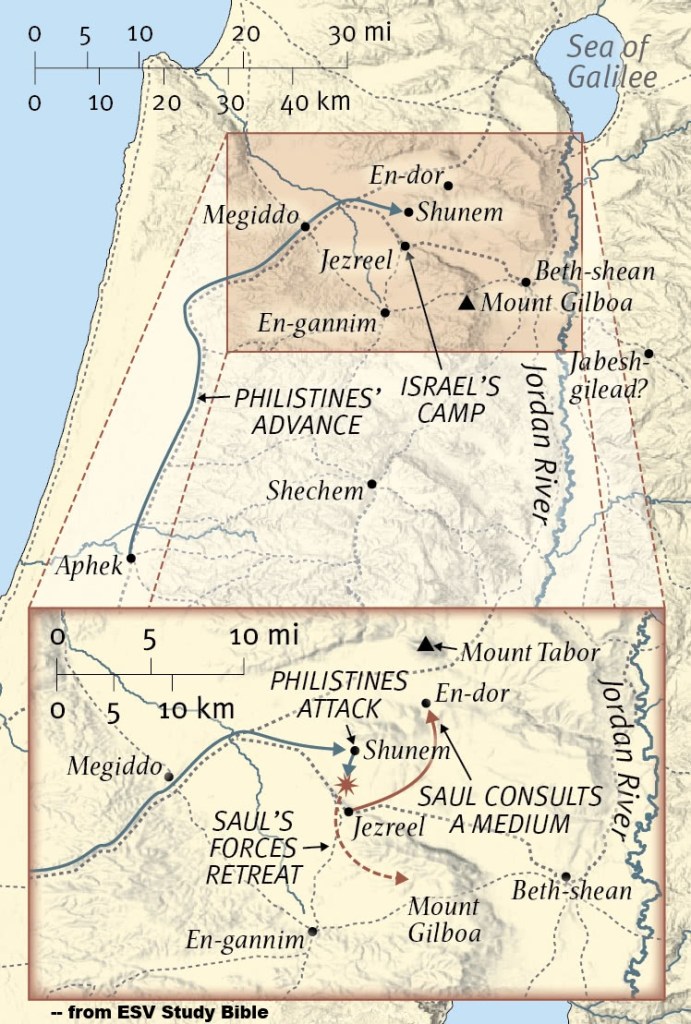
Results of Disobedience — This chapter records the sad end of Saul’s life and his kingdom. It was sad also because Saul killed himself and David’s good friend, Jonathan, also died. It was a losing battle in many ways. Samuel had accurately predicted that Saul would die the next day. In fear, Israel’s army fled about 10 miles (16 km) to Mount Gilboa (see map) where Saul died. Surrounding cities were abandoned by the Israelites (v. 7). The Philistines desecrated the bodies of Saul and his sons by hanging them on a wall (vv. 10, 12). All of this happened because of Saul’s disobedience to God’s command. He was not acting as God’s leader. As predicted, God was removing him from office. Obedience to God is very important for us as well. We can avoid many hard times by following what we know to be God’s will. After reading several more psalms connected with this timeframe, we will move on to the reign of David in 2 Samuel.
October 10, Friday
Reading A283 — Psalm 18 — David’s Plea for Rescue Audio: Psalm 18 (ESV)
An audio recording of the following comments is available below:
Our Strength — This psalm, personally sung by David, will be basically repeated in 2 Samuel 22, where the congregation is encouraged to sing it. Its theme is God’s rescue during times of trouble. Something that stood out to me today was the contrast that was made between David’s inadequate strength versus the supernatural strength God gave to him for battle. David said of his enemies, “they were too mighty for me” (v. 17). The honest recognition of our own weakness is an important part of God’s rescue. We are not strong enough to successfully fight our personal battles on our own. God seems to wait until we admit our need for Him, before He steps in to help us. What a different picture David painted regarding what he could do in God’s strength! Twice, he wrote of “the God who equipped me with strength…” (vv. 32, 39). He said of the Lord, “by you I can run against a troop, and by my God I can leap over a wall” (v. 29), “He made my feet like the feet of a deer” (v. 33), and “my arms can bend a bow of bronze” (v. 34). It is important to notice that God did not fight David’s battles for him, but He gave him the strength to fight successfully. How dependent am I on God when I face problems that are “too mighty for me”? Do I recognize my need? Do I humbly and trustingly call upon God for what I need to find victory? He is our strength.
October 11, Saturday
Reading A284 — Psalm 121, 123-124 — God is Our Keeper Audio: Psa. 121, 123-124
An audio recording of the following comments is available below:
Uplifted Eyes — These psalms are three of a group of 15 Songs of Ascents that picture the feelings and prayers of Israelites approaching the elevated tabernacle (or temple) in the Promised Land. They are saying, “I lift up my eyes to the hills” (121:1), while acknowledging that “My help comes from the LORD, who made heaven and earth” (v. 2). Today’s reading opens and closes with the almighty Yahweh, “the LORD who made heaven and earth” (v. 2; cf. 124:8). Psalm 121 focuses on God as our “keeper,” mentioned six times in eight verses. He keeps us from harm and from evil (vv. 6-7). Like Psalm 121, Psalm 123 also opens with uplifted eyes: “To you I lift up my eyes” (v. 1), this time seeking for mercy from those unbelievers who look with scorn and contempt (v. 4) as they watch them journey toward their place of worship. Are people mocking you for what they see as wasting your time attending church on Sunday? Keep looking up! Psalm 124 was written by David, as he considered the probable negative consequences that would result in the absence of God’s help and protection: “If it had not been the LORD who was on our side…” (vv. 1-2), Israel’s enemies “would have swallowed us up” (v. 3).
 accbibleread.com
the msg of Psalm 121 is so timing in our situation here in the Philippines, despite the calamities and government plunder case still God is my refuge, looking after to His Children. Trusting his guidance, protection . I always look upon him in times of trouble and sickness.
LikeLike