
Save or print this page by clicking on “Download” below:
August 10, Sunday
Reading A222 — Judges 6 — The Fleece of Gideon Audio: Judges 6 (ESV)
An audio recording of the following comments is available below:
Hesitant Faith — Although “the angel of the LORD” called Gideon a “mighty man of valor” (v. 12), this fifth judge showed himself to be fearful, hesitant, and doubting in this chapter. To his hesitant fear, God said, “I will be with you” (v. 16). As we will read later, this was going to be a God-dominated war, and it would be His power that would bring the victory. God is the answer to our fears and hesitations as well. We need to elevate our trust in His presence and help. Gideon showed doubt by requesting many signs of proof. This “angel of the LORD” proved His divinity (likely being the pre-incarnate Christ), first, by touching Gideon’s food offering and causing fire to come from the rock to consume it, and then, by physically vanishing (v. 21). This proved to Gideon that the messenger was divine (v. 22), but he also wanted proof that His divine message was true. There are many Christians today who claim to believe that the Bible is the Word of God, but they have doubts about some of its statements and commands. We need to believe both the Messenger and the message. In direct disobedience to God’s earlier command that “You shall not put the LORD your God to the test” (Deut. 6:16), Gideon used the same word in his request that God would not be angry when he asked, “let me test just once more” regarding the fleece (v. 39). Despite Gideon’s faults, God stooped to his level to grant his requests so that He might demonstrate His power.
August 11, Monday
Reading A223 — Judges 7 — 300 Men Rout Midianites Audio: Judges 7 (ESV)
An audio recording of the following comments is available below:
From Fear to Faith — Israel had a fearful leader. Gideon had asked God for signs to support His promises. That fear was broken in this chapter. God would prove to Gideon that this victory over the Midianites would be His alone. He reduced Israel’s army down to less than one percent and armed them with torches and rams’ horns. God first had Gideon send home 22,000 of his men who were afraid. It is surprising that Gideon didn’t go with them! Finally, there were only 300 of them left. Gideon was still afraid, maybe more so, because God told him to “go down against the camp … But if you are afraid … go down … with Purah your servant” (vv. 9-10). Proving that he was still afraid, he went with his servant (v. 11). But Gideon’s fear turned into faith when he heard a Midianite tell his dream to his comrade, who interpreted it (v. 13). And this was the turning point for Gideon, and “he worshiped” (v. 15). He believed that God could and would make them victors over Midian. When we agree with God about His plans, we should worship Him for His wisdom, power, and patience with our hesitation and fear. God is almighty. That is what we need to learn in practice.
August 12, Tuesday
Reading A224 — Judges 8 — Gideon’s End Audio: Judges 8 (ESV)
An audio recording of the following comments is available below:
Falling Away — It was surprising to me that, after four tribes of Israelites were called to chase the Midianites, only Gideon’s 300 men chased the armies headed by Zebah and Zalmunna. Although Gideon had lost not a single man, the armies he chased had lost almost 90% of their men (v. 10). God was still working miraculously for Israel. When Gideon returned, he was asked to be Israel’s ruler, but he refused, saying, “the LORD will rule over you” (v. 23). In spite of this positive stance for Yahweh, he collected earrings to make an ephod, which turned into an object of worship that “became a snare to Gideon” (v. 27). God’s use of Gideon provided 40 years of rest from Israel’s enemies, but as soon as Gideon died, “the people of Israel turned again and whored after the Baals … and did not remember the LORD their God, who had delivered them” (vv. 33-34). Israel was in a downward spiral, and their foolishness reminds us of our need to follow God closely and refuse to let the world around us lead us away from Him.
August 13, Wednesday
Reading A225 — Judges 9 — Abimelech and Gaal Audio: Judges 9 (ESV)
An audio recording of the following comments is available below:
Recognizing Leadership — This chapter is the story of two men who wanted to be leaders and one city that had a hard time recognizing a good leader. Abimelech was one of Gideon’s sons, born from a concubine from Shechem (8:31). The fickle hearts of the leaders of Shechem “were inclined to follow” this violent leader (9:3), and they appointed him as king over Israel (v. 6), a man-made position he held for only three years (v. 22). This was many years before Saul became the real first king of Israel. That God was certainly not in favor of Shechem’s appointment of Abimelech was shown in that He “sent an evil spirit between Abimelech and the leaders of Shechem” (v. 23). The second self-exalted leader, Gaal, moved into Shechem, and “the leaders of Shechem put confidence in him” (v. 26). That resulted in Gaal being ousted from the city and the city being destroyed and all its people killed by Abimelech. His life ended with the shame of being struck on the head by a woman dropping a stone from a tower. The end result of these two great uprisings was that “everyone departed to his home” (v. 55). Nothing was accomplished but tragic death. These were false leaders, not people sent and empowered by God. Pick your leaders wisely!
August 14, Thursday
Reading A226 — Judges 10 — Judges Tola and Jair Audio: Judges 10 (ESV)
An audio recording of the following comments is available below:
Full Repentance — Like Judge Shamgar (3:31), Tola and Jair are the third and fourth judges about which little is recorded. The bulk of chapter 10 is an introduction to the need for another judge. As usual, Israel’s need was caused by their turning from serving Yahweh to serving false gods of the people around them who had not been driven out of their land. They recognized that their troubles were God’s discipline for their apostasy, and they came to Him for help, crying out, “We have sinned against you, because we have forsaken our God and have served the Baals” (v. 10). Recognition of sin is the first step of repentance. The second step was that they did something about it. The second time this is mentioned, they not only said, “We have sinned,” but that “they put away the foreign gods from among them and served the LORD” (v. 15-16). They not only confessed their sin, but they corrected it. That is when God’s mercy stepped in, which we will read more about tomorrow. Is there any sin in your life that you have often confessed to the Lord but have made little effort to forsake it? If so, you are falling short of God’s mercy. Feeling sorry for our sin is not repentance; turning away from it is what God is waiting for.
August 15, Friday
Reading A227 — Judges 11 — Judge Jephthah Audio: Judges 11 (ESV)
An audio recording of the following comments is available below:
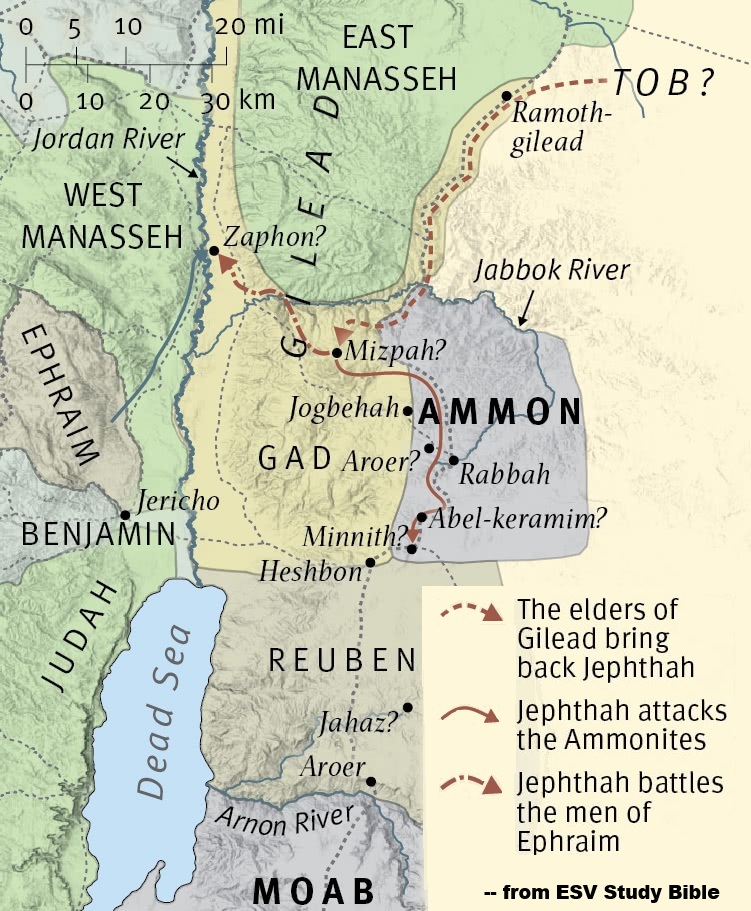
Faith with Foolishness — Jephthah was quite a mixture! On the positive side, he had faith, being listed in the Hall of Faith of Hebrews (Heb. 11:32). Some evidence in our reading was that he “spoke all his words before the LORD” (Judges 11:11), “…the Spirit of the LORD was upon Jephthah” (v. 29), “the LORD gave [the Ammonites] into his hand” (v. 32), and “Jephthah made a vow to the LORD…” (v. 30). On the negative side, however, he showed evidence of being very foolish. After being rejected by his brothers, “worthless fellows collected” around him (v. 3). His vow was strong evidence that Jephthah was foolish. He vowed that if his campaign were victorious, “whatever comes out from the doors of my house … I will offer it up for a burnt offering” (v. 31). He later told his daughter, “I cannot take back my vow” (v. 35). He knew much about the history of Israel’s journey to the Promised Land, so he should also have known that God had made provision for someone to get out of a foolish vow by confessing it as a sin and offering a lamb or goat in sacrifice (Lev. 5:4-6). Jephthah was not only willing to sacrifice his only child, but he even appeared to blame her for the problem: “You have brought me very low, and you have become the cause of great trouble to me” (v. 35). How about us? Few of us would claim to be as bad as Jephthah. Yet, if God could use Jephthah to accomplish His purpose for all Israel, He can also use you and me to do supernatural things for Him. We need to concentrate on staying on the side of faith.
August 16, Saturday
Reading A228 — Judges 12 — Aggressive Ephraim Audio: Judges 12 (ESV)
An audio recording of the following comments is available below:
The Penalty of Pride — We see another piece of evidence in this chapter of relationship deterioration between tribes. Ephraim seemed to have had a bad attitude and was looking for a fight. If they were so feisty, why did they fail to drive out the Canaanites from Gezer in their own area? (1:29). They had complained to Gideon about not being called to fight against Midian (8:1). Now, they were complaining to Jephthah about not being asked to fight against the Ammonites (12:1). They threatened to burn his house (v. 1) and called Jephthah’s people “fugitives of Ephraim” (v. 4). Gideon had managed to calm them down, but Jephthah failed and decided to face them. Ephraim was soundly defeated. It seems like pride was the primary motivator for Ephraim’s aggressive attitude. They were braggarts who became bullies. This warning came true for Ephraim: “Pride goes before destruction, and a haughty spirit before a fall” (Prov. 16:18). God hates pride in our lives as well. Selfish pride shifts our dependence away from our Creator and Defender.
 accbibleread.com
God chose us even before we accepted Him to be our Savior. Trust & obey is the only way to make Lord Jesus happy.
LikeLike