
Save or print this page by clicking on “Download” below:
July 27, Sunday
Reading A208 — Joshua 15 — Boundaries of Judah Audio: Joshua 15 (ESV)
An audio recording of the following comments is available below:
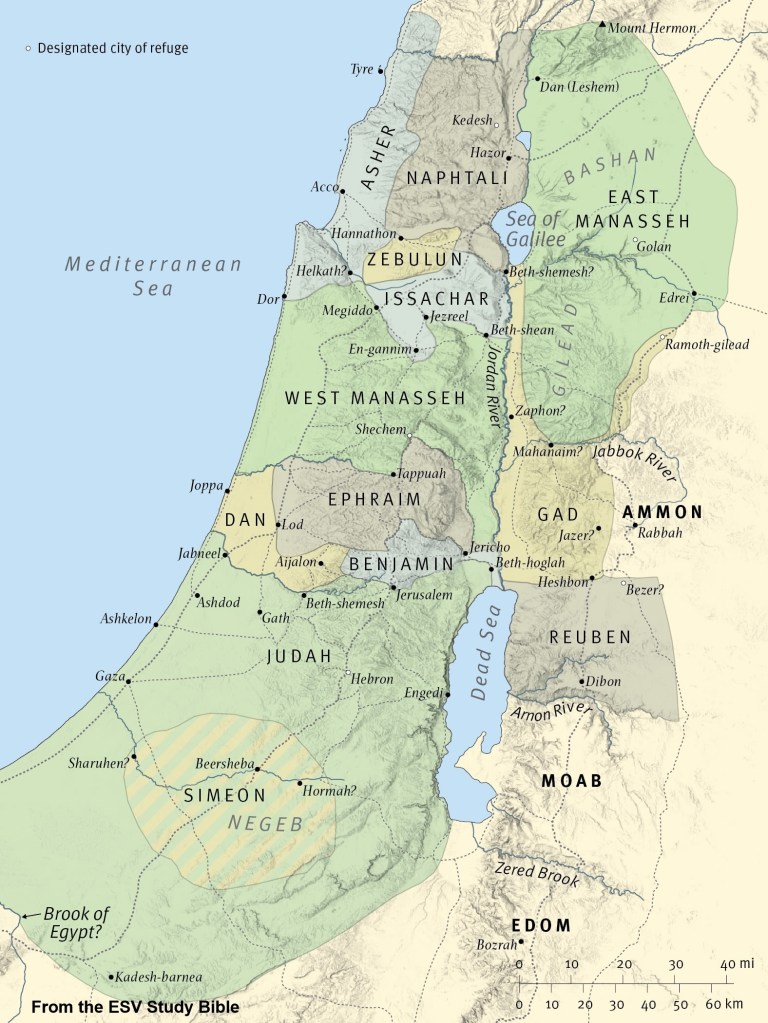
Consistently Godly — The leadership tribe of Judah was given the largest geographical portion of the Promised Land (see the map). Since the distribution of land to various tribes was to be chosen by lot, it was God who accomplished His will by directing these choices. Included within the territory of Judah were several significant places. The first one mentioned was the city of Hebron, which was given to Caleb and his descendants, as we saw in yesterday’s reading. That gift is reviewed in today’s chapter, along with the interesting addition of his daughter’s request for certain springs of water (vv. 16-19). The second significant location within the territory of Judah was the city of Jerusalem, which had not been conquered (v. 63). Why not? God, who is almighty, had promised Joshua that “no man shall be able to stand before you all the days of your life” (4:24). As was true for Israel’s failure at their first attempt to conquer Ai because of Achan’s sin (7:11), perhaps sin within the tribe of Judah was the cause of their inability to conquer Jerusalem. Sin can contribute to our failures as well, so we need to live consistent, godly lives to be able to experience the best that God wants for us.
July 28, Monday
Reading A209 — Joshua 16-17 — Allotments to Joseph Audio: Joshua 16-17 (ESV)
An audio recording of the following comments is available below:
Faith Against Fear — Joseph’s tribes of Manasseh and Ephraim received their inheritance in these two chapters. Manasseh had seven sons (17:1-2), so they had become very numerous and were given two large territories on either side of the Jordan River. The tribe of Ephraim, however, complained about their much smaller space (17:14, 16). Joshua’s solution was to give them the hill country with its forests (vv. 15, 18). They had to clear out the forests and develop agricultural terracing for their crops. The other problem for Ephraim was the Canaanites: “…they did not drive out the Canaanites … in Gezer … but [they] have been made to do forced labor” (16:10). This was puzzling to me. If Ephraim was strong enough to make slaves of the Canaanites, why couldn’t they drive them out or kill them as they were commanded to do? When they complained to Joshua about the Canaanites having “chariots of iron” (17:16), Joshua replied that the Ephraimites were numerous and powerful enough to drive them out (vv. 17-18). Manasseh had a similar problem with the Canaanites, not being able to drive them out but putting them to forced labor (v. 13). It seems to me that, for both of these tribes, the problem was less about their lack of ability than it was about their lack of willingness or faith. What are you hesitant to do because of fear?
July 29, Tuesday—————————ACCOUNTABILITY TIME!
Reading A210 — Joshua 18 — Boundaries of Benjamin Audio: Joshua 18 (ESV)
An audio recording of the following comments is available below:
Prayerful Lots — The people of Israel were now in their own land, but most of the tribes had not yet received their geographical allotment. The tent of meeting found its first semi-permanent home at Shiloh, a place mentioned here for the first time in the OT (v. 1), which was located 19 miles (31 km) north of Jerusalem in the territory of Ephraim. The rest of the land was then mapped out and lots were cast for each of the seven remaining tribes. It seemed significant to me that, for each of the three times casting lots is mentioned in this chapter, the expression, “before the LORD” was added (vv. 6, 8, 10). These actions were rather intentional “prayers” to God, asking for His will to be shown. That should be a reminder for us to pray about significant decisions in our own lives. God wants to direct us into paths that will be best for us. The boundaries of the first tribe in this group to be defined were for Benjamin. It was one of the smallest territories but included the significant cities of Jericho (in ruins), Bethel, and Jerusalem (vv. 21, 22, 28). Jerusalem is also connected with the tribe of Judah, but it was actually located just within the boundaries of Benjamin. Jewish tradition suggested that the border of these two tribes even went through the city and the temple area of Jerusalem.
ACCOUNTABILITY TIME! If you are up to date in your reading as of today, please
click here to leave your email address or let me know at accbibleread@gmail.com.
July 30, Wednesday——————-ACCOUNTABILITY REMINDER
Reading A211 — Joshua 19 — Allotments Completed Audio: Joshua 19 (ESV)
An audio recording of the following comments is available below:
Isolated Tribes — The six remaining tribes received their allotments in this chapter, all but two of them having their boundaries described as well as the included cities named. Those two whose boundaries were not defined are significant, like Simeon, whose cities were all within the boundaries of the tribe of Judah. Why was the tribe of Simeon contained within Judah’s territory? One reason is given here: “Because the portion of the people of Judah was too large for them” (v. 9). There seems to be another reason, however. You will remember that Levi and Simeon slaughtered all the men of Shechem in revenge for the rape of their sister, Dinah (Gen. 34:25-26). Just before Jacob died in Egypt, he blessed each of his sons, and this is what he said about Levi and Simeon: “Cursed be their anger, for it is fierce, and their wrath, for it is cruel! I will divide them in Jacob and scatter them in Israel” (Gen. 49:7). These were the only two tribes that did not end up with their own independent territories in the Promised Land. It was a penalty applied over 400 years later. The other tribe with undefined boundaries was Dan because their territory “was lost to them” (Josh. 19:47). They were not able to conquer a single city of what was given to them, and they ended up at Leshem in the far north on the east side of the Jordan River. One other interesting fact in this chapter is that there was a less famous city called Bethlehem in the northern tribe of Zebulun (v. 15), which was located only 6 miles (10 km) west of Nazareth, where Jesus grew up.
ACCOUNTABILITY REMINDER If you are up to date in your reading as
of today, but did not report yesterday, please click here to leave your
email address or let me know at accbibleread@gmail.com.
July 31, Thursday———————ACCOUNTABILITY FINAL DAY
Reading A212 — Joshua 20 — Cities of Refuge Audio: Joshua 20 (ESV)
An audio recording of the following comments is available below:
Finding Eternal Safety — This is the third time the cities of refuge are discussed in Scripture. God first introduced them to Moses in Exodus 21, and they were more fully described in Numbers 35. Now that Israel had arrived in the Promised Land, these six cities were formally appointed (see Sunday’s map for the cities with white circles). It seems significant that all six of these cities were chosen from among the 48 cities given to the Levites that we will read about tomorrow. A place of refuge was to be found where the religious leaders lived. The writer of the book of Hebrews brought this idea into the New Covenant era, describing Christians as, “we who have fled for refuge …” (Heb. 6:18). Are you resting in the protection of Christ, our refuge? Initially, we likely ran to Him when we discovered the danger of the consequences of our sin and, like the elder of the city of refuge, God “shall take him into the city and give him a place, and he shall remain” (Josh. 20:4). We are safe in the arms of Jesus.
ACCOUNTABILITY FINAL DAY! If you have not yet reported for this month,
please let me know your reading status today at accbibleread@gmail.com.
August 1, Friday
Reading A213 — Joshua 21 — Cities for Levites Audio: Joshua 21 (ESV)
An audio recording of the following comments is available below:
Living Presence — Gershon, Kohath, and Merari were the three sons of Levi, and the 48 cities given to the Levites were divided according to these three clans. Although Gershon was the first-born son of Levi, Kohath received special blessing from God, probably because Moses and Aaron were from that clan. The Kohathites received twice as many cities as the two other clans, the Gershonites and Merarites. Other evidence of favor was that the Kohathites were the first group chosen by the God-controlled lot (v. 10). The priestly descendants of Kohath were given cities in Judah, Simeon, and Benjamin, the tribes located in closest proximity to Jerusalem, the final place God chose to put the tabernacle. The cities given to the Levites were scattered throughout the land, not only to fulfill Jacob’s final “blessing” for scattering them (Gen. 49:7), but also to provide spiritual exposure and influence on all Israel as the tribe chosen by God to be spiritual leaders. That is somewhat like our role as Christians. We were not intended to be isolated from unbelievers, but to influence them by our presence. We are to be light in our world of darkness.
August 2, Saturday
Reading A214 — Joshua 22 — The Jordan Altar Audio: Joshua 22 (ESV)
An audio recording of the following comments is available below:
Witness: the Reminder — The 2 ½ tribes that settled on the east side of the Jordan River kept their promise to send their fighting men to help their brothers conquer the Promised Land, and Joshua gave them high praise as he sent them home (vv. 2-3). He also challenged them to stay true to Yahweh (v. 5). On their way home, however, they decided it would be a good idea to build a large altar on the west side of the Jordan River as a monument to the fact that the Israelites on both sides of the river served the same God. It was a well-meaning gesture, but it was misinterpreted by those on the west side, who saw it as a “breach of faith” (v. 16) and wanted to go to war over it (v. 12). Thankfully, the leaders of both sides got together to share the charges and the explanations with each other. Plans to fight were abandoned and peace resulted. It is amazing what good can come from seeking a clear understanding of opposing sides of a dispute. Misunderstandings do happen, and when conflicts arise, we ought to ask, “Do I really understand the other side?” The altar was named “Witness,” as a reminder that people on both sides of the river believed that “the LORD is God” (v. 34). It could also be thought of as a reminder of how easily actions can be misinterpreted.
 accbibleread.com