Save or print this page by clicking on “Download” below:
June 22, Sunday
Reading A173 — Deut. 2 — Protecting Given Land Audio: Deut. 2 (ESV)
An audio recording of the following comments is available below:
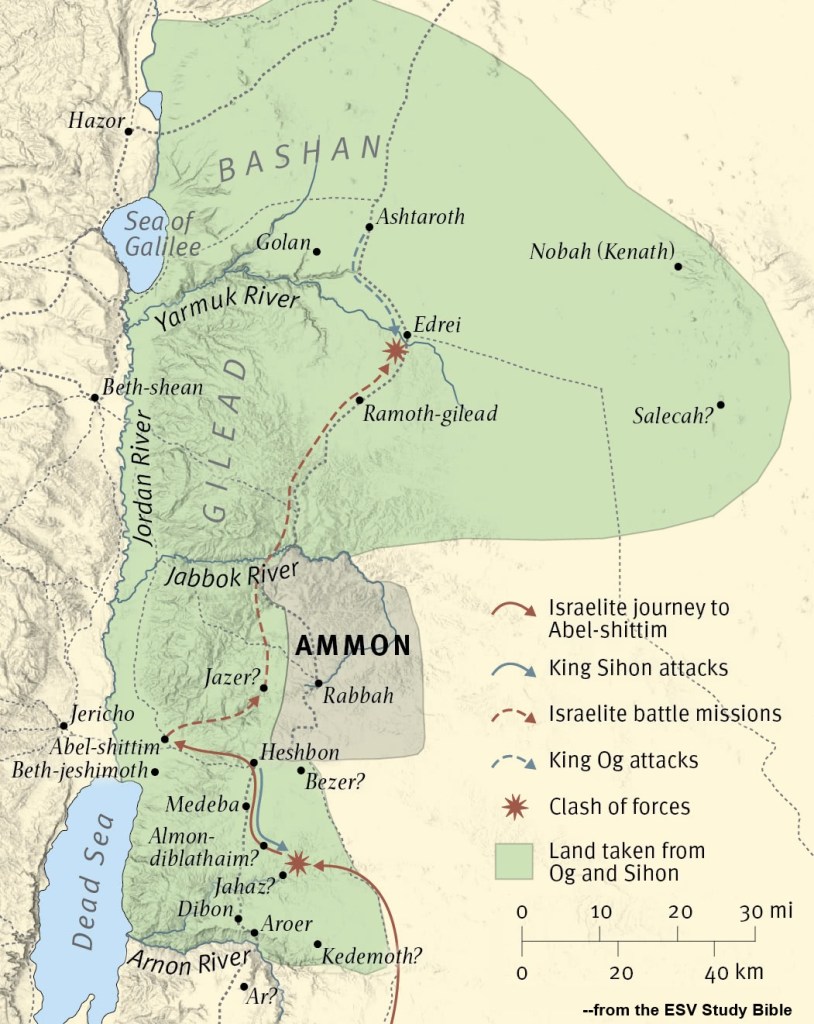
Promising and Protecting — In this chapter, God reaches back into Israel’s history to build their confidence in His promise to give them the land as their inheritance. First, He reminded them of the land he had given to Israel’s twin brother, Esau. God was protecting that land for them, so He told Israel, “Do not contend with them … because I have given Mount Seir to Esau as a possession” (v. 5). If God could grant and protect land for Esau, He could and would do it for Israel. Second, God reminded Israel of the land He had given to one of Lot’s sons: “Do not harass Moab … because I have given Ar to the people of Lot for a possession” (v. 9). Moab was the first son of Lot (Gen. 19:37). Third, Israel was reminded about the land God had given to Lot’s other son, Ben-ammi, who was “the father of the Ammonites” (Gen. 19:38). God warned Israel again, “… do not harass them or contend with them … the people of Ammon … because I have given [the land] to the sons of Lot for a possession” (Deut. 2:19). The message about the similar-sounding word “Amorites” was quite different. These people, living around Ammon, had not been promised or given any land by God. That land was going to be given to Israel as part of the conquest for their homeland. God’s message to Israel was this: “I have given into your hand Sihon the Amorite … contend with him in battle” (v. 24). God even helped the conquest along: “But Sihon … would not let us pass by him, for the LORD your God hardened his spirit” (v. 30). What God promises, He will provide, and what He provides, He will protect. God had promised Abraham that his descendants would return after their slavery to take over this land, “when the iniquity of the Amorites was complete” (Gen. 15:16). This battle was God’s punishment for the Amorites’ long history of sin.
June 23, Monday
Reading A174 — Deut. 3 — Israel Defeats More Amorites Audio: Deut. 3 (ESV)
An audio recording of the following comments is available below:
Big King and Small Favor — Whereas yesterday’s chapter covered the battles that captured the Amorite King Sihon’s land at the southern part of the Transjordan, today we read about the conquest extending to even north of the Sea of Galilee, taking the large land of Bashan from the Amorite King Og. This king was said to be “the last remnant of the Rephaim,” which seems to have been a race of giants. The size of his bed supports that understanding, being over 13 feet (4 m) long and 6 feet (1.8 m) wide, almost twice the area of our modern “king size bed.” Also in this chapter is one more attempt by Moses to convince God to allow him to enter the Promised Land: “Please let me go over and see the good land beyond the Jordan…” (v. 25). What Moses probably considered to be a small favor, God rejected firmly, saying, “Enough from you; do not speak to me of this matter again” (v. 26). For a second time, also, Moses tried to blame this refusal on Israel, saying, “the LORD was angry with me because of you” (v. 26). This reminded me of God’s response to Paul’s request that his “thorn … in the flesh” be removed from him: “My grace is sufficient for you, for my power is made perfect in weakness” (2 Cor. 12:9). Moses was pushing against God’s plan, and so was Paul. Sometimes we also push back, wanting to avoid pain or disappointment, but God’s way is always the best.
June 24, Tuesday
Reading A175 — Deut. 4 — Obey and Inherit Audio: Deut. 4 (ESV)
An audio recording of the following comments is available below:
Listening, Doing, and Teaching — Much of this chapter concentrates on the importance of the Word of God. Israel was to “listen to the statutes … and do them” so that they could “take possession of the land” (v. 1). That points to the importance of exposure and obedience. God’s Word is not magical, but it is our source of spiritual power. Israel was not to “add to the word … nor take from it” (v. 2) because it was “righteous” (v. 8). What we read today is, indeed, the “Holy Bible.” Sometimes we encounter portions of Scripture that bother us, so we are tempted to add a more comfortable interpretation to it or just treat it as if it were not there. No, it is God’s Word, and we must face it, believe it, and obey it. We also must pass on to our children and grandchildren what we have learned from God’s Word. Don’t assume that the children’s department in your church is sufficient; we are to make sure that we are training them as well. “Make them known to your children and your children’s children” (v. 9).
June 25, Wednesday
Reading A176 — Deut. 5 — The Commandments Reviewed Audio: Deut. 5 (ESV)
An audio recording of the following comments is available below:
Hungry Hearts — Moses continued his sermon to Israel about what they had already heard, but he reinforced it as they were about to enter the Promised Land. This chapter is mostly about the Ten Commandments, given initially in Exodus 20. What Moses emphasized in this review is hearing these laws, learning them, and obeying them. He opened his message with this command: “Hear, O Israel, the statutes and the rules that I speak in your hearing today, and you shall learn them and be careful to do them” (v. 1). Israel’s promise near the end of the chapter contains the same emphasis: “…speak to us all that the LORD our God will speak to you, and we will hear and do it” (v. 27). God responded favorably by saying, “They are right … Oh that they had such a heart as this always…” (vv. 28-29). This is the kind of heart the Lord wants us to have today as well, being hungry to hear, to learn, and to do.
June 26, Thursday
Reading A177 — Deut. 6 — The Shema Audio: Deut. 6 (ESV)
An audio recording of the following comments is available below:
The Greatest Verse — This might be the most important chapter in the Bible, and it might contain the greatest verse: “You shall love the LORD your God with all your heart and with all your soul and with all your might” (v. 5). This is the verse Jesus quoted when He was asked, “Teacher, which is the great commandment in the Law?” (Matt. 22:36). All four Gospels record His reply that the most critical thing we must do is to love God wholeheartedly. The second question is, “How do we do that?” Jesus answered that one, too: “If you love me, you will keep my commandments” (John 14:15). Obedience shows love. We are also to “fear the LORD … by keeping all his statutes” (Deut. 6:2). Another emphasis in this chapter is that we need to remember God’s commandments, keeping them in front of us. They should “be on your heart” (v. 6). We should “teach them … and talk of them” (v. 7). We should keep reminders of them on our body and in our house (vv. 8-9). Expose and saturate yourself with what God desires from you!
June 27, Friday
Reading A178 — Deut. 7-8 — Separation from Evil Audio: Deut. 7-8 (ESV)
An audio recording of the following comments is available below:
Not by Bread Alone — When Jesus was being tempted in the wilderness by Satan, to all three temptations presented, Jesus answered by quoting Scripture (“it is written…”). All three of those responses came from what we read yesterday and today (Deut. 6:13 [NIV], 16 and 8:3; cf. Matt. 4:3-10). The response we read today was this: “…man does not live by bread alone, but … by every word that comes from the mouth of the LORD” (8:3). Jesus acknowledged that eating food is vital to humans. In addition, He put the need for also “consuming” the Word of God on a spiritual level. We need the Bible desperately. We are taking in spiritual nourishment every day when we read God’s Word. We also need to meditate on it throughout the day. Share with someone else something that struck you or something that you learned in your reading. When you pray before your meals each day, thank God for something specific that you took away from your reading. Keep “chewing” on it! Keep being fed!
June 28, Saturday————————ACCOUNTABILITY TIME!
Reading A179 — Deut. 9 — Golden Calf Revisited Audio: Deut. 9 (ESV)
An audio recording of the following comments is available below:
God’s Motives for Action — God guaranteed victory for Israel over the nations on the west side of the Jordan River, and He assured them that it would be done by His power. They didn’t believe Him 40 years earlier when He told them to enter from the south. After they would see those amazing future victories, starting with the falling walls of Jericho, they would be convinced that it was, indeed, only by God’s power. What Moses anticipated, however, was that they might claim that God performed these amazing victories because they were so much better than the defeated nations. Israel would probably give God the credit for the victory, but they would tend to claim that they were the reason. Moses warned, “Do not say … ‘it is because of my righteousness’…” (v. 4a). God’s stated reason for giving the land to Israel was “because of the wickedness of these nations” (v. 4b). They had been worshiping false gods for centuries, and their deserved judgment was coming soon. Rather than Israel being righteous, it is repeatedly said that they were “a stubborn people” (vv. 6, 13, 27) and had been “rebellious” against Yahweh (vv. 7, 23, 24). It was from God’s grace that He gave them this land. There is one more stated reason for God’s land-gift to them: it was because of His promise to Abraham, Isaac, and Jacob. It was “that he may confirm the word … to your fathers” (v. 5). He also gives us many things we do not deserve, which are not given to us because we have earned them, but because He loves us and wants what is best for us.
ACCOUNTABILITY TIME! If you are up to date in your reading as of today, please
click here to leave your email address or let me know at accbibleread@gmail.com.
 accbibleread.com
God is faithful and never fails in his promises to Israel.
LikeLike