
Save or print this page by clicking on “Download” below:
December 15, Sunday
An audio recording of the following reading is available below.
Sorry but no audio is available right now.
XXX
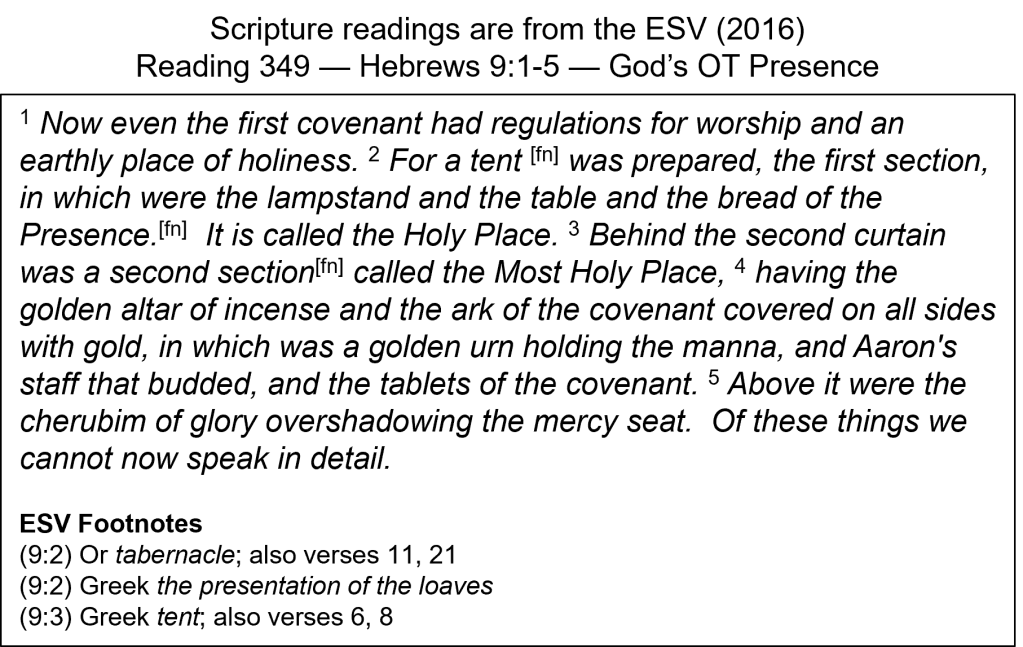
Place of Holiness — The concept of holiness is mentioned three times in this passage that describes the OT tabernacle as “an earthly place of holiness” (v. 1). This was the place God chose to serve as His dwelling place for the people of Israel. This divine dwelling was symbolic, as Solomon indicated in his prayer at the dedication of the more permanent temple: “But will God indeed dwell on the earth? Behold, heaven and the highest heaven cannot contain you; how much less this house that I have built!” (1 Kings 8:27). It was Israel’s center place for worship, and it was divided into two significant holy places. The “Holy Place” (v. 2) was holy because only appointed priests could enter there to perform ceremonial acts of worship. The “Most Holy Place” (v. 3) was even more holy, containing the ark of the covenant, above which “the cherubim of glory” spotlighted God’s presence. Only the high priest could enter that portion, and only once a year, to perform his acts of worship. All this description was given at the beginning of Heb. 9 to prepare the reader for the dramatic change to the new covenant, “when Christ appeared as a high priest … [and] entered once for all … into heaven itself” (vv. 11, 12, 24). Now, God’s holy place on earth is in the hearts of believers like us. You are “God’s temple and … God’s Spirit dwells in you” (1 Cor. 3:16). What a transition from an external, geographical place in Israel to an internal, personal experience with the Most Holy God! We are walking temples.
O Holy Spirit, Enter In – YouTube
XXX
XXX
December 16, Monday
An audio recording of the following reading is available below.
XXX
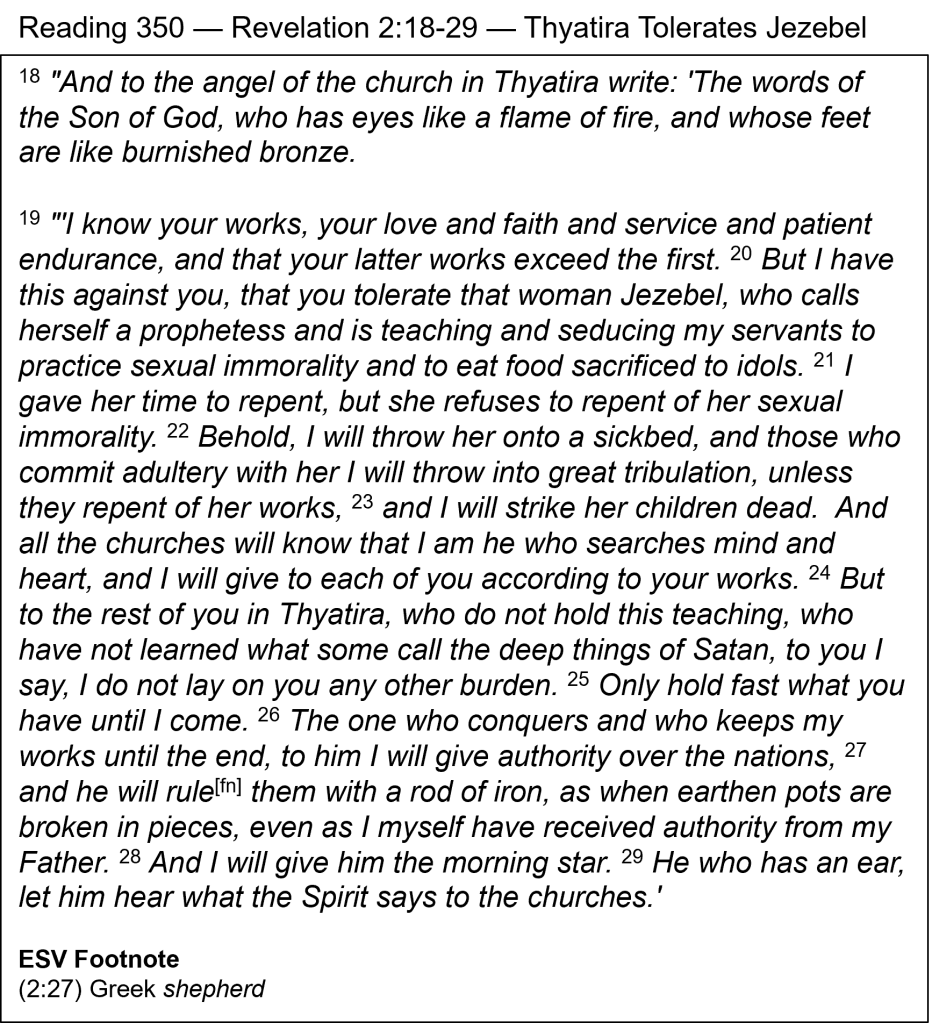
The Morning Star — The main theme of this passage about the church in Thyatira is twofold: the theme of repentance for those who were tolerating the immoral and satanic influence of the so-called prophetess, Jezebel (v. 20), and the theme of tenacity of those who had remained faithful and would “hold fast what you have” (v. 25). Things that are new and exciting in the world still tempt Christians to drift away from the solid rock of God’s truth. Christ’s reward for those who remain faithful is a bit puzzling here: “I will give him the morning star” (v. 28). What is that? The “morning star” is mentioned in only two other places in Scripture, both also pointing to something in the future. Peter used it in the context of looking forward toward the fulfillment of prophecy, when “the morning star rises in your hearts” (2 Pet. 1:19). At the end of Revelation, it is used again and even defined, when Jesus said, “I am the root and the descendant of David, the bright morning star” (Rev. 22:16). He is the ultimate climax of all prophecy. So, when Jesus says in today’s passage that He will give those who “hold fast … the morning star,” He is promising more of Himself. How can that be? We can only imagine, and still not come close. Our future is bright, very bright.
O Morning Star, How Fair and Bright – YouTube

XXX
XXX
December 17, Tuesday
An audio recording of the following reading is available below.
XXX
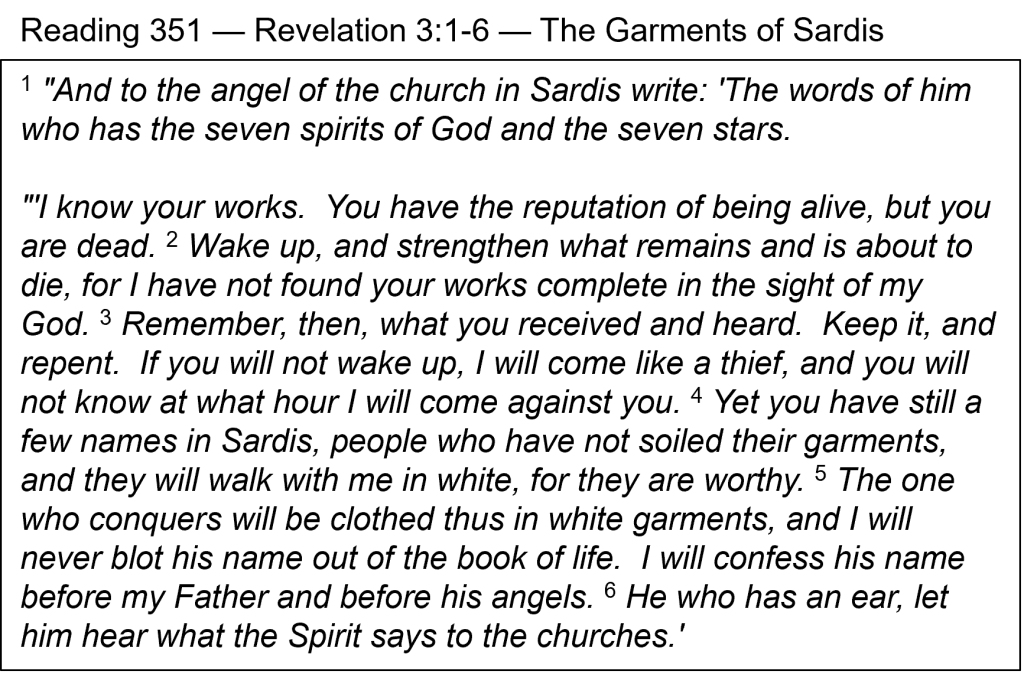
Clothed and Confessed — The word “spirit” begins and ends this passage about the church in Sardis. At the end, “…what the Spirit says to the churches,” certainly refers to the Holy Spirit. At the beginning, the expression, “the seven spirits of God,” is used three other times, all in Revelation (1:4; 4:5; 5:6), and it may be another way of referring to the one Holy Spirit. Christ’s twofold challenge in today’s reading is to “Wake up” (v. 2) and “repent” (v. 3). They had not only become spiritually drowsy, but they had also become morally lax. These are both very serious problems, leading to Jesus’ threat that “I will come against you” (v. 3). We should not be in that group but among those who “have not soiled their garments … for they are worthy” (v. 4). There are two rewards for the faithful here: they “will be clothed … in white garments, and … I will confess his name before my Father” (v. 5). That is “what the Spirit says” — it is part of our reward.
O the Crowning Day is Coming – YouTube

XXX
XXX
December 18, Wednesday
An audio recording of the following reading is available below.

XXX
A Pillar in the Temple — Philadelphia and Smyrna are the only churches in these two chapters about which nothing negative is said, even though both were facing persecution. The Greek word philadelphia (or philadelphos) means “love of brethren,” and Jesus said of them, “I have loved you” (v. 9); it was a loved and loving church. What “the Spirit says to” this church includes the promise that each member will be an engraved “pillar in the temple of my God” (v. 12), which describes strength, stability, and significance. Our rewards in heaven will be determined by our works on earth. Christians who declare that they don’t care about rewards don’t understand how great they are. To be “a pillar in the temple” will be an honor beyond our limited imagination. Those pillars will be supremely glad that they worked hard at being faithful and useful in God’s kingdom work on earth.
O Jesus I Have Promised – YouTube

XXX
XXX
December 19, Thursday
An audio recording of the following reading is available below.
XXX
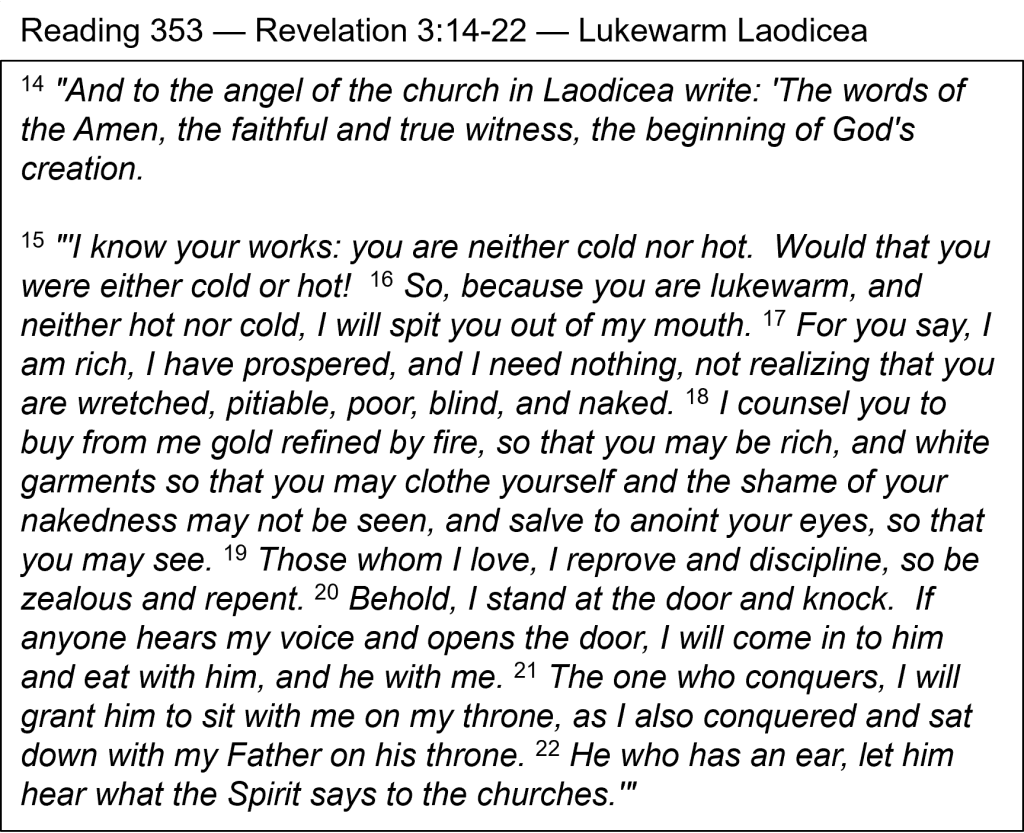
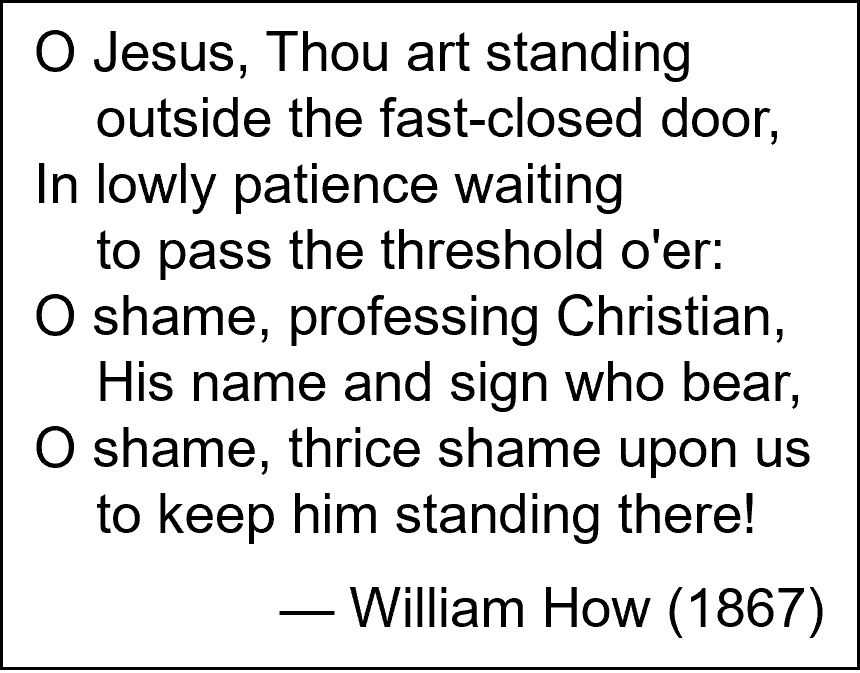
Sit on My Throne — Laodicea was so self-sufficient and proud that, after a damaging earthquake in A.D. 60, they refused disaster relief from Rome. This is the only church of the seven for which Jesus has no compliment. There is no praise for pride. They were proud of what was of little importance in God’s sight. They were “lukewarm” (v. 16) because they were trying to love wealth and God at the same time. We Christians need to constantly evaluate our own earthly priorities in relationship to what we know is pleasing to God. Jesus called the Laodiceans to repent (v. 19) and gently invited them to open the door for Him, to find spiritual nourishment and fellowship (v. 20). The focus of “what the Spirit says to the churches” here seems to be the promise to the “one who conquers,” which is “to sit with me on my throne” (v. 21). What does that mean? Since a throne is a symbol of authority, faithful believers will be given some kind of influence over others, perhaps referring to the time of Christ’s 1000-year reign on earth. They will be positions of great honor and satisfaction.
O Jesus, Thou Art Standing – YouTube
XXX
XXX
December 20, Friday
An audio recording of the following reading is available below.
XXX
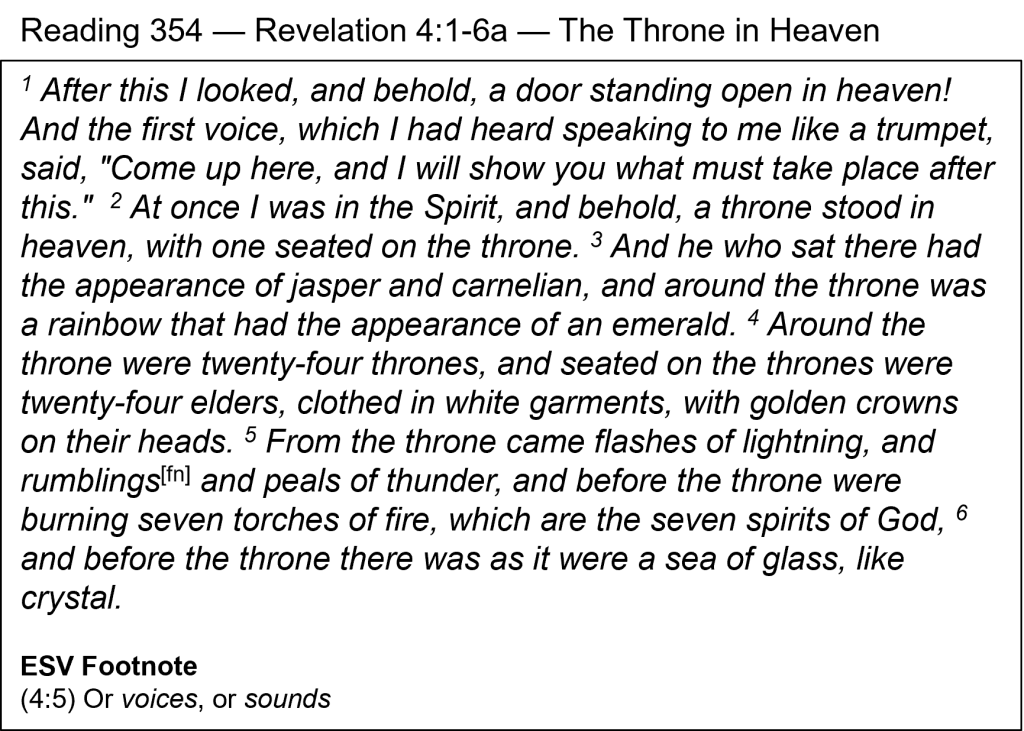
Focus on the Throne — The Holy Spirit appears near the beginning and at the end of today’s passage. In verse 2, He is the means of transporting John to heaven (“At once I was in the Spirit”). A voice, identified as coming from Jesus in Rev. 1:10, 18, invited John to “Come up here” (4:1) to witness symbols of future events. What he first saw was a throne in heaven with “one seated on the throne” (v. 2), who is later identified as “the Lord God Almighty” (v. 8). The colorful description John gives of what he saw reveals his inability to explain something never seen by man. The throne was certainly the center of focus, with the 24 thrones of elders surrounding it, likely representing the unity of all God’s people from the 12 tribes of Israel to the 12 apostles of the Church. Facing the throne were first, “the seven torches … of the seven spirits of God” (v. 5; cf. 3:1), probably representing the Holy Spirit, and second, the calm and beautiful “sea of glass” (v. 6). What a scene! Heaven will be so amazingly different from our life on earth. All will be new and beautiful, but there will be connections with what is familiar to us. We will know each other, and we will see our nail-scarred Savior face to face.
Before the Throne of God Above – YouTube

XXX
XXX
December 21, Saturday
An audio recording of the following reading is available below.

XXX
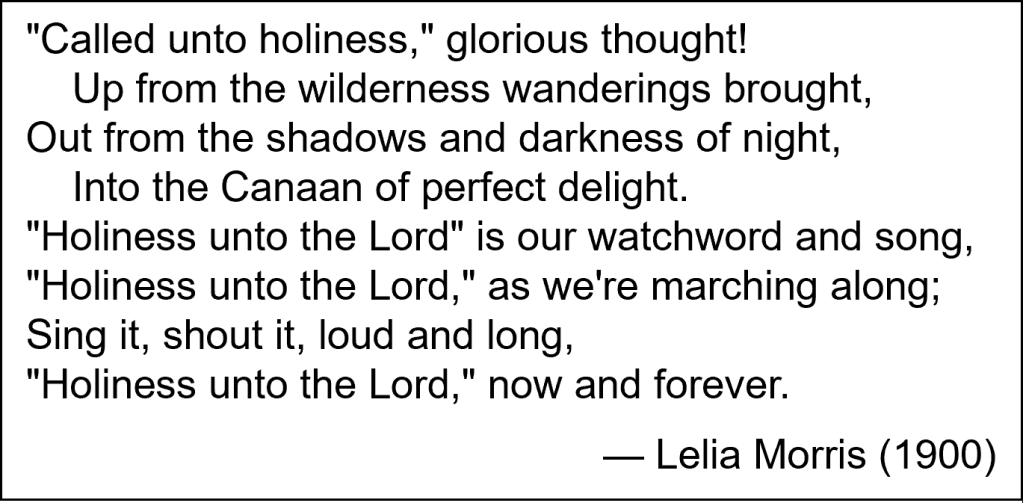
Sanctified Through Sacrifice — What a wonderful picture this provides for how Jesus’ single sacrifice fulfilled and ended the repeated OT animal sacrifices! His sacrifice was perfect, good for all people, and sufficient for all time. The idea of our sanctification (being made holy) is twice tied to Christ’s sacrifice in this passage. The first time, it looks backward to our conversion: “we have been sanctified through the offering of the body of Jesus Christ once for all” (v. 10). We stepped into salvation by accepting Jesus’ death on the cross as the permanent payment for our sin. Sanctification is mentioned the second time in verse 14, where “by a single offering he has perfected for all time those who are being sanctified.” The Greek tense in the last phrase suggests a continuing action of being made holy. If we are still “being sanctified,” was our sanctification at conversion insufficient? We might look at it this way: Our sanctification at conversion made us holy enough for heaven, but our need for greater holiness will continue throughout our life on earth.
Holiness Unto the Lord – YouTube
XXX
 accbibleread.com