Save or print this page by clicking on “Download” below:
November 3, Sunday
An audio recording of the following reading is available below.
XXX
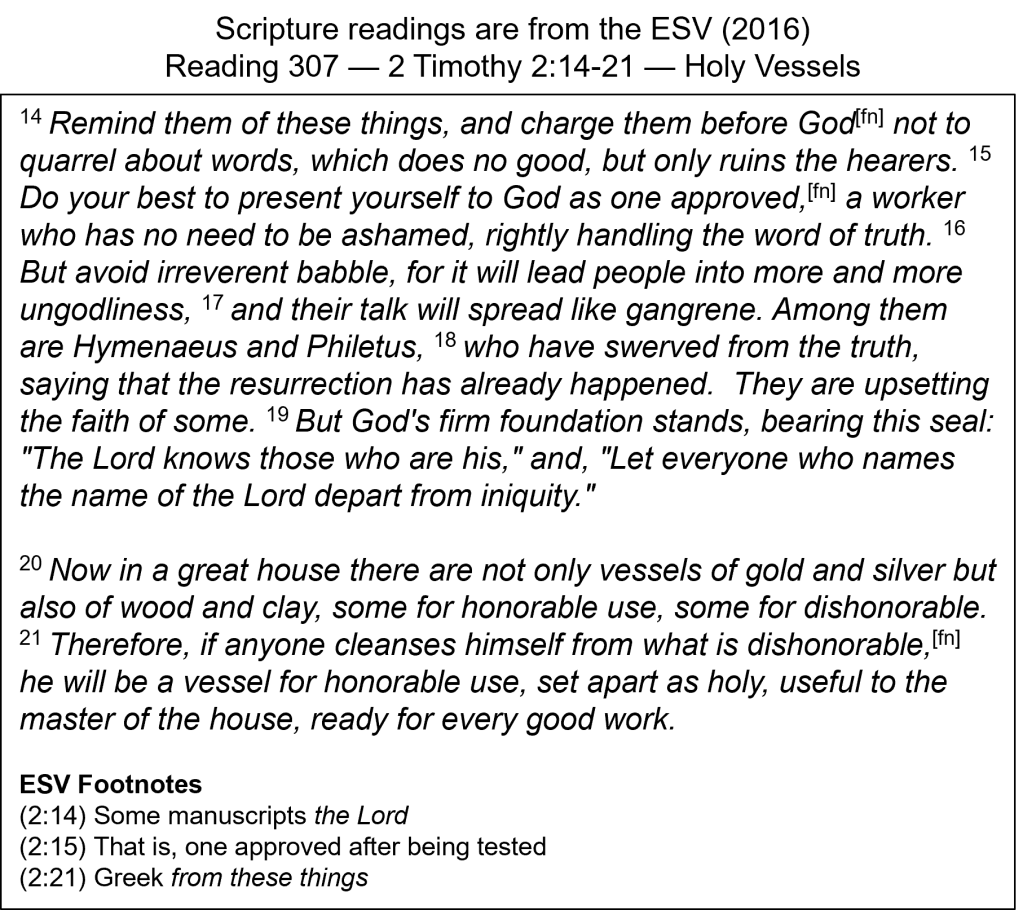
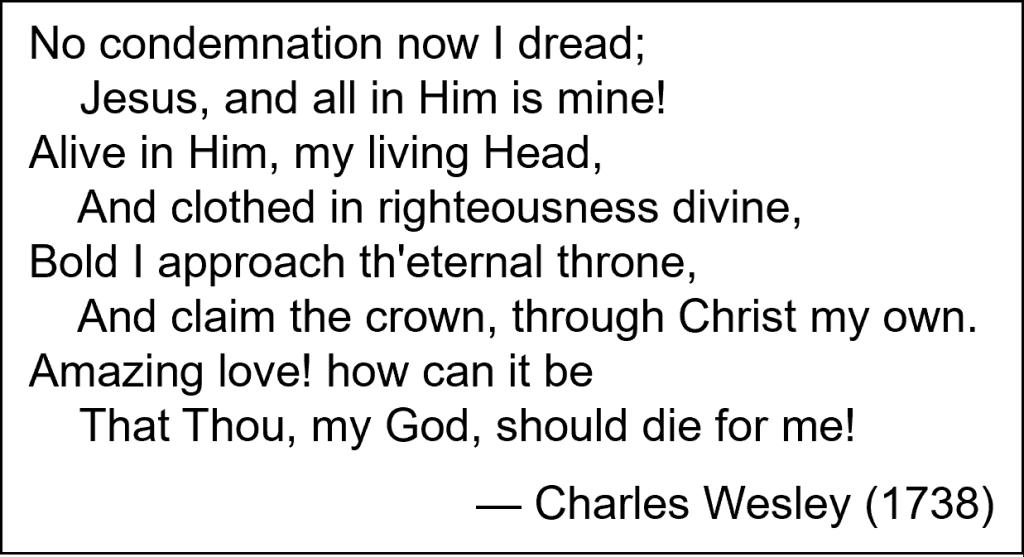
Guarding Our Talk — The twin concepts of godliness and holiness appear in this passage, and they are related. First, Paul said that “irreverent babble … will lead people into … ungodliness” (v. 16; cf. 1 Tim. 6:20). This would include arguing about things that don’t matter and about unorthodox interpretations of Scripture. We need to stick to the truth and guard our talk. We are to be leading others toward godliness, not away from it. Paul then wrote of holiness in his illustration about vessels used in a house: “…if anyone cleanses himself from what is dishonorable, he will be a vessel for honorable use, set apart as holy” (v. 21). Notice the personal responsibility that is involved here (“cleanses himself”). Included in “what is dishonorable” would be things like the meaningless and unhelpful talk that was mentioned earlier. We are to not only guard our talk but our whole lives as well. If we do, we will be “set apart as holy, useful to the master” (v. 21b). Useful vessels are both godly and holy. Using another picture, we are clothed in the righteousness of Christ.
XXX
XXX
November 4, Monday
An audio recording of the following reading is available below.
XXX
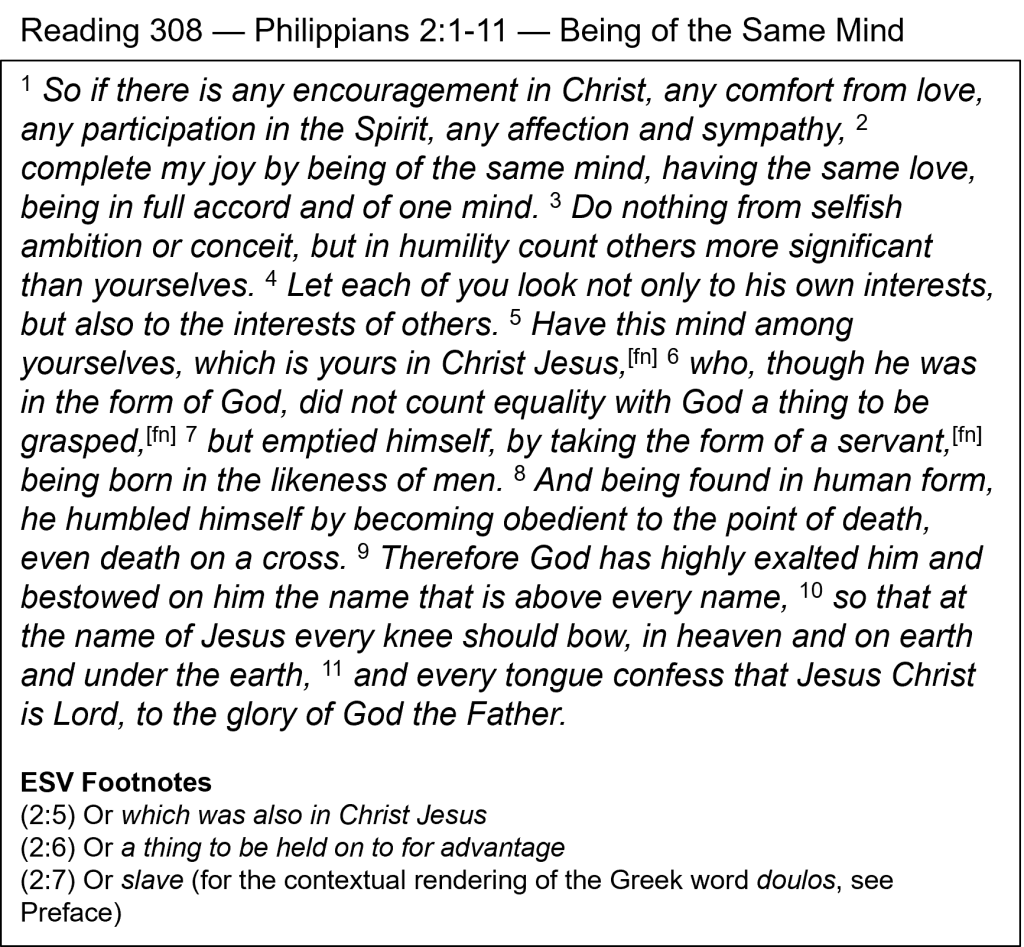
Fellowship in the Spirit — This passage is mostly about the humility and exaltation of Christ, as Paul used Him as the ultimate example of perfect humility. The Philippians were encouraged to be “of the same mind” as Christ (v. 2) so that they might become united in humility and love toward each other. Part of this plea for unity included the reality of their “participation in the Spirit” (v. 1). The Greek word for “participation” here is koinōnía, which is often translated “fellowship.” It describes the personal, intimate, constant, and rich relationship we have with the Holy Spirit who dwells within us. Do you consciously fellowship with the Spirit? When we pray, our minds often picture a God who is far away in heaven, but He is really close—He dwells within us. We should think about that as we go through our day. Purpose to think about Him today and talk to Him often.
Leaning on the Everlasting Arms – YouTube

XXX
XXX
November 5, Tuesday
An audio recording of the following reading is available below.
XXX
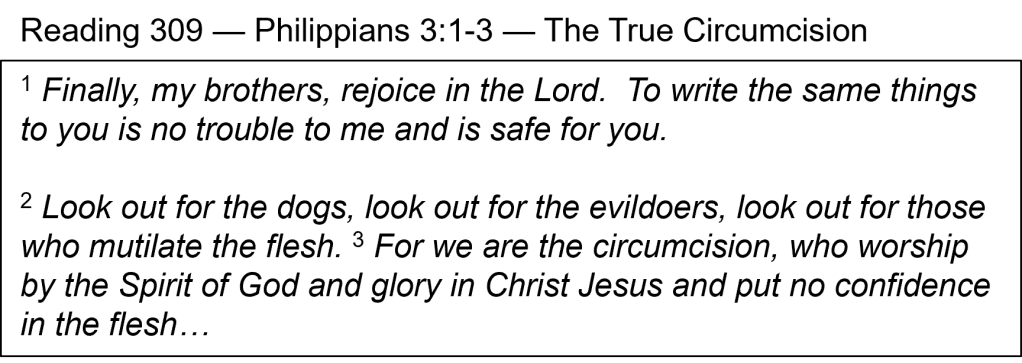
Worship by the Spirit — The people who Paul said, “mutilate the flesh” (v. 2) were the Judaizers, those who believed that Jesus was the promised Messiah but insisted that OT laws, like circumcision, must continue to be kept. In contrast, Paul called true believers, “the circumcision, who worship by the Spirit of God” (v. 3). We have seen this expression, “the Spirit of God,” and talked about it before. In fact, that phrase is used 12 times in the NT. Is it referring to the Holy Spirit or to the Father, who is also Spirit? It is often hard to tell. If it refers here to the Holy Spirit, it is one more expression that includes all three Persons of the Trinity: “…the Spirit … of God … Christ Jesus.” In either case, we believers are described as those “who worship by the Spirit.” We don’t worship superficially by ritual or by memorized prayers. Rather, we worship in a spiritual way—worship that comes from the heart and communicates with God in a deep manner that affects our emotions. It is worship that is participated in and aided by the Holy Spirit. Where the ESV says worship “by” the Spirit, some other translations say, “in” the Spirit. It is worship from the heart.
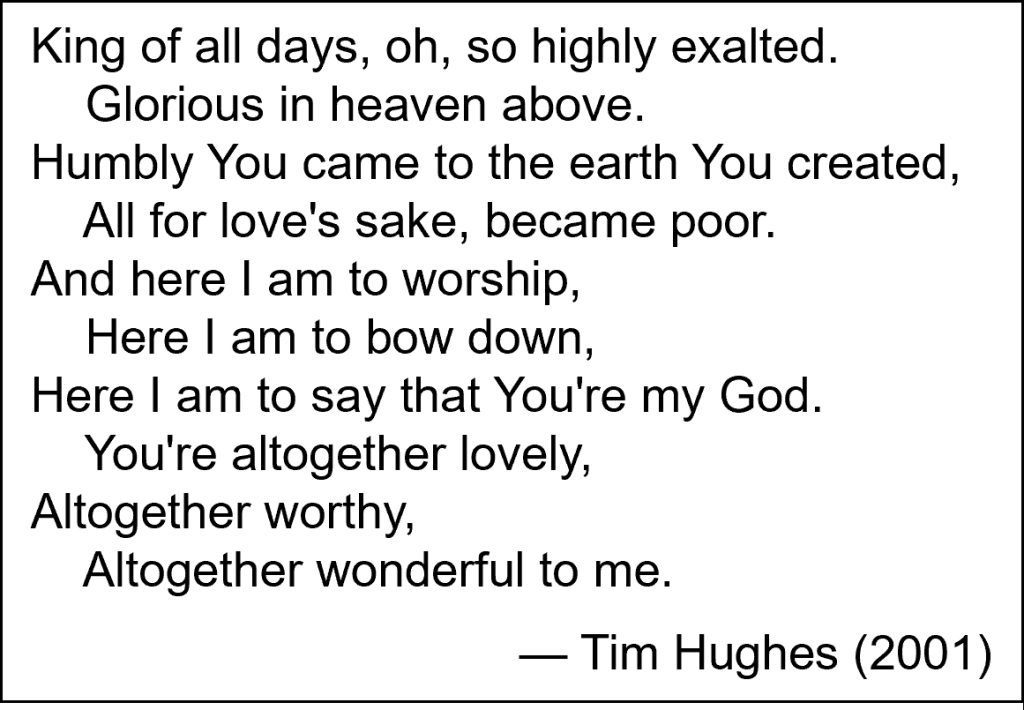
Here I Am to Worship – YouTube
XXX
XXX
November 6, Wednesday
An audio recording of the following reading is available below.
XXX
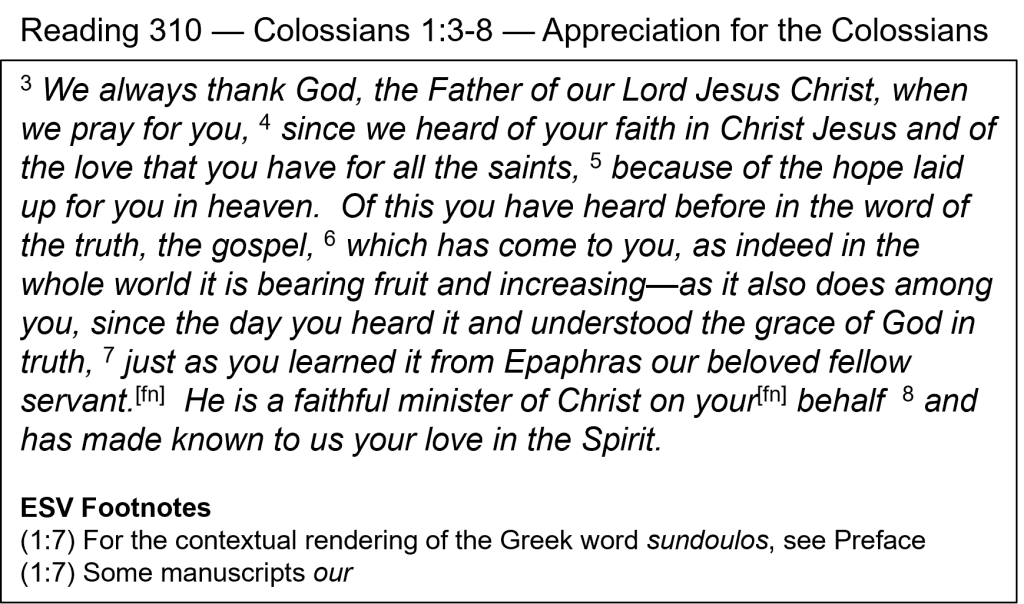
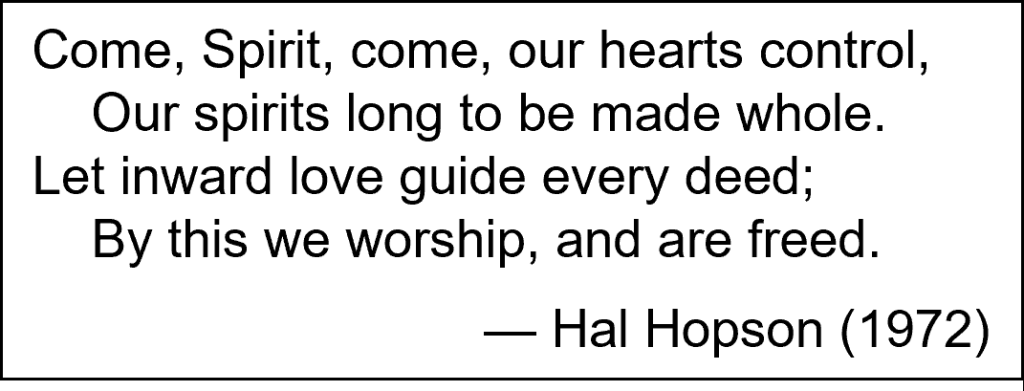
Love in the Spirit — Paul did not plant the church at Colossae; he had never met them. All he knew about them was told to him by Epaphras, who had apparently planted the church. What he had heard about them was good, however, and he wrote this letter to encourage and direct them. One important group character quality they were known for was love. They had “love … for all the saints” (v. 4), and “love in the Spirit” (v. 8). The object of their love was other people, and the source of their love was the Holy Spirit. What spiritual character quality are you known for? Of the three qualities of “faith … love … hope” mentioned in verses 4-5, Paul said elsewhere that “…the greatest of these is love” (1 Cor. 13:13). We should be known for all three but especially love.
XXX
XXX
November 7, Thursday
An audio recording of the following reading is available below.

XXX
Vindicated by the Spirit — In summarizing the purpose and life of the Son of God, Paul presents what looks like a hymn to describe “the mystery of godliness” (v. 16). After a statement of Jesus’ incarnation, it says that He was, “vindicated by the Spirit.” This word for “vindicated” can also be translated “justified” (NKJV), but being “vindicated,” or proven to be the Son of God through the resurrection, seems to fit better in this context. Although many translations mention in a footnote that this could be referring to Christ’s spirit, it makes much more sense to see it as the Holy Spirit, especially in connection with what Paul wrote earlier in Romans 1:4, that He “was declared to be the Son of God in power according to the Spirit of holiness by his resurrection from the dead.” As the Holy Spirit, in the form of a dove, was involved in the baptism of Jesus, so He was somehow also involved in His resurrection, again pointing to Christ as the Son of God.
I Know That My Redeemer Lives – YouTube
Sadly, the video omits the following fitting verse about the Resurrection:

XXX
XXX
November 8, Friday
An audio recording of the following reading is available below.

XXX
The Spirit Warns About Spirits — Paul didn’t reveal how “the Spirit expressly says” (v. 1), although it was likely through prophecy. There is a contrast here between the Holy “Spirit” and the “deceitful spirits,” using the singular and plural forms of the same word in Greek. The truth reveals what is false, and we are those who “know the truth” (v. 3) because we know the Word of God. We just need to stay in the truth and be cautious about any teaching that does not fit with the orthodox understanding of the Scriptures. Paul also mentioned holiness at the end of this passage, saying that food “is made holy by the word of God and prayer” (v. 5). The food we eat is holy because God declared it to be holy. It is also “made holy by … prayer,” which supports our habit of praying before each meal. Think about that at your next mealtime—your prayer is making your food holy, set apart for God’s purpose of nourishing and strengthening your body.
I could not find a video for this song.

XXX
XXX
November 9, Saturday
An audio recording of the following reading is available below.

XXX
The Appearance of Godliness — We are in “the last days” (v. 1). The sins listed in verses 2-5 are with us now, and they are getting worse and more prevalent. The people who commit them could generally be described as “unholy” (v.2). They are not “set aside for God,” but they are “lovers of pleasure rather than lovers of God” (v. 4). On the other hand, these same people have “the appearance of godliness” (v. 5). They are religious people, including so-called Christians seen by the world and labeled as hypocrites. The problem is that they then assume that all Christians are like that. This is why true followers of Jesus must stand out as lights in the world. The world needs to see us as exceptions to their label. How brightly is your light shining? Could we, instead, be showing signs of being “lovers of money … proud … ungrateful …”? The world is watching. Are we giving them excuses for their continued unbelief or are they seeing us as exceptions to the hypocrite label? Is our godliness genuine?
God, Make My Life a Little Light – YouTube

 accbibleread.com