
Save or print this page by clicking on “Download” below:
Accountability Window: Apr. 28-30
April 21, Sunday
An audio recording of the following reading is available below.

XXX
Holy vs. Common — This passage describes the spiritual condition of the land of Judah before God sent destruction on them from the Babylonians. The prophets, priests, and princes, who were responsible for leadership, were taking advantage of the people for their own gain. The priests, who were to be the spiritual leaders “profaned my holy things. They have made no distinction between the holy and the common, neither have they taught the difference between the unclean and the clean” (v. 26). Keeping holy things holy was important to God. He had punished two of Aaron’s sons in the past when they offered “unauthorized fire before the LORD … And fire came out … and consumed them” (Lev. 10:1-2). After that, God ordered Aaron and his two remaining sons to be careful not to drink any alcohol before entering the tabernacle “lest you die … You shall distinguish between the holy and the common” (vv. 9-10). Are we maintaining that kind of distinction today? What things or actions do we treat as holy in our times? Do we look at the content of the Bible as actual words from God that are binding? Do we come to the Lord’s Table periodically with minds focused with thanksgiving for the sacrifice of Jesus for us? Do we worship with other Christians in church with our minds concentrating on the words we sing? Do our “common” neighbors see something that is “holy” about us? There is a difference.
Take My Life / Holiness – YouTube

XXX
April 22, Monday
An audio recording of the following reading is available below.

XXX
Words Through the Spirit — When God spoke to His prophets in the past, it was by means of the Holy Spirit, i.e., “…the words that the LORD of hosts had sent by his Spirit through the former prophets” (v. 12). It had been two years since God spoke to Zechariah about rebuilding the temple in Jerusalem, so God chose special times when He would speak to His prophets. When the Holy Spirit spoke to them, it was with specific words, whether audibly or in their minds, the statements often introduced with the word “saying…” (e.g., v. 8). The words from God on this occasion came in answer to the question about whether to continue celebrating a ritual fast commemorating the destruction of Jerusalem 70 years earlier. This was not a fast ordered by God, so in answering them He spoke to the core of fasting and feasting: “Do you do it for Me or for you?” (cf. v. 6). Evidence of sincerity is shown in righteous living, with “true judgments … kindness … do not oppress … none of you devise evil…” (vv. 9-10). This was the problem 70 years earlier when people went through the superficial motions of worship without any indication of life-change. When the Spirit speaks to your heart as you read God’s Word every day, is it changing your life, or are you just checking a box of completion? We need to seek the Spirit as we read, opening ourselves to change through repentance and obedience.
Change My Heart, Oh God – YouTube

XXX
April 23, Tuesday
An audio recording of the following reading is available below.
XXX
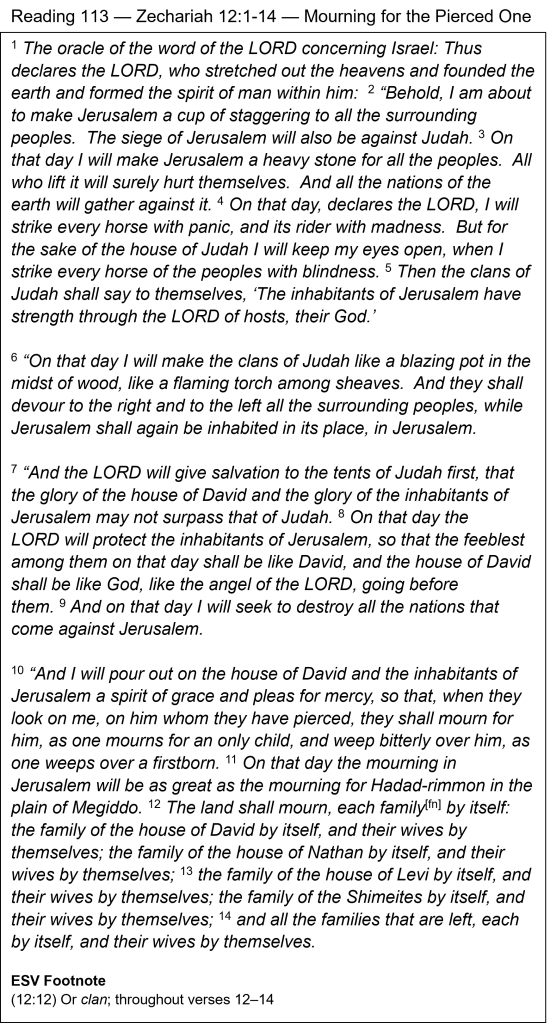
Poured Out Grace and Mercy — Seven times in this chapter, the expression “on that day” is used to indicate that the prophesied events were far in the future. We may see some of that happening already in our times, with Islamic nations being supported by other nations to militarily oppose Israel. Twice in this prophecy, a God-given “spirit” is mentioned. The first one clearly refers to the human spirit, when the Creator “formed the spirit of man within him” (v. 1). The second appearance of the word is not as clear. The ESV says, “I will pour out … a spirit of grace and pleas for mercy…” (v. 10), while other translations capitalize “Spirit” (NKJV, NASB, LSB). I lean toward the interpretation of this referring to the Holy Spirit. In 10 of the other 11 places in Scripture where it says that God “pours … spirit,” it clearly refers to God’s own Spirit. Isa. 29:10 is the exception, where a negative “deep sleep” is being poured out, but in Zechariah, it is positive “grace” and “mercy” that is being given. This shows that both repentance (“pleas for mercy”) and forgiveness (“grace”) are provided by the Holy Spirit. When will this future prophesied event happen? It is certainly still in the future because this repentance and forgiveness by the Jewish people will look back in time “on him whom they have pierced” (v. 10b), which clearly refers to Jesus’ sacrifice (John 19:37). Perhaps it will be at a future time when, after “the fullness of the Gentiles has come in … all Israel will be saved…” (Rom. 11:25-26).
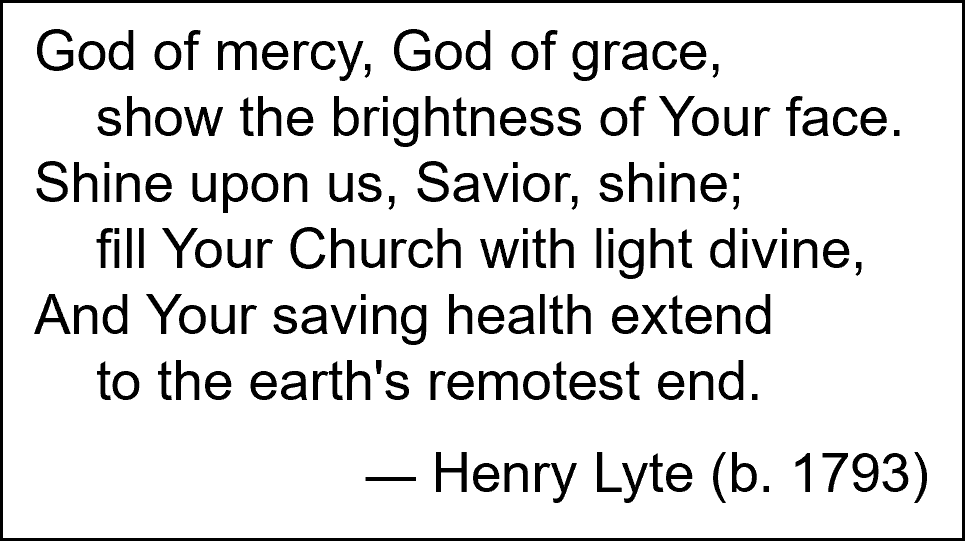
God of Mercy, God of Grace – YouTube
XXX
April 24, Wednesday
An audio recording of the following reading is available below.

XXX
God’s Spirit in Marriage — Both Israel and Judah had been guilty of spiritual adultery against God by incorporating the worship of foreign gods (v. 11). As a result, God rejected their worship of Him (v. 12). They had broken the covenant given to them through Abraham and Moses. This parallels divorce, the broken covenant of the marriage relationship between a husband and wife. A similar rejection of worship results here, where God “no longer regards the offering…” (v. 13). This marriage covenant was holy because it included God who made them one “with a portion of the Spirit in their union” (v. 15). The Holy Spirit might be seen as a “spiritual glue” in the matrimonial union. Twice in this passage God warned to “guard yourselves” against the unfaithfulness of divorce (vv. 15-16). He is deeply involved in the marriage relationship, as Jesus taught: “What therefore God has joined together, let not man separate” (Matt. 19:6). We are to be faithful spiritually in our relationship to God as well as emotionally and sexually faithful in our relationship to our mate.
XXX
April 25, Thursday
An audio recording of the following reading is available below.
XXX
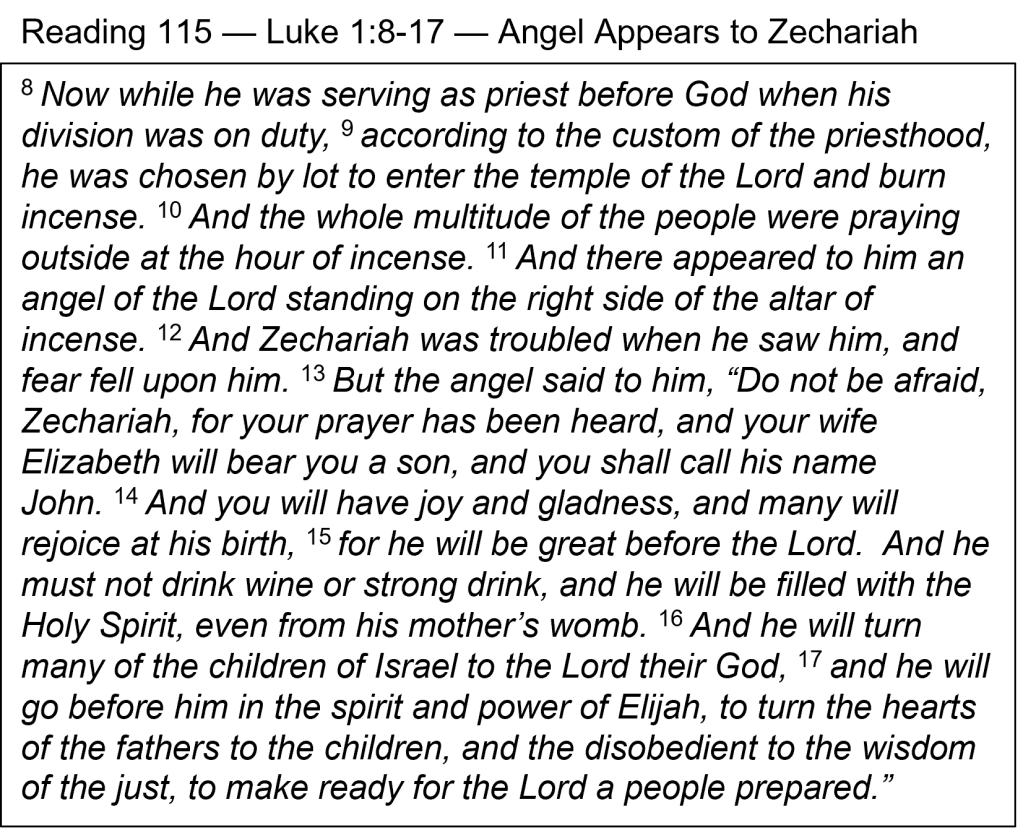
Spirit-powered Ministry — As we move into the New Testament, on the weekdays, we will progress chronologically, looking for evidence of the Holy Spirit and His work. We will also consider the letters of the NT in the order in which they were written. The first encounter of the Holy Spirit in the Gospels comes through the message of an angel that appeared before John the Baptist’s father, the priest Zechariah. This godly couple had prayed for many years for a child, but it had not happened. Although they likely stopped asking for a child after Elizabeth was long past childbearing age, the answer came in God’s timing and in His miraculous way. That should encourage us never to give up in praying for things that only God could do. The angel told Zechariah two unusual things about John. The first was that he was to live the life of a Nazarite, being separated to God and abstaining from alcohol (Num. 6:2-3). The second would be miraculous, i.e., being “filled with the Holy Spirit, even from his mother’s womb” (Lk. 1:15). It was a filling with power for ministry, similar to “the spirit and power of Elijah” (v. 17). John’s primary purpose would be to prepare the way for the Messiah by turning “the hearts of fathers … and the disobedient” (v. 17). The Holy Spirit has a similar purpose in all Christians’ hearts today, that of being part of turning the hearts of other people to Jesus.
Canticle of the Turning – YouTube

XXX
April 26, Friday
An audio recording of the following reading is available below.
XXX
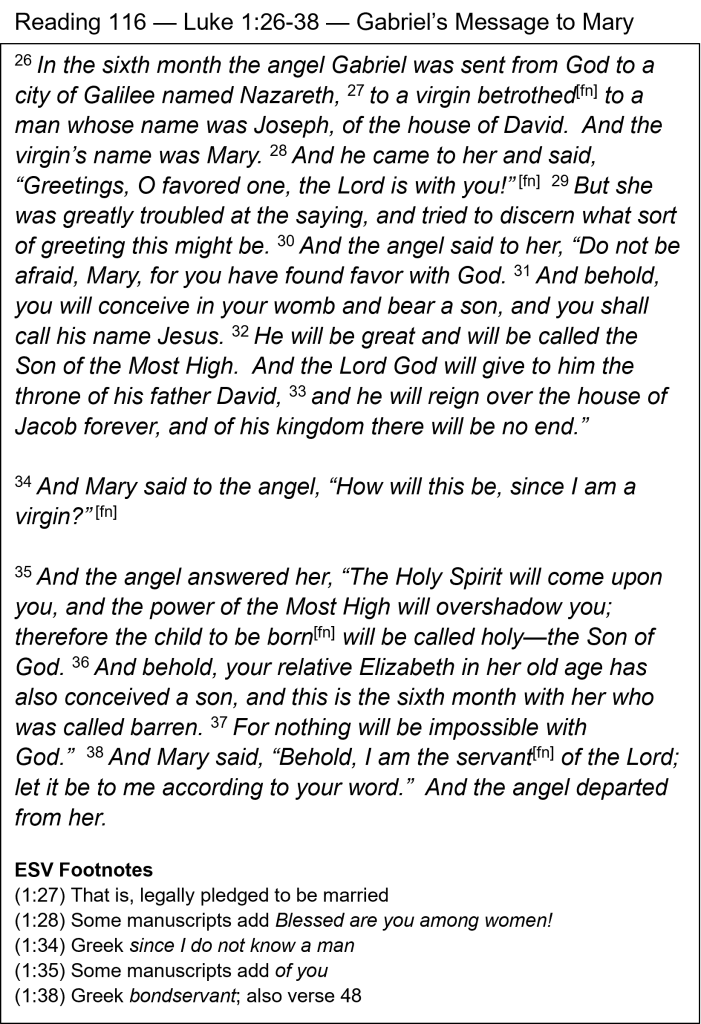
The Spirit of Conception — This miraculous conception of Jesus was predicted in the OT (Isa. 7:14; cf. Matt. 1:22-23), but the means for the miracle was revealed here to be that of the Holy Spirit: “The Holy Spirit will come upon you” (Lk. 1:35). It was for this reason that “the child … will be called holy.” With the Holy Spirit taking Joseph out of the picture, it became possible for Jesus to be born without the sinful nature shared by all people since Adam and Eve. Naturally, Mary was puzzled by this news, and she asked the angel, “How will this be, since I am a virgin?” (v. 34). It had never happened before. It seemed impossible, so the angel said, “nothing will be impossible with God” (v. 37). I love Mary’s response: “let it be to me according to your word” (v. 38). That is how a true servant of the Lord thinks and speaks. We, too, are holy because we have the Holy Spirit dwelling in us. When we see statements in God’s Word that are promises to us, we should respond like Mary. For example, when we read that “the fruit of the Spirit is love, joy, peace, patience, kindness, goodness, faithfulness, gentleness, self-control…” (Gal. 5:22-23), we should pray, “let it be to me according to your word.” Nothing is impossible with God.

XXX
April 27, Saturday
An audio recording of the following reading is available below.

XXX
Demons Fear Holiness — We jump ahead a bit in this weekend’s reading to think about the awesome holiness of Jesus. He met a man in the synagogue who had “an unclean spirit” (v. 23). That makes me wonder whether the man was in the synagogue to negatively influence others or to try to escape the demon’s influence. When the demon encountered Jesus, he was fearful because he knew he would be eventually destroyed by God for his rebellion. Why did he publicly cry out that Jesus was “the Holy One of God”? (v. 24). Perhaps it was an attempt to try to gain some control over Jesus. In any case, Jesus shut him up. The evil spirit had met its master. Much of the world around us also reacts negatively to holiness because it is so contrary to the unholy way they are living. Holiness is a threat to evil, but holiness is what God wants for us. Peter quoted from the Law when he wrote, “You shall be holy, for I am holy” (1 Pet. 1:16; cf. Lev. 11:44-45). God wants us to be like Jesus—a bright contrast to the evil world we live in.
Take the World but Give Me Jesus – YouTube

 accbibleread.com