
Save or print this page by clicking on “Download” below:
April 14, Sunday
An audio recording of the following reading is available below.

XXX
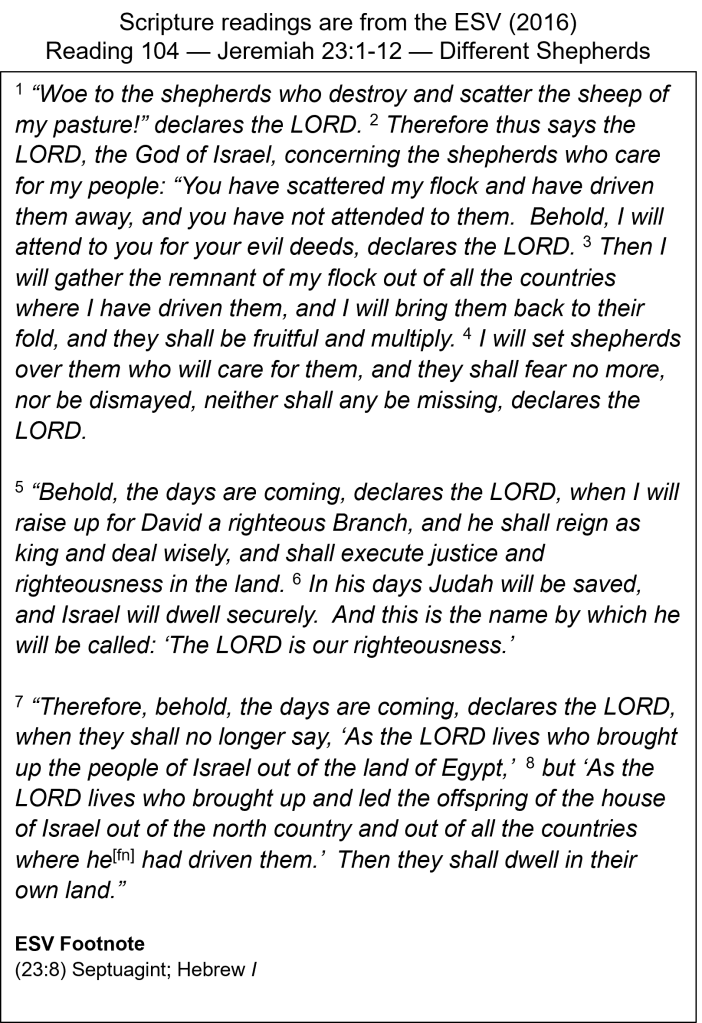
Holy Words — The shepherds of Israel—the prophets and priests—had strayed from the truth of God’s Word, committing spiritual adultery and leading the people astray with them. They had been given the Torah, written through Moses, the book of Judges, the books of Samuel, most of Kings and Chronicles—all describing God’s direction and the peoples’ sin. It was God’s Word, “his holy words” (v. 9). Those “holy words” that Jeremiah mentions, however, were spoken in the context of sorrow, where he said, “My heart is broken within me…” This friendless prophet was sent with this message of judgment against the false prophets and wayward leaders before Babylon conquered Jerusalem: “I will bring disaster upon them in the year of their punishment, declares the LORD” (v. 12). They were not only “holy words” coming from a holy God, but they were also horrifying words of punishment. The covers of our Bibles say, “Holy Bible.” They are holy because of the Source, the Holy God, but they contain both wonderful words of direction and blessing as well as the words of warning that there will be punishing consequences for sin. If we are following the wonderful words, we have no fear of the warning words.
Wonderful Words of Life – YouTube

XXX
April 15, Monday
An audio recording of the following reading is available below.

XXX
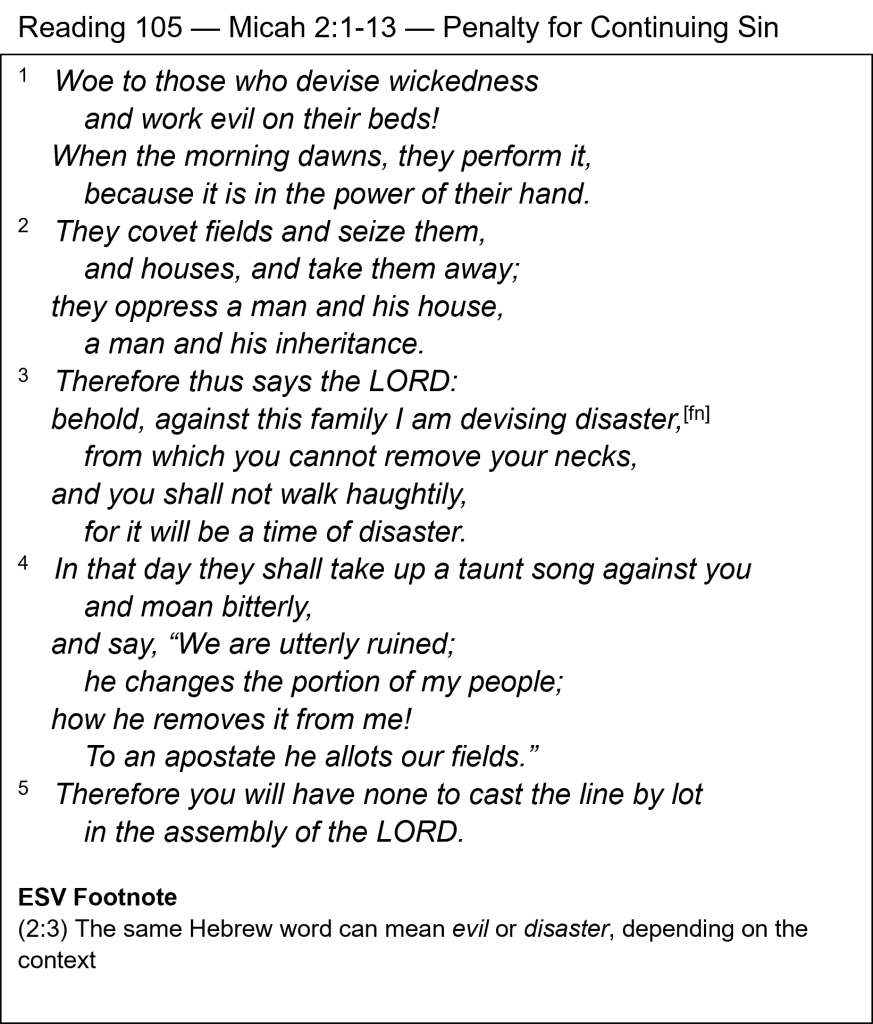
The Nudging, Patient Spirit — The prophet Micah lived in the period before the northern kingdom of Israel was conquered by the Assyrians and scattered among many nations. God warned them through Micah, “I am devising disaster” (v. 3). Their defeat would be the fulfillment of centuries of prophetic warnings from God about their having turned away from Him to serve other gods. The Holy Spirit is mentioned in this passage, but it is hidden in the footnotes of the ESV and NIV translations of verse 7. The question, “Has the LORD grown impatient?” is more literally, “Is the Spirit of Yahweh impatient?” (Legacy Standard Bible). That question is in response to Israel’s insistence that “disgrace will not overtake us” (v. 6). They were counting on the never-ending grace of God’s Spirit because they were His chosen people. That sounds much like the attitudes of many Christians today, who are continuing in sinful practices with the expectation that God will forgive them. The warning from Micah might be summarized with, “Don’t push God’s patience!” God’s discipline will come even to Christians who persist in sin. Punishment and discipline are not God’s preference; He desires to give blessings instead. Verse 7 ends with this: “Do not my words do good to him who walks uprightly?” If we walk in obedience, we walk in safety. The Holy Spirit will nudge us with conviction when we begin to stray from the path of righteousness.
O Patient, Spotless One! – YouTube

XXX
April 16, Tuesday
An audio recording of the following reading is available below.

XXX
Boldness in the Spirit — The false prophets in Micah’s day had two main faults: they misled others, and they sought profit for themselves by doing it. God said that they “lead my people astray” (v. 5a). They were not challenging people about their sin, but they were comforting them in it. They were also making their living by exploiting people, telling them what they wanted to hear, crying the positive message, “’Peace’ when they have something to eat” (v. 5b). Where was the cry against Israel’s sin that was leading them to disaster? They were not prophets but profit-seekers. There are many modern preachers on television and in some churches today with the same apparent motive, making no waves about sin but telling people only what is pleasant for them to hear. Micah was much different than the false prophets of his time because he said, “I am filled with power, with the Spirit of the LORD, and with justice and might, to declare to Jacob his transgression and to Israel his sin” (v. 8). The difference was the Holy Spirit, who gave him boldness and power. He was bold to warn people about sin and its consequences, and he was empowered by words from God. We have the same responsibility and power to stand up against the sinful culture around us, warning them with the powerful words of God that “the wages of sin is death, but the free gift of God is eternal life in Christ Jesus our Lord” (Rom. 6:23).
We Have a Gospel to Proclaim – YouTube
XXX
April 17, Wednesday
An audio recording of the following reading is available below.

XXX
Continuing Presence — The Jews had been released to return to Judah from Babylon. Zerubbabel was appointed to be the governor and Joshua was the high priest. They were surrounded by the discouraging sight of the ruins of Solomon’s temple and the city of Jerusalem. God had ordered a new temple to be built, but it would be much smaller than the one the older returnees remembered. The people still felt defeated and alone, so God challenged and encouraged them. He gave them three commands: “Be strong … Work … [and] Fear not” (vv. 4-5). In the middle of these commands were two statements of God’s presence: “I am with you … [and] My Spirit remains in your midst” (vv. 4-5). In this context, the meaning seems to be that, whether you see any evidence of God’s presence or not, keep on working with energy and confidence. How about you? Do you sometimes feel that God is not around, that the Holy Spirit is not really in your heart? Remember Zerubbabel and Joshua; keep on working and trusting. God is still present, cares about you, and is working for His purpose and for your good. We are living in “the latter glory” (v. 9) promised by God, when His people would have His Spirit living within them. We are walking temples of the resident God.
XXX
April 18, Thursday
An audio recording of the following reading is available below.
XXX
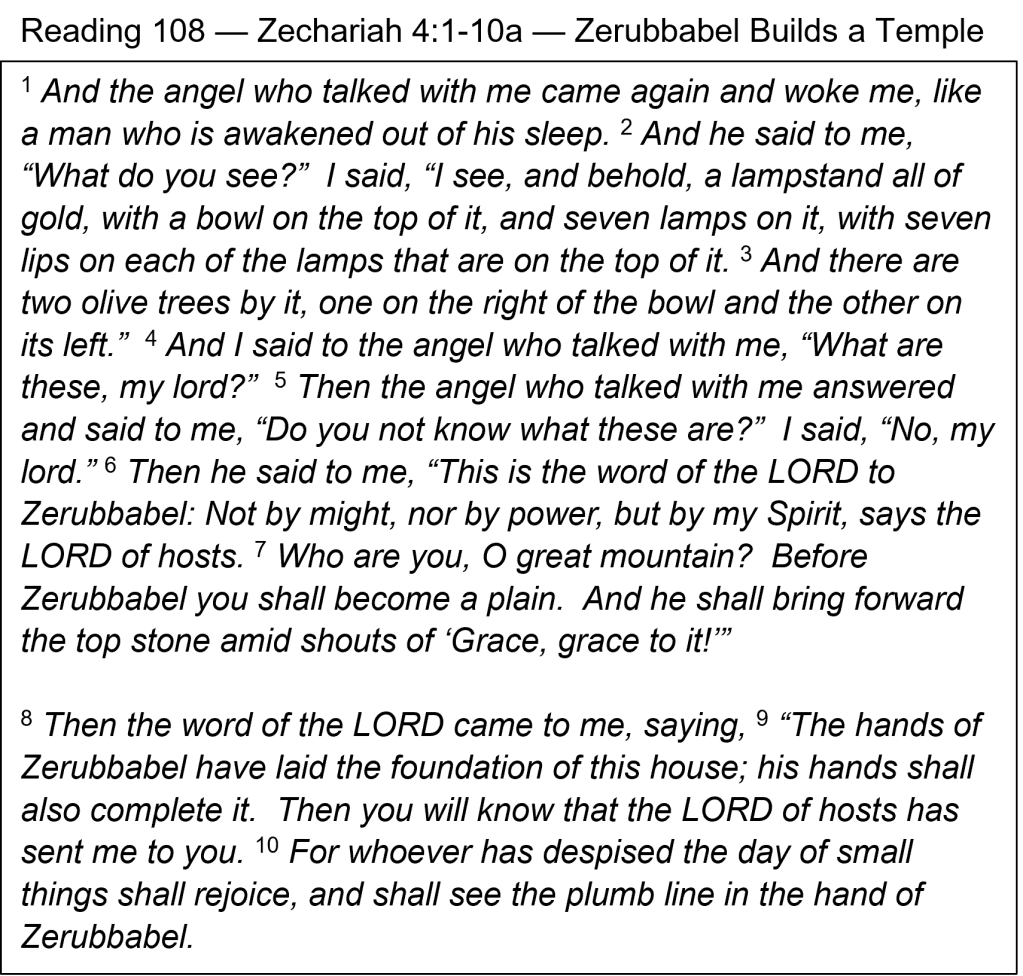
Effective Power — God had commissioned Judah’s new governor, Zerubbabel, through the prophet Haggai, to build a new temple in Jerusalem (Hag. 1:1, 7). Many of the leaders were opposing the building of a temple. The obstacles seemed like a “great mountain” to Zerubbabel, but the message of this vision assured the governor that it “shall become a plain” (Zech. 4:7). How? “Not by might, nor by power, but by my Spirit, says the LORD of hosts” (v. 6). The Holy Spirit would make the difference, supplying the wisdom and energy needed to accomplish the task ordered by the Lord. That is true for us, too. Remember that one of the names of the Spirit is “Helper.” He comes alongside to help us do the things that are beyond our own human ability in controlling circumstances or making our efforts eternally effective. All our might and power are useless in the higher scope of God’s work; it takes divine power. We need to recognize our limitations and lean on the Holy Spirit to supply effectiveness in what we attempt to do for the cause of Christ.
O God, Our Help in Ages Past – YouTube

XXX
April 19, Friday
An audio recording of the following reading is available below.

XXX
Spirit at Rest — Chariots in ancient times were military symbols of power. Since the four chariots in this vision came “after presenting themselves before the Lord of all the earth” (v. 5), they represented God and His action. One chariot was sent to the south toward the military power of Egypt and two chariots were sent north, the direction from which both Assyria had come to defeat Israel and Babylon had come to destroy Judah. The angel who interpreted what Zechariah saw was no ordinary angel because he not only commanded the chariots to go, but he also spoke as God, saying that the two chariots “have set my Spirit at rest in the north country” (v. 8). This was likely “the angel of the LORD,” the pre-incarnate Christ. The Spirit’s “rest” was either a rest from war or a rest from wrath. Both Assyria and Babylon had carried out God’s wrath against His own people because of their sin, but these two nations had also experienced God’s wrath for their own actions. We would probably rather think of the Holy Spirit in connection with rest than wrath, but He was involved in both. His presence in our hearts does involve the negative idea of conviction and discipline, but it primarily provides a condition of rest. Both Jeremiah and Jesus promised that those who sought for God would “find rest for your souls” (Jer. 6:16; Matt. 11:29). That rest is peace, and the Holy Spirit provides that for those in whom He dwells.
It Is Well with My Soul – YouTube

XXX
April 20, Saturday
An audio recording of the following reading is available below.
XXX
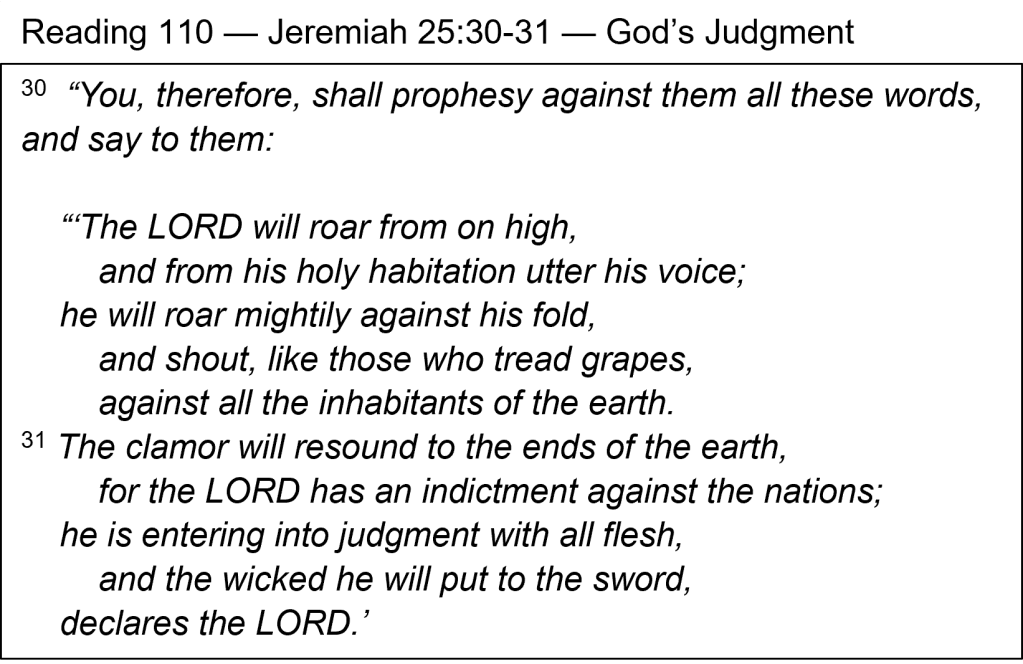
Holy Habitation — This prophesy of God’s judgment goes back to the time before Judah’s defeat by Babylon. Almost all of it is negative, judgment not only “against his fold” (v. 30) but also “against the nations” (v. 31). The wicked will be punished for all generations of people who refuse to follow the Lord. The one positive fact that I got from this passage was the description of heaven as “his holy habitation” (v. 30). That picture appears in other OT statements as well. It is the place from which God blesses His people (Deut. 26:15) and from which He serves as “Father of the fatherless and protector of widows” (Psa. 68:5). The prayers of the priests and Levites “came to his holy habitation in heaven” (2 Chron. 30:27). David said, “I love the habitation of your house and the place where your glory dwells” (Psa. 26:8). Another worshipful response from us toward this ultimate dwelling place of God is to “be silent, all flesh, before the LORD…” (Zech. 2:13). Since God is holy, His habitation in heaven is holy, and we will be with Him there for eternity.
 accbibleread.com