
Save or print this page by clicking on “Download” below:
April 7, Sunday
An audio recording of the following reading is available below.
XXX
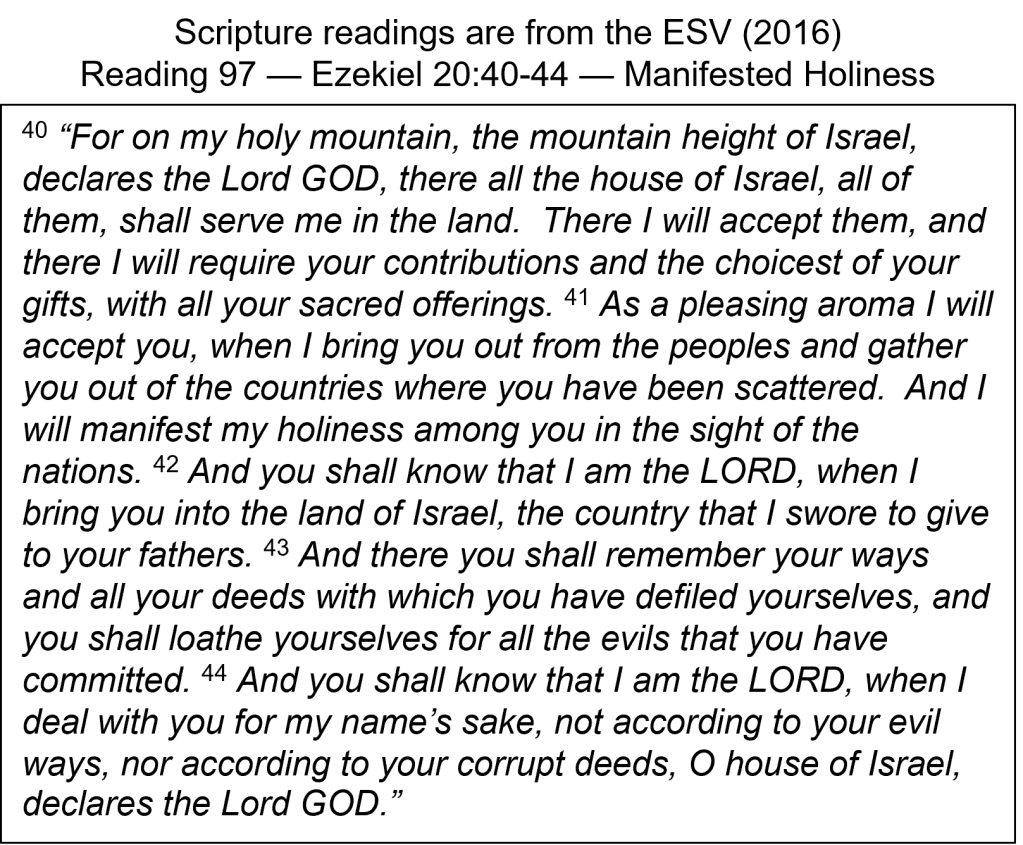
You Shall Know — Again, God repeats His promise to the exiled people of Israel that He would return them to their Promised Land. Through that event, and to two groups of people, He promised to “manifest my holiness” (v. 41). It would be done “…among you [and] in the sight of the nations.” Part of that demonstration of His holiness would be that of keeping His promises, as we read about yesterday. A whole nation of people had been conquered by the Babylonians and marched away into captivity. It looked like the end for Israel. Then, 70 years later, they came marching back again. It looked miraculous, and it was. God’s holiness was demonstrated to the surrounding nations who were watching. It was God’s revelation to His own people, however, that is emphasized here. Twice, God concluded that when this happened, “… you shall know that I am the LORD” (vv. 42, 44). First, it had to do simply with the miracle of their return: “…when I bring you into the land of Israel” (v. 42). They would recognize God’s hand because He had returned them to the land promised to their fathers. Only Yahweh could accomplish that. Second, they would also “know that I am the LORD” because they would realize that He had dealt with them “for my name’s sake, not according to your evil ways” (v. 44)—they would recognize God’s grace. They didn’t deserve the good He had done, but He did it because of His name, a name that incorporates His grace. We Christians also know that He is God because He delivered us from bondage and led us into His kingdom because of grace.
Marvelous Grace (Grace Greater Than Our Sin) – YouTube

XXX
April 8, Monday
An audio recording of the following reading is available below.
XXX
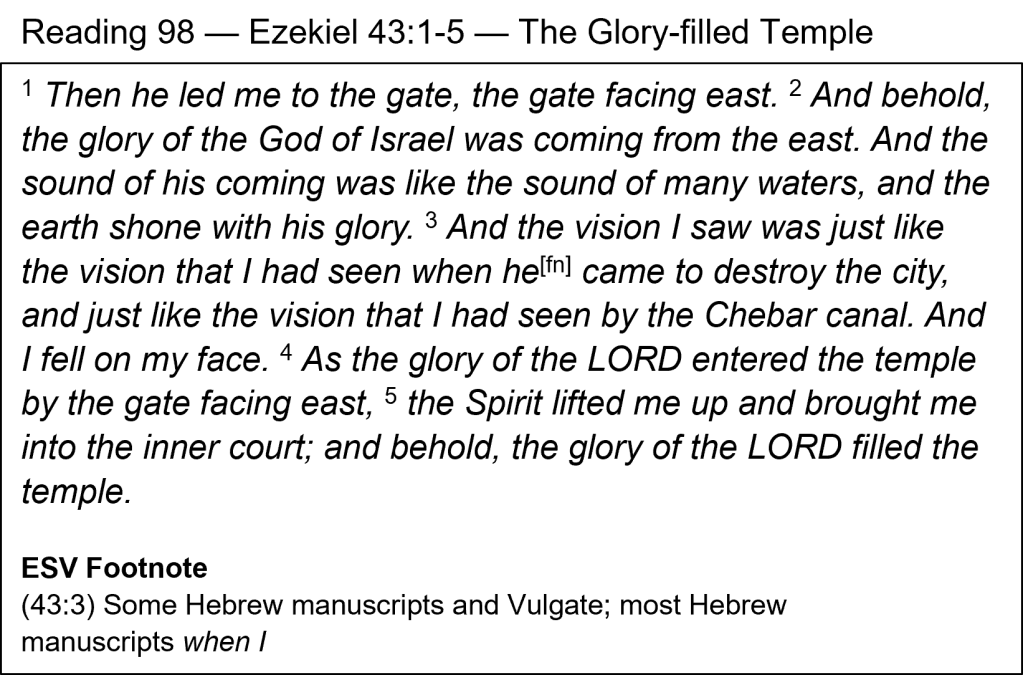
The Focusing Spirit — In this reading, we step into the midst of a long vision described by Ezekiel. A bronze-like man with a measuring rod (40:3) was providing details of a new, future temple, and “he brought me to the gate, the gate facing east” (43:1). The glory of the Lord had left the destroyed temple of Solomon (11:23), and now it was returning with a deafening roar and reflecting brilliant brightness (43:2). In verse 3, Ezekiel’s response was to fall on his face as “the glory of the LORD filled the temple” (v. 5). From his position of being face down on the ground, “the Spirit lifted me up and brought me into the inner court” (v. 5). The Holy Spirit wanted Ezekiel to see “the glory of the LORD.” That is true today as well. The Spirit doesn’t point attention to Himself; He points it to the Father and to the Son. He is the focusing Spirit, moving and positioning us so we can better see the wonder and majesty of Jesus and the Father.
Teach Me, My God and King – YouTube

XXX
April 9, Tuesday
An audio recording of the following reading is available below.
XXX
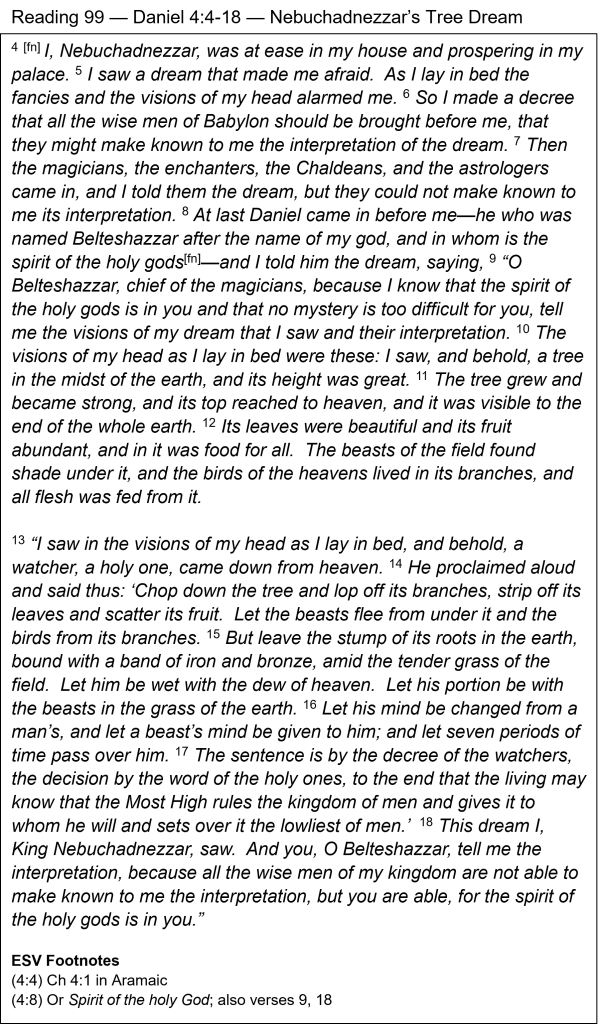
What Spirit? — Three times in this passage, King Nebuchadnezzar made the somewhat puzzling statement that Daniel was indwelt by “the spirit of the holy gods” (vv. 8, 9, 18). To what “spirit” and to what “gods” was he referring? Speaking of the plural “holy gods,” shows that the king was a polytheist, believing in multiple gods. He had already referred to Daniel’s other name, Belteshazzar, as having come from the name of “my god,” so the king still identified primarily with the god Bel. This happened even after his response to Daniel following his earlier interpretation of the dream about the image of the man with a gold head: “Truly, your God is God of gods and Lord of kings” (2:47). So, Nebuchadnezzar was still a polytheist, but what he saw in Daniel was the true Holy Spirit of the only God, Yahweh. People may see evidence of the Spirit’s presence in our lives today and yet attribute it to something else that fits into their own frame of reference, making statements like, “He seems to have unusual wisdom,” or “How can she take that tragedy with such peace?” The Holy Spirit produces fruit in our lives that is noticed by people around us. They see our “love, joy, peace, patience, kindness, goodness, faithfulness, gentleness, [and] self-control” (Gal. 5:22-23), and it both puzzles and attracts them. When they mention it, we should let them know that what they see came from God. It was from the Holy Spirit. Daniel did correctly interpret the king’s new dream, and after its dramatic fulfillment, this was the humbled king’s response: “Now I, Nebuchadnezzar, praise and extol and honor the King of heaven, for all his works are right and his ways are just…” (Dan. 4:37).
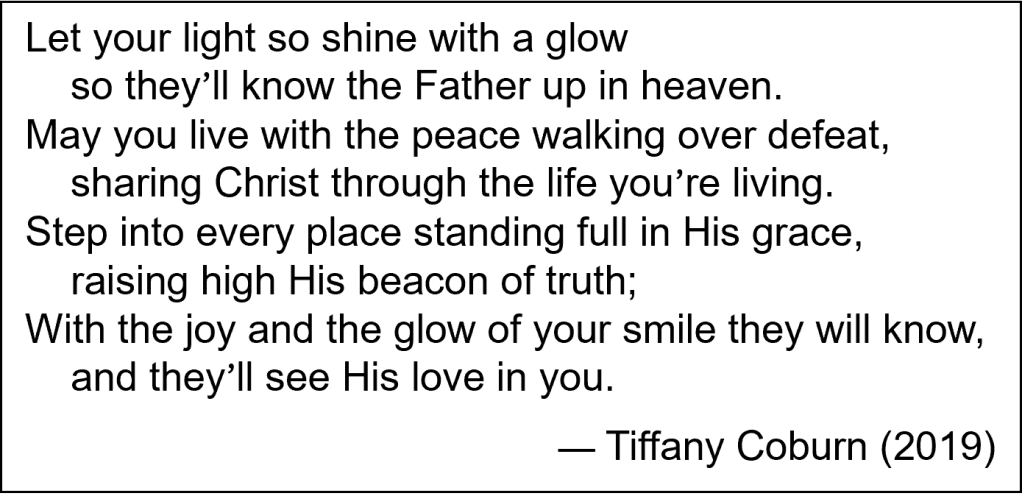
Let Your Light So Shine – YouTube
XXX
April 10, Wednesday
An audio recording of the following reading is available below.

XXX
Degrading Holiness — King Belshazzar learned nothing about holiness from his ancestor, Nebuchadnezzar. One of the activities of this famous Belshazzar’s Feast was that he ordered the sacred gold and silver vessels captured from the Jerusalem temple to be brought in for his guests to drink wine (5:2). He not only ignored the holiness of these vessels, but deliberately desecrated them by praising other gods in the process (v. 4). What was the holy God’s response? “Immediately…” (v. 5) came the writing on the wall. That frightened the king, whose name ironically meant, “O Bel, protect the king!” The Queen Mother came to the apparent rescue with the reminder of the interpreter Daniel, “in whom is the spirit of the holy gods” (v. 11), the same expression used by Nebuchadnezzar three times in yesterday’s reading. King Belshazzar didn’t even acknowledge Daniel as the interpreter who led Nebuchadnezzar through critical times of his rule, but only identified him as one of the Jewish exiles (v. 13). When he got to his statement about the Holy Spirit in Daniel, he left out an important word, saying “I have heard of you that the spirit of the gods is in you” (v. 14). He omitted the word “holy.” He had subtly degraded the holiness of God. Judgment came quickly: “That very night Belshazzar the Chaldean king was killed” (v. 30), ending the Babylonian Empire. Bel couldn’t protect the king from the only Holy God. The holiness of God is not to be ignored or disgraced.
Holy Is the Lord! (Instrumental with lyrics) – YouTube

XXX
April 11, Thursday
An audio recording of the following reading is available below.

XXX
The Spirit of Integrity — This paragraph sets up the story of Daniel being thrown into the lions’ den. The end of the previous chapter shows that Belshazzar kept his promise to make Daniel “the third ruler in the kingdom” for interpreting the writing on the wall (5:29). The other two officials may have been the same ones retained by King Darius to rule over the 120 regional satraps (6:1), whose primary job was apparently to oversee the collection of taxes “so that the king might suffer no loss” (v. 2). Daniel quickly rose to the top in importance so that “the king planned to set him over the whole kingdom” (v. 3). The stated reason was “because an excellent spirit was in him.” Although the Holy Spirit is not mentioned directly here, that “excellent spirit” seen in Daniel was the result of the collective effects of the Spirit of God that was upon him. What evidence did they see? It was basically integrity. His plotting colleagues “could find no ground for complaint” in him (v. 4). He was faultless, faithful, and accurate in this financial leadership. Are those same characteristics demonstrated in our Christian lives because we have the Holy Spirit living within us? He is the Spirit of integrity, and we are not to grieve Him by smudging His reputation through selfishly and dishonestly cutting financial corners to bring advantage to us. We should be so positively different, that we will make jealous enemies like Daniel did.
True-Hearted, Whole-Hearted – YouTube

XXX
April 12, Friday
An audio recording of the following reading is available below.
XXX
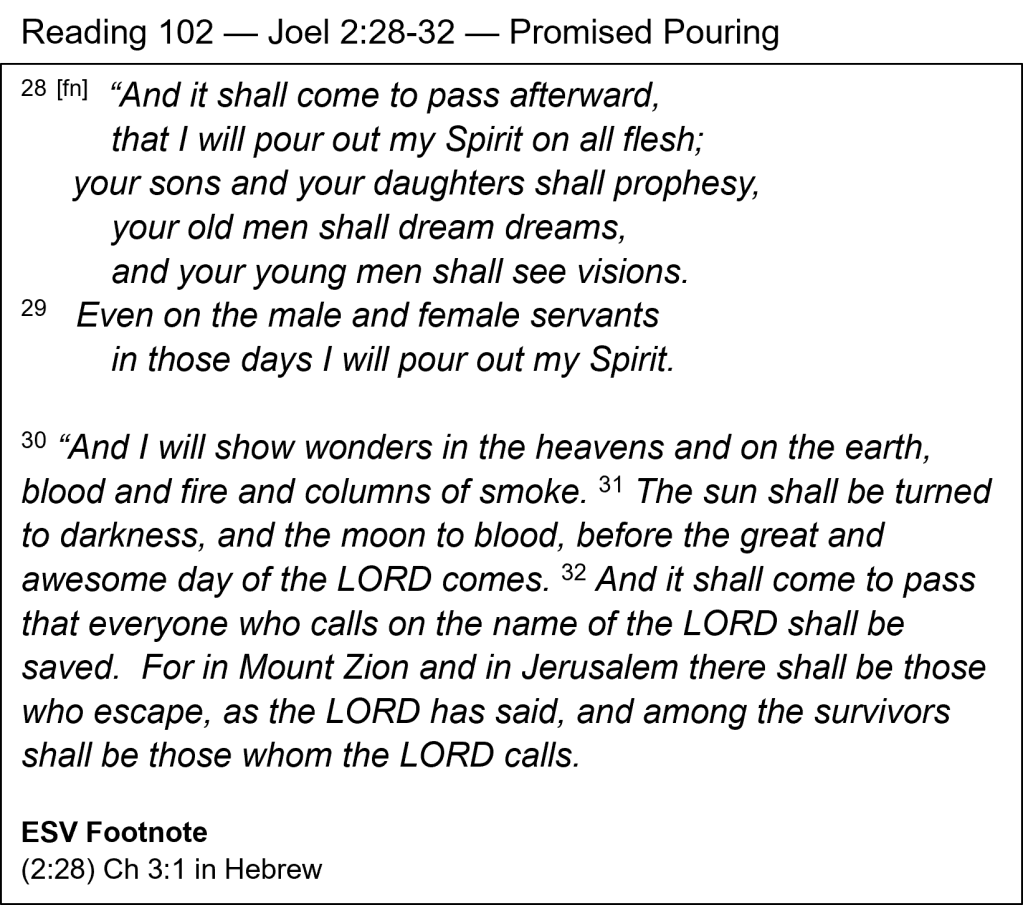
The Poured-out Spirit — Since Peter, by the Spirit, quoted verses 28-29 of this passage at the historic Day of Pentecost, we know that this pouring out of the Holy Spirit applied to that day at which the Church was started. It was part of that hinge of history that included the birth, death, and resurrection of Jesus. We are still living in that outpouring era as the Holy Spirit enters the hearts of probably thousands of people around the world every day who turn to follow Christ. The second prediction that follows in Joel, however, did not accompany that first-century event. There were no “wonders in the heavens and on the earth” (v. 30) at that time, so those subsequent experiences still await “the awesome day of the LORD” (v. 31) at the return of Christ. In a sense, we live between the promises, enjoying one and anticipating the other. Maranatha! Come, Lord Jesus!
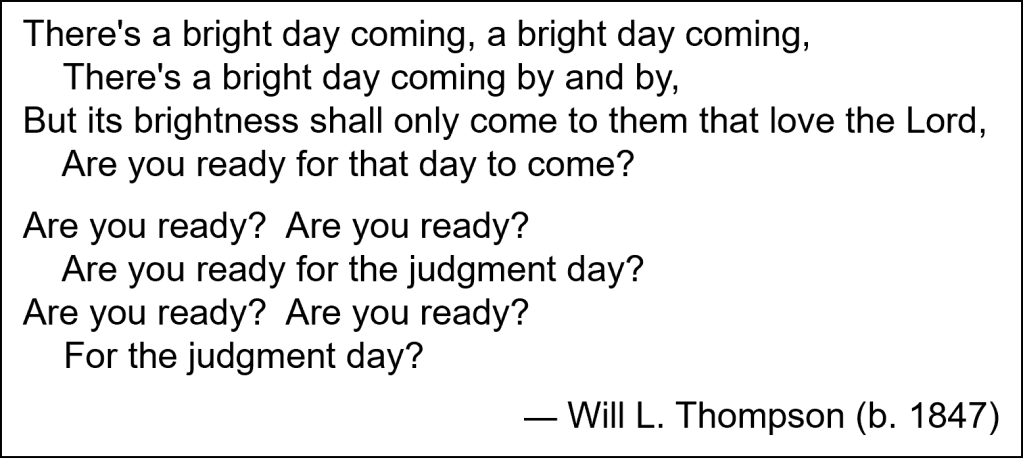
There’s a Great Day Coming – YouTube
XXX
April 13, Saturday
An audio recording of the following reading is available below.

XXX
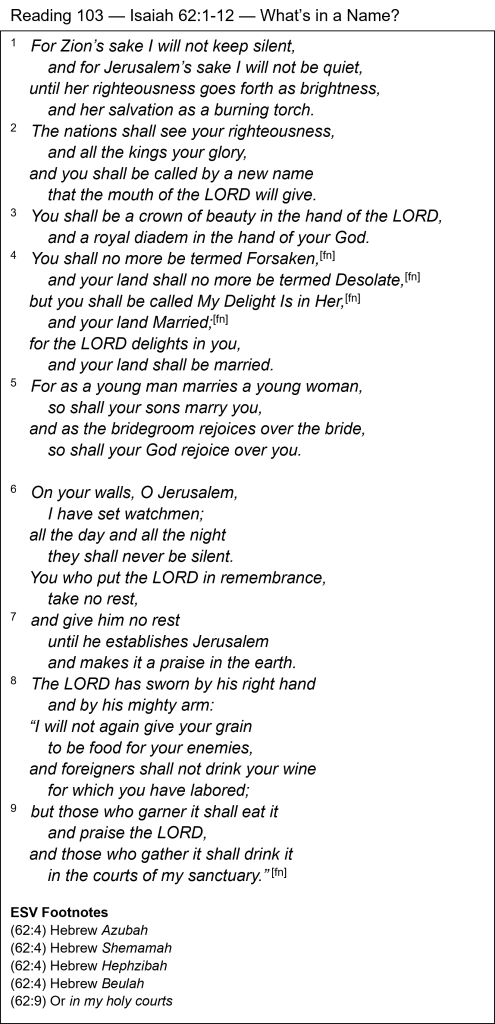
Holy People — This passage has much to say about names for God’s people. Because of their waywardness, God disciplined Israel so that they were called “Forsaken” and “Desolate” (v. 4), but because of His love and faithfulness, their new names would be “My Delight Is in Her, and … Married” (v. 4b), “The Holy People, The Redeemed … Sought Out … A City Not Forsaken” (v. 12)—two names of discipline and six names of delight. God’s discipline of His people is because of His love (Heb. 12:6). Although this list of names refers primarily to Israel, they extend to us as well. The call went out to “prepare the way for the people … lift up a signal over the peoples” (v. 10). Those “peoples” are the Gentiles, and “the LORD has proclaimed to the end of the earth … Behold, your salvation comes” (v. 11). God chose Israel to proclaim His name to the Gentiles. Those of us who have come to Christ are now “The Holy People.” Why are we holy? Because we are “The Redeemed.” God made us holy by giving us the righteousness of Christ. What a privilege it is to be the object of God’s delight!
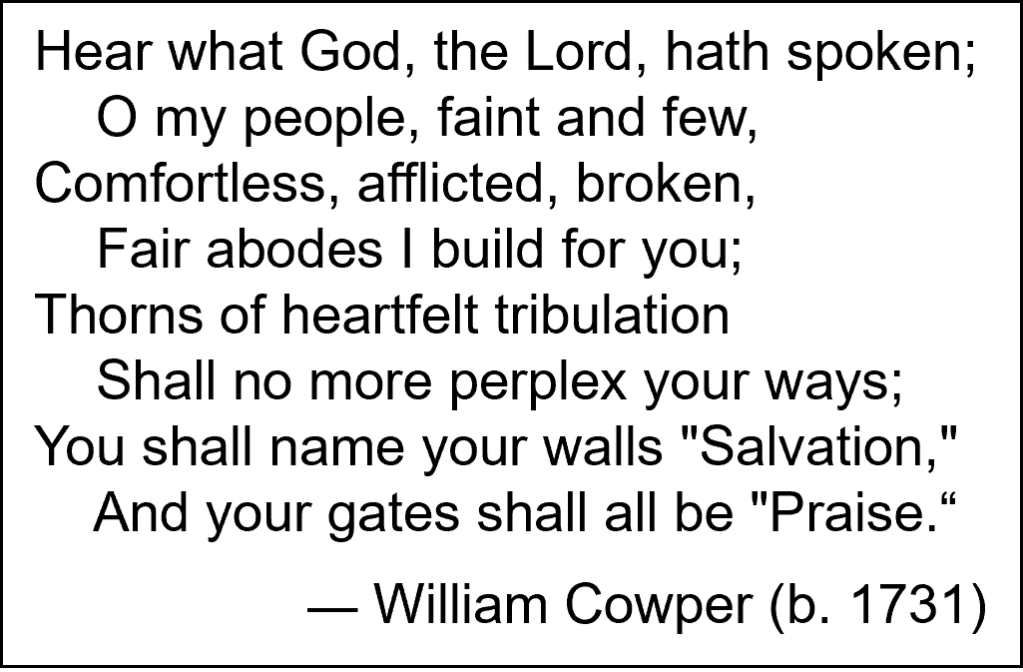
God, Your Everlasting Light – YouTube
 accbibleread.com