
Save or print this page by clicking on “Download” below:
Accountability Window: Mar. 29-31
March 17, Sunday
An audio recording of the following reading is available below.
XXX
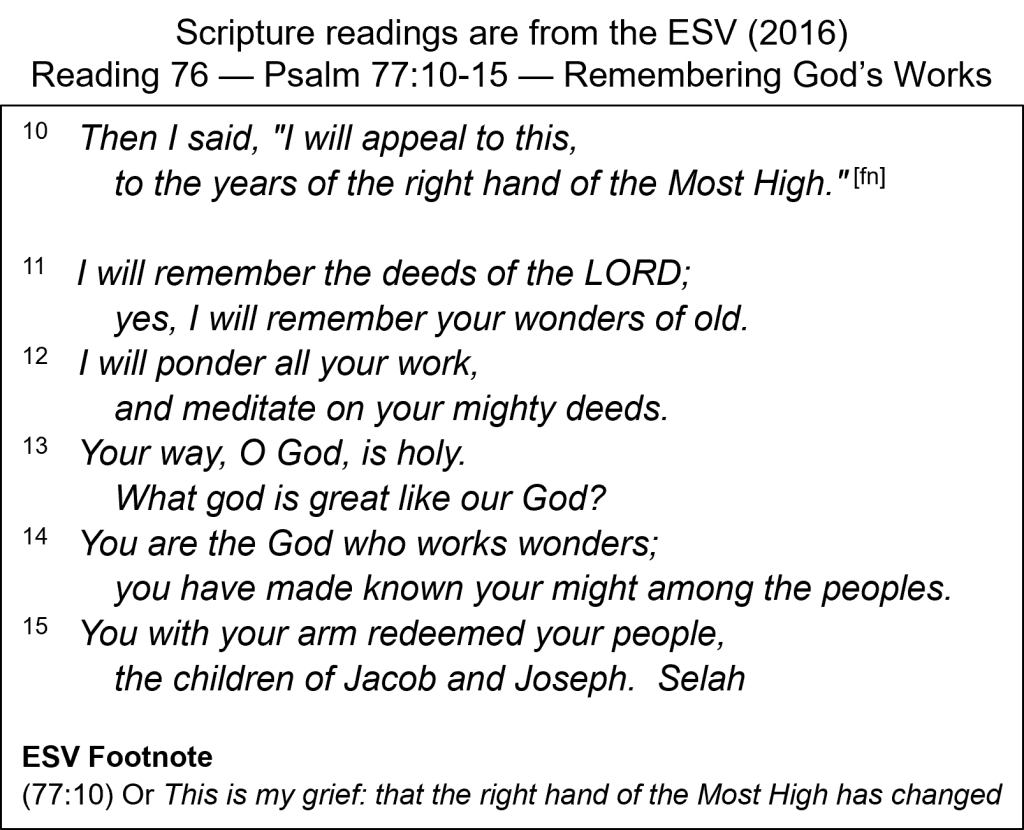
God’s Holy Way — The centerpiece of today’s reading says, “Your way, O God, is holy” (v. 13). His way is holy because He is holy. God’s way is demonstrated in this psalm by looking back in history to what He has done for His people. It was a history of power displayed through His “deeds … wonders … work … deeds … works wonders … [and] might.” It was a way of power. It was also a way of salvation: “… your arm redeemed your people” (v. 15). All this holy power was exercised to rescue His people from Egypt and from many subsequent enemies. The world today has the history of that holy power contained in the Holy Bible, if they have access to it, and if the Church is faithful in spreading its message. Are you helping to support a missionary who has gone to an unreached area of the world to take the message of God’s power and salvation? There is another statement that God made, showing a different aspect of His holy way: “I am the LORD your God, who teaches you to profit, who leads you in the way you should go” (Isa. 48:17). This is the holy way of righteousness, the path of obedience in which we walk to please God and receive many benefits.
God’s Way Is the Best Way – YouTube

XXX
March 18, Monday
An audio recording of the following reading is available below.
XXX
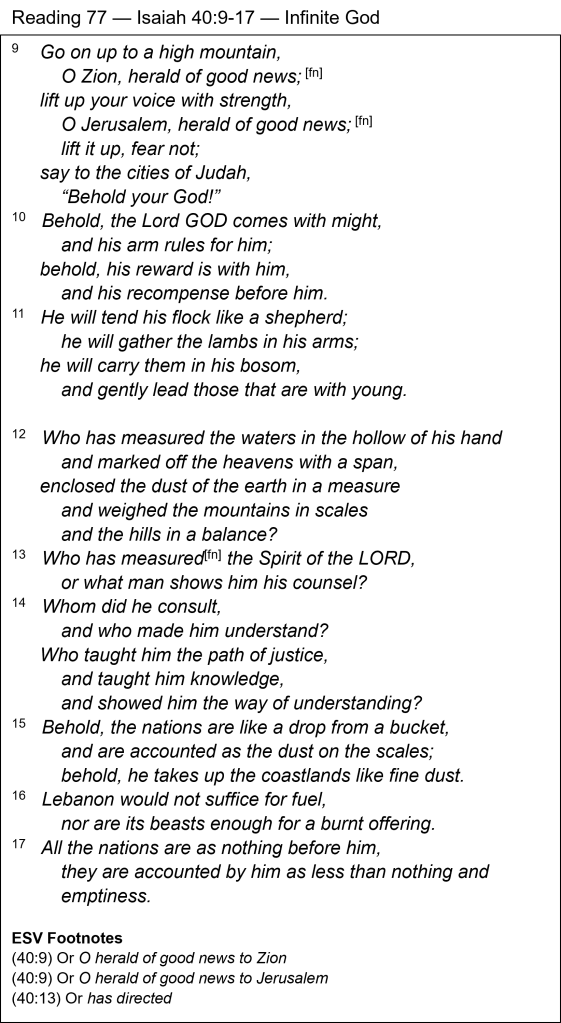
Limitless Spirit — Five times in this passage we are commanded to “behold” something unusual. It begins by calling us to “Behold your God!” (v. 9). Everything about God should make us wonder. First, we are told to wonder at His mighty rule: “Behold, the Lord GOD comes with might…” (v. 10a). That is backed up by a comparison to the relative insignificance of powerful nations that He rules: “Behold, the nations are like a drop from a bucket” (v. 15). Next is the wonder of His generous reward (v. 10b) and His loving care (v. 11). In the middle of all this are two verses about the Holy Spirit’s limitless understanding. Verses 13-14 ask three questions about the immensity of His counsel, understanding, and knowledge. They basically ask, “Who can measure up to ‘the Spirit of the LORD’?” (v. 13). The answer is, “No one!” The Holy Spirit doesn’t need to be counselled, informed, or taught because He knows everything. Sometimes we pray as if God doesn’t know about our situation, but He knew about it before we were born! When we ask God to answer our prayer in a certain way, we are trying to direct Him, to give Him counsel. He already knows the best way. He just wants us to present our need to Him, not because He doesn’t already know it, but because we need to admit our helplessness. If whole nations are “a drop from a bucket” to God, what are we as individuals? The second thing He wants is for us to ask for help, but we should leave the method to the Holy Spirit who knows everything!
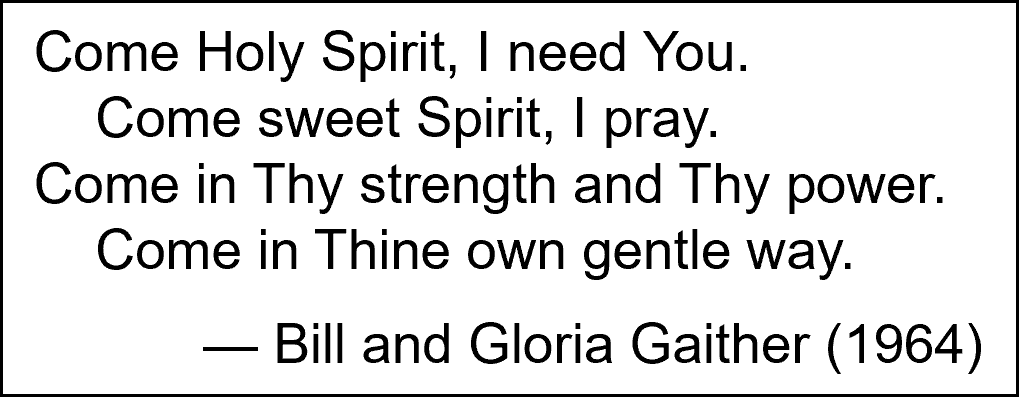
Come, Holy Spirit, I Need You – YouTube
XXX
March 19, Tuesday
An audio recording of the following reading is available below.

XXX
The Spirit Upon Jesus — This is the first of Isaiah’s Servant Songs, predicting the coming Messiah. Although our reading for today is primarily about Jesus, it includes an important statement about the Holy Spirit’s involvement in authenticating and empowering Jesus for ministry. God’s declaration was this: “I have put my Spirit upon him” (v. 1). That was visually fulfilled at Jesus’ baptism, when John “saw the Spirit of God descending like a dove and coming to rest on him” (Matt. 3:16). It demonstrated that Jesus was, indeed, the Son of God. It also fulfilled Isaiah’s earlier prophecy that “the Spirit of the LORD shall rest upon him” (Isa. 11:2), and it was confirmed by Jesus when He quoted the prophecy in Isa. 61:1 at the synagogue in Nazareth, saying, “The Spirit of the Lord is upon me…” (Luke 4:18). He had been empowered by the Holy Spirit to do mighty works in support of His message. As the Holy Spirit “came upon” the prophets of the OT, so the Spirit rested upon Jesus. It is different for us now, however, because the Holy Spirit dwells permanently within each born-again believer. His presence makes us different and identifies us as being members of God’s spiritual family. The Holy Spirit dwelling in us also gives us supernatural power to minister effectively to others.
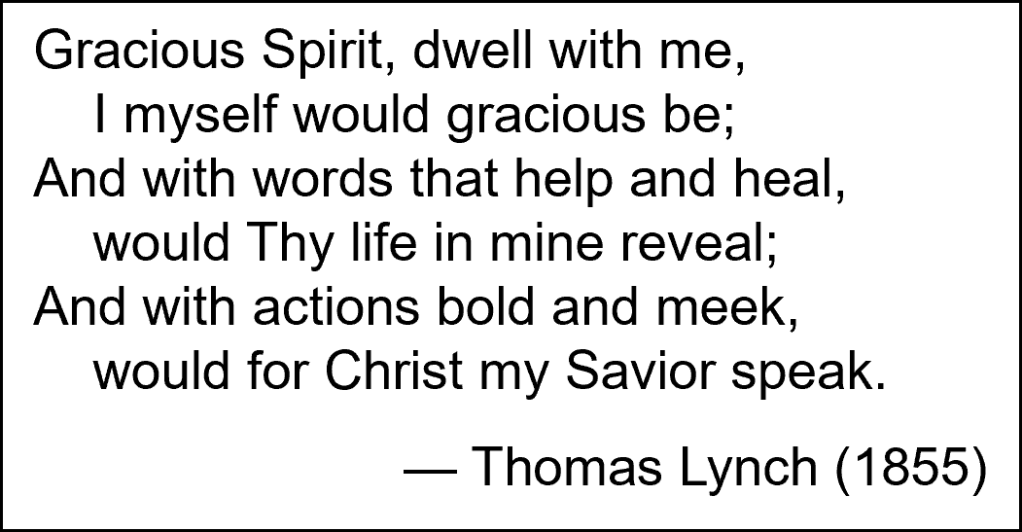
Gracious Spirit, Dwell with Me – YouTube
XXX
March 20, Wednesday
An audio recording of the following reading is available below.
XXX
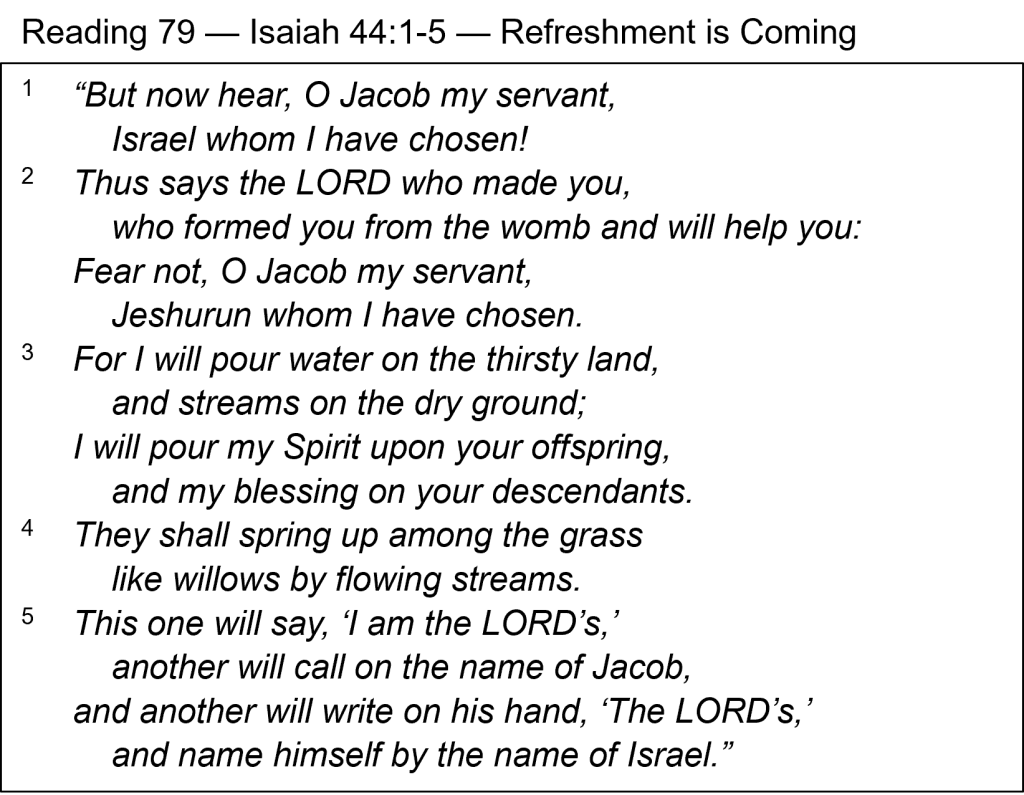
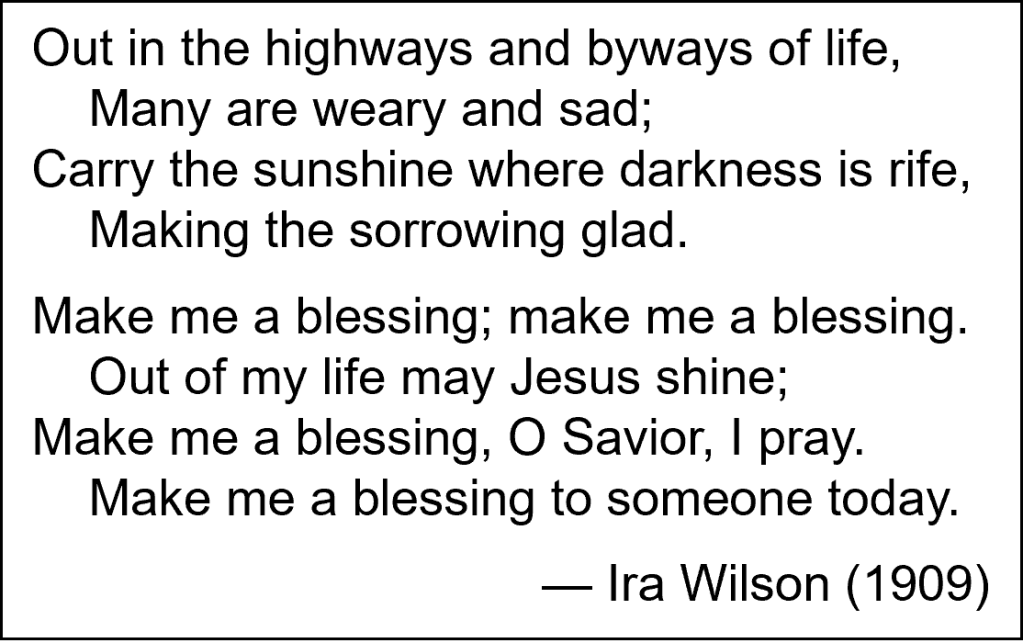
Blessed for Blessing — God’s past blessing on Israel is emphasized in the first two verses of this passage. Twice, God calls them “my servant … whom I have chosen.” The one “who formed you … will help you” (v. 2). That promised help is described in verses 3-4, with the Holy Spirit being poured out upon them like water on thirsty ground. This could refer in part to the time following their return from being exiled in Babylon, but it also looks ahead to the forming of the Church on the Day of Pentecost. The result of this outpouring would be tremendous growth (v. 4). The last verse brings in the “outsiders,” people who were not racially connected with the Jews. They would identify with Israel and their God, “the LORD” (Yahweh). That happened to some degree in Israel following the exile, but its great fulfillment came when the Church was formed, and the gospel message began to spread around the world from generation to generation. We are a part of that flood of spiritual blessings, and we are part of bringing that blessing to others. We were blessed to be a blessing.
XXX
March 21, Thursday
An audio recording of the following reading is available below.

XXX
The Sent Spirit — The Holy Spirit is mentioned in verse 16 of this passage in the context of several different persons. First are the people of Israel who are called to assemble for a message: “Draw near to me, hear this.” Within that command, there is another person, “me,” who is God, the Creator, as it is made clear in verses 12-13. Then comes this important statement at the end of verse 16: “And now the Lord GOD has sent me, and his Spirit.” The word “me” in this declaration speaks of another person. Most commentators feel that it refers to Cyrus, the Persian king who would conquer Babylon to end Israel’s 70-year exile as predicted by Jeremiah (Jer. 25:11-12). Earlier in Isaiah, God said of Cyrus, “He is my shepherd, and he shall fulfill all my purpose” (Isa. 44:28), and He calls him “his anointed” (Isa. 45:1). In our passage for today, it is said of Cyrus, “The LORD loves him” (Isa. 48:14) because he would perform God’s purpose of judgment on Babylon, thus freeing Israel. Others believe that the word “me” in that verse 16 statement could also be seen as the pre-incarnate Son of God, the servant of the Lord, in which case all three Persons of the Trinity are mentioned together. The end of this statement says that “his Spirit” was also sent by the Father, probably to direct and empower Cyrus in fulfilling God’s purpose. The Holy Spirit’s action is subtle here, as it often is throughout Scripture. He serves as the behind-the-scenes wisdom and power of Yahweh. He was sent, not only to help Cyrus, but also to help us: “God has sent the Spirit of His Son into our hearts…” (Gal. 4:6). He is the sent Spirit.
For Your Gift of God, the Spirit – YouTube

XXX
March 22, Friday
An audio recording of the following reading is available below.
XXX
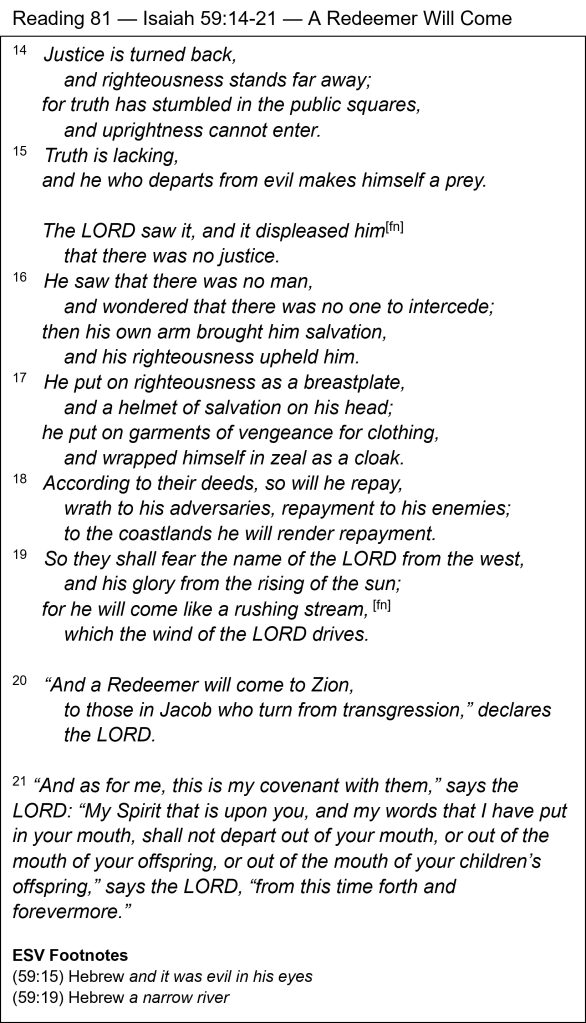
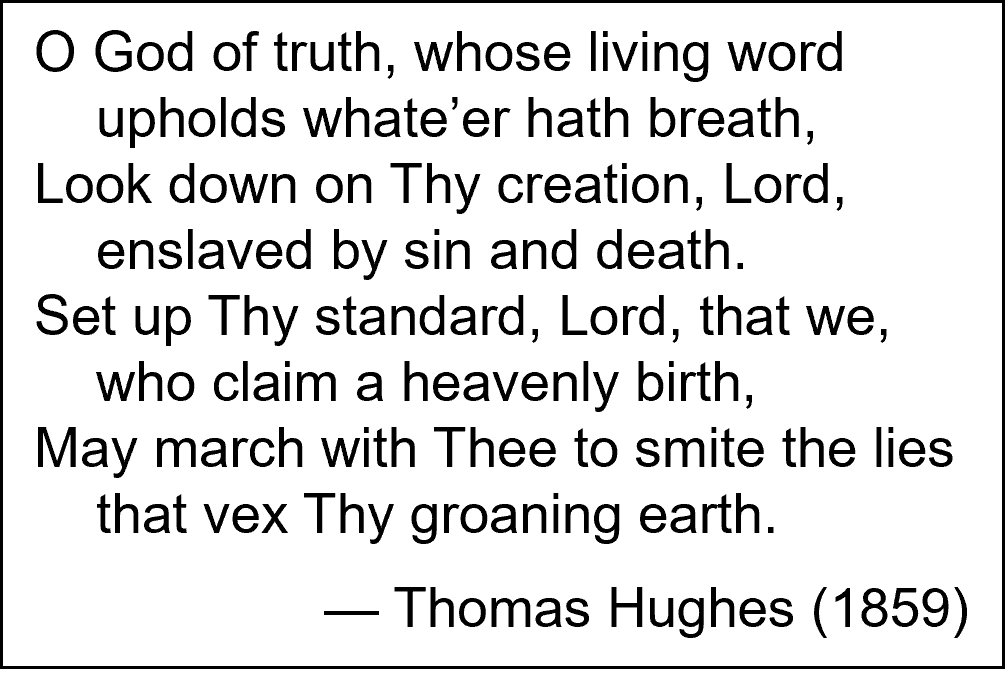
The Spirit of Truth — We saw earlier (Jan. 8) that the Holy Spirit was referred to as the “Spirit of Truth” four times in John’s writings. We find a similar concept in today’s reading from Isaiah 59. Verses 14-15 show how far the culture of mankind slipped away from truth: “…truth has stumbled … truth is lacking.” God’s solution for that condition was that “a Redeemer will come to Zion” (v. 20), which was accomplished by sending the Son of God to earth so that He could redeem those “who turn from transgression.” Then comes verse 21 about the Holy Spirit. The result of the new covenant formed by Christ’s coming to earth was that “My Spirit … is upon you.” Upon whom? The first impulse is to think that it refers to the Redeemer, Jesus, because other statements support that conclusion, like when the Holy Spirit came upon Him at His baptism. The rest of Isaiah’s final verse in this chapter, however, shows that the person upon whom the Spirit comes will have offspring, which creates a problem unless those refer only to spiritual children in the family of God. An alternative interpretation is that the Spirit came upon the prophet Isaiah; however, the hereditary succession of prophecy to children of prophets is not supported elsewhere in Scripture. The third offered alternative is that the singular “you” and “your” pronouns of that verse refer first to collective Israel and then to the Church. An interesting conclusion is that the problem of lacking truth at the beginning of today’s reading is remedied in the last verse by the Spirit of truth providing true “words that I have put in your mouth.” Those are words of the Bible that were given to last forever. Although we may see the concept of truth crumbling in the culture around us, we have absolute, eternal truth provided in the Scriptures, given by the Spirit of truth.
O God of Truth, Whose Living Word (piano) – YouTube
XXX
March 23, Saturday
An audio recording of the following reading is available below.

XXX
Only Related to Holiness — This passage begins well in that the people of Israel “swear by the name of the LORD and confess the God of Israel” (v. 1). That verse ends, however, with the revealing truth that this association with God was only superficial — it was “not in truth or right.” This embarrassing revelation continues by saying that “they call themselves after the holy city” (v. 2). That was the city of Jerusalem, and it was holy because God chose it to be the place where His name would dwell in the Most Holy Place in the temple that Solomon built. The problem is that real holiness is more than mere association. It wasn’t good enough that they were born Jews, God’s chosen people, or that they traveled to Jerusalem to worship God with their sacrifices. Most of them were not holy people; they were only people related to holiness. Sadly, there is a similar condition existing today with many so-called Christians who are only associated with a church, even attending regularly, but their lives show little evidence of genuine holiness. Holiness is not just being associated with God; it is being committed to Him. We must be intentional and genuine in living for and worshiping God.
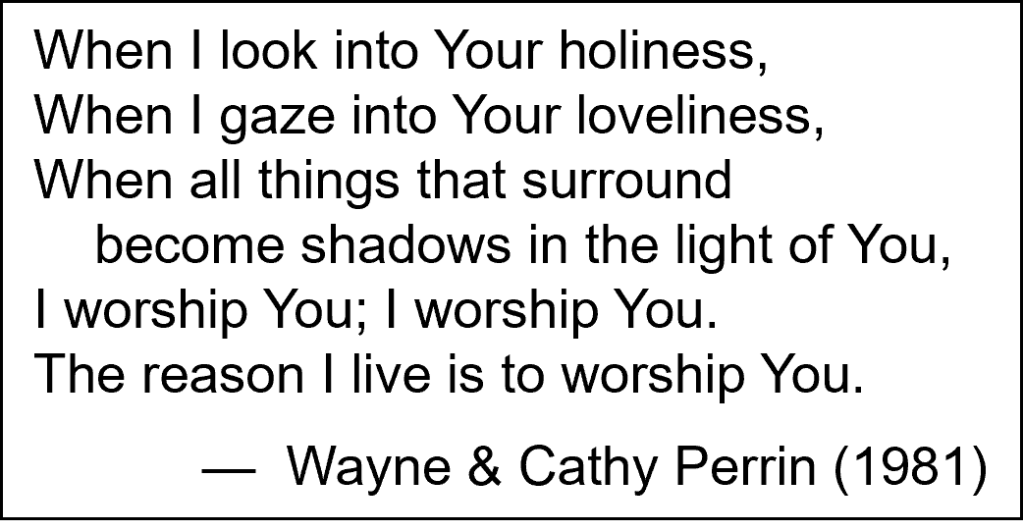
When I Look into Your Holiness – YouTube
 accbibleread.com