
Save or print this page by clicking on “Download” below:
March 3, Sunday
An audio recording of the following reading is available below.
XXX
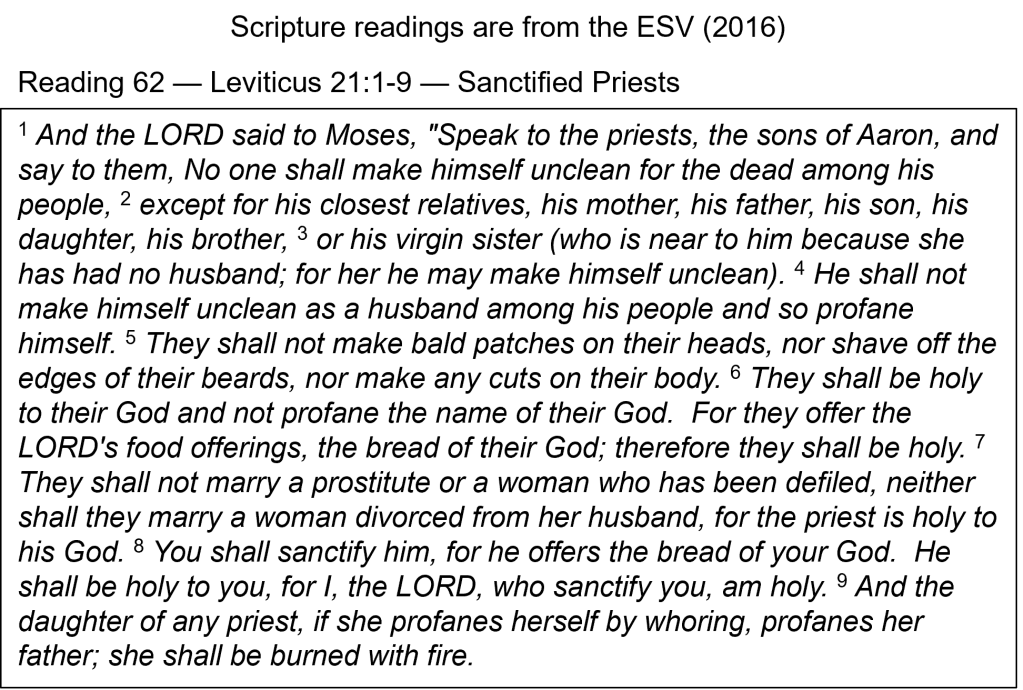
The Sanctifying One — Three times in this chapter, God declares that He is the one who sanctifies (vv. 8, 15, 23). There are two kinds of holiness spoken of in our passage for today. Most of it is about external or outward holiness. A higher standard was required of priests because they were involved with the holy objects in the temple and the holy offerings they prepared and burned on the altar (v. 6). How did they keep themselves holy? It was by outwardly abstaining from certain things, like not touching a dead body (except for a close blood relative—v. 2), not cutting their beards or bodies (v. 5), and not marrying a non-virgin (v. 7). They kept themselves holy by abstaining from things that defile, which is also what we ought to do. Paul instructed us, “…let us cleanse ourselves from every defilement of body and spirit, bringing holiness to completion in the fear of God” (2 Cor. 7:1). We are told to “Abstain from every form of evil” (1 Thess. 5:22) and to “abstain from the passions of the flesh” (1 Pet. 2:11). We keep ourselves holy by abstaining from what God considers to be unclean. That is how we keep ourselves holy, but we don’t make ourselves holy—God does that (“I, the LORD, who sanctify you, am holy”—Lev. 21:8). He does that by His holy presence in our hearts. His holiness makes us holy. That is inward holiness. He is the Sanctifying One who makes us holy.
XXX
March 4, Monday
An audio recording of the following reading is available below.
XXX
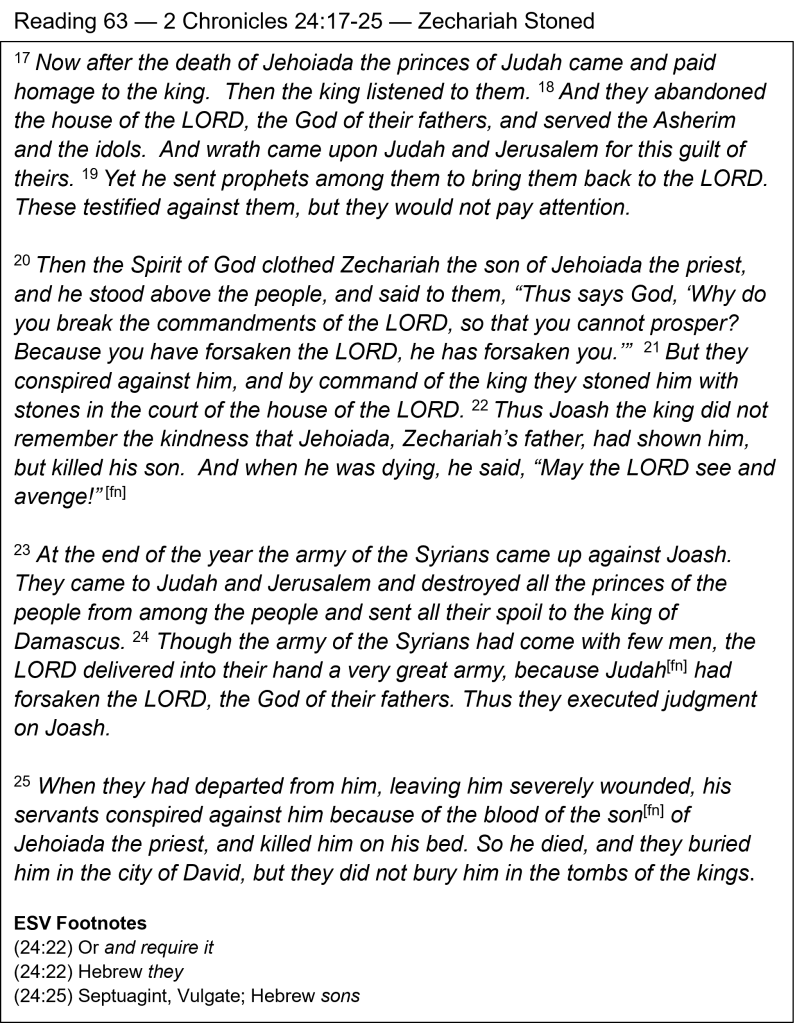
Spirit of Warning — When wicked Athaliah was about to slaughter all the king’s sons so she could be the ruling queen, the infant Joash was rescued by the wife of the priest, Jehoiada, and raised by them for six years (2 Chron. 22:11-12). Jehoiada had great influence on Joash after he became king at the age of seven, and he reigned righteously for 40 years (24:1-2). As we read in our passage for today, however, after the godly Jehoiada died, King Joash was influenced by other leaders and turned away from God. The Lord then sent prophets “to bring them back to the LORD … but they would not pay attention” (v. 19). Then God turned a priest into a prophet, as “the Spirit of God clothed Zechariah” (v. 20), to challenge and warn Joash and his rebellious influencers, but Joash agreed to have him stoned in the court of the temple. Why would the Holy Spirit empower Zechariah to speak this warning, only to be killed as a result? It didn’t bring King Joash back to God because he would be killed by his own servants that same year as God’s punishment for his rebellion (vv. 23, 25). The Holy Spirit’s desire was to turn people back to God, and likely some of those people did repent. Innocent Jesus also died as He reached out to offer forgiveness to rebellious people. We Christians, as God’s people and witnesses, may not be spared from suffering because we challenge and warn others to repent and turn to Him, but we are to continue to do it as the Holy Spirit empowers us.

XXX
March 5, Tuesday
An audio recording of the following reading is available below.

XXX
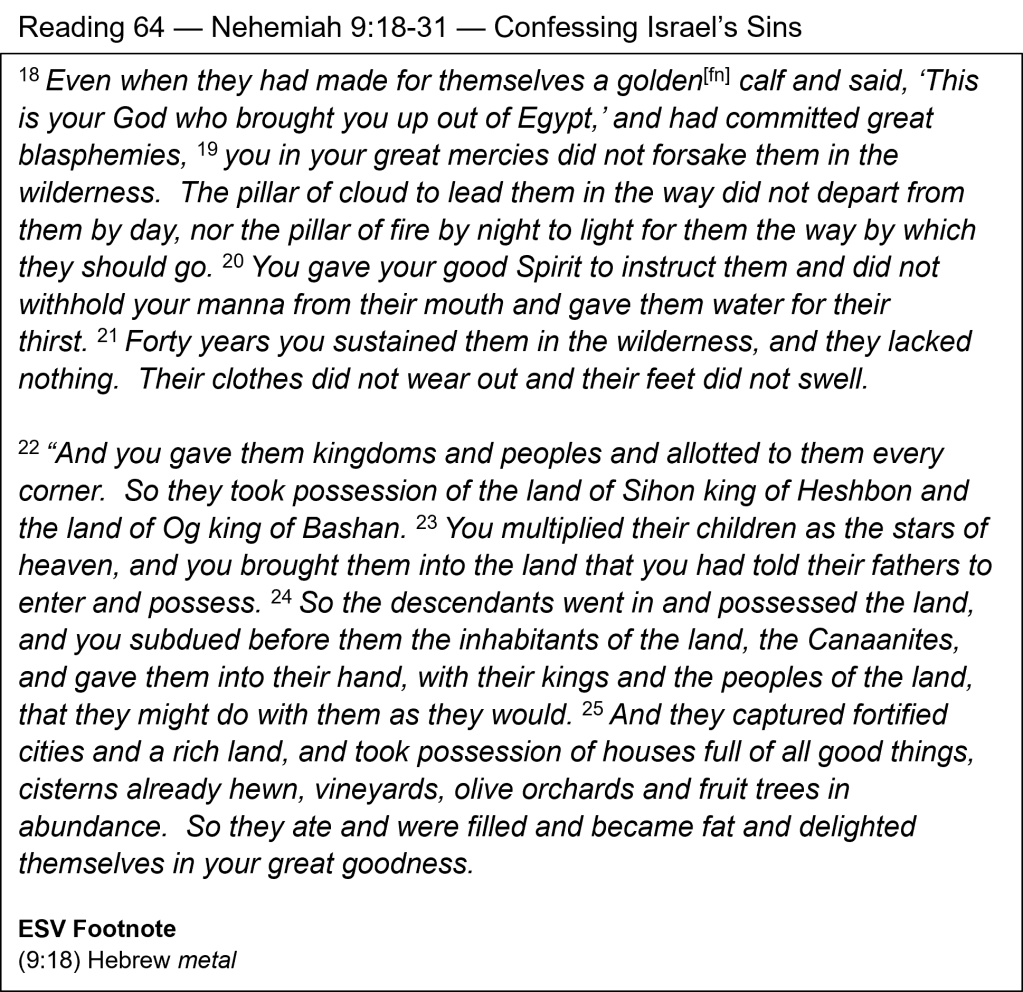
The Spirit Guides and Cautions — After many of the exiled Israelites returned from Babylon, under the leadership of Ezra (rebuilding the temple) and Nehemiah (rebuilding Jerusalem’s wall), they had a huge dedication ceremony to confess their sins and seek God’s blessing. Part of the Levites’ summary of Israel’s rebellious history was confessed in our reading for today, twice mentioning the Holy Spirit. The first time recalled how God “gave your good Spirit to instruct them” (v. 20) as they were led in the wilderness by the pillars of cloud and fire and provided with miraculously supplied manna, water, and clothes that didn’t wear out for 40 years (v. 21). How did the Spirit instruct them? Probably through the teaching of the priests and Levites, leading them in the way they should go. We are also instructed today by the Holy Spirit as we read His Inspired Word and sit under the teaching of His messengers. Through His guidance, we are told and encouraged to walk in God’s way for our own benefit. The Holy Spirit instructs us. After summarizing their many times of victory, rebellion, and defeat in the Promised Land, God’s patience was emphasized, and the second action of the Holy Spirit was mentioned: “…you bore with them and warned them by your Spirit through your prophets” (v. 30). This is more than instructing them in the way they should go, it was warning them of the consequences of disobedience. Many of the OT prophets were not well received by the people because their message was often one of warning. We don’t like to be told that we are wrong. It strikes against our pride. When we read the Scripture, however, we should pay just as much attention to the warnings as to the instructions. The Holy Spirit guides and cautions us.
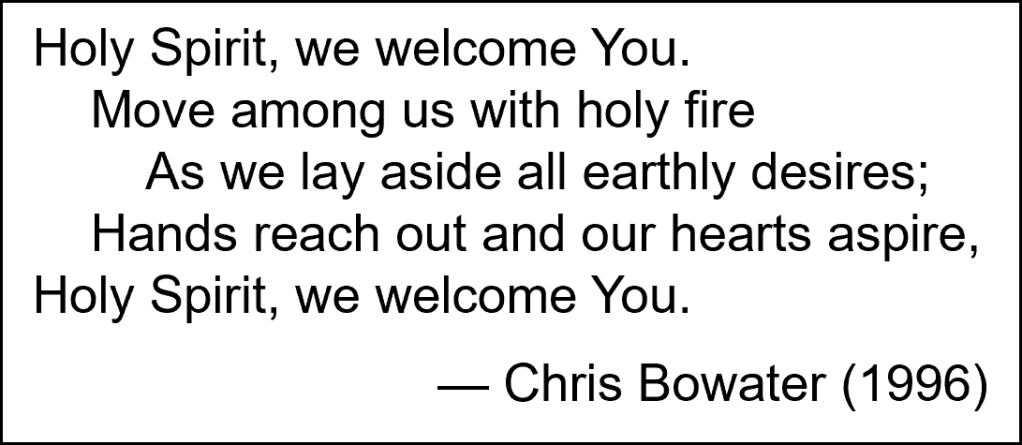
Holy Spirit, We Welcome You – YouTube
XXX
March 6, Wednesday
An audio recording of the following reading is available below.

XXX
The Creating Spirit — We need to be cautious regarding statements people make in the book of Job because even godly Job was rebuked by God in the end for some of the things he had said. The problem is even worse with his four friends who came, trying unsuccessfully to comfort and encourage him. The final visitor’s message came from the rather proud lips of young Elihu, the one speaking in today’s passage. What he said about the Holy Spirit was this: “The Spirit of God has made me…” (v. 4), and figuratively, that he “was pinched off from a piece of clay” (v. 6). Was the Holy Spirit involved in how we were created? We learned earlier from Isaiah 11:2 that one of the names for the Holy Spirit is “the Spirit of … might,” showing that He is very powerful. We also read that He was present at the time of Creation, where Genesis 1:2 says, “And the Spirit of God was hovering over the face of the waters.” It is sometimes hard to separate the three Persons of Yahweh. Although they have different roles, they are One in essence and act together in a united purpose. Before David wrote in Psalm 139:13 about his own “creation,” saying, “… you knitted me together in my mother’s womb,” he mentioned the Holy Spirit: “Where shall I go from your Spirit?” (v. 7). Other statements in the Bible do seem to support the truth of Elihu’s statement that “The Spirit of God has made me…” We will read later that the Holy Spirit is certainly involved in “re-creation” as He works in our hearts to gradually change us into the likeness of Christ.
This song may be sung to the tune of “Crown Him with Many Crowns,”
as provided, without visual lyrics, at Come, Holy Spirit, Come! – YouTube

XXX
March 7, Thursday
An audio recording of the following reading is available below.
XXX
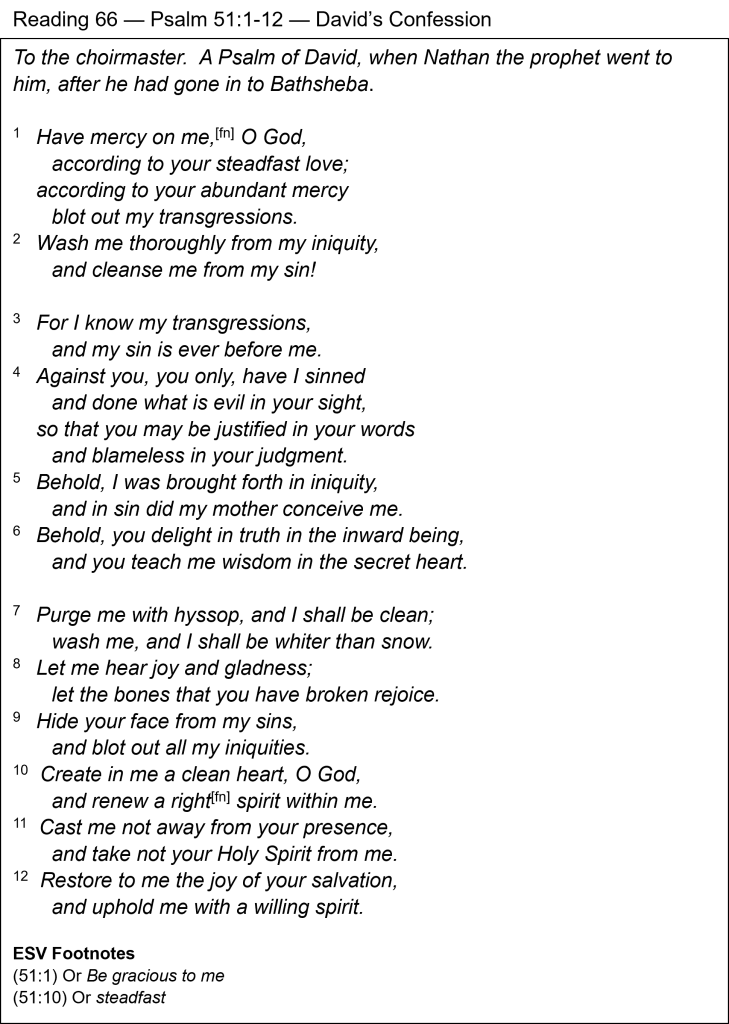
The Spirit-changing Spirit — David’s sin with Bathsheba and his arranging for her husband’s death was horrible, something that one would want to remain hidden, yet David not only confessed it to God, but wrote a psalm about it to be sung by congregations of people for their instruction and warning. He was thoroughly repentant. The last three verses of our reading for today use the word “spirit” three times but not in the same way. The first and last refer to David’s own spirit, asking God to “renew a right spirit within me” (v. 10) and to restore to him “a willing spirit” (v. 12). That is also what God does to us when we humbly confess our sin and turn from it in repentance and to God in surrender. A “right spirit” is one that knows what is right and is consistent in practicing it. A “willing spirit” genuinely desires to do what is right. It is a spirit that is obedient to God’s will, not out of duty or to avoid the embarrassment of being discovered in sin, but a spirit that appreciates the fact that obedience is truly good and that it benefits us in the long run. The Holy Spirit mentioned in David’s request (v. 11) was not dwelling within David as He does with us today, but was “upon him,” as it is regularly expressed in the OT. He provided divine guidance and empowerment for royal leadership. David had seen that the Spirit had been removed from King Saul, and he didn’t want it to be his experience. It was the Spirit that could change David’s attitudes, and He accomplishes the same transformation within us today.

XXX
March 8, Friday
An audio recording of the following reading is available below.

XXX
The Renewing Spirit — Two days ago, we read Elihu’s statement, “The Spirit of God has made me” (Job 33:4), and we considered the Holy Spirit’s involvement in how we were created. Our reading for today gives evidence that the Spirit is still involved in creation or, maybe better, re-creation. The picture here is more about sustaining and replenishing life. God provides food for the creatures He made, and the Spirit supplies new life to the creatures that die. Their death is described in Psalm 104:30 as happening “when you take away their breath (Heb. rûaḥ),” and that same Hebrew word is used also to point to a new generation: “When you send forth your Spirit (rûaḥ)” (v. 30a). The same Spirit of God that gave life in the initial creation, gives life to new babies that are born today. The same re-creation idea continues for living plants: “…and you renew the face of the ground” (v. 30b). The same Holy Spirit ministers to Christians, as Paul wrote that you are being “transformed by the renewal of your mind” (Rom. 12:2), that “our inner self is being renewed day by day” (2 Cor. 4:16), and that we are saved “by the washing of regeneration and renewal of the Holy Spirit” (Tit. 3:5).
Renew Me, O Eternal Light – YouTube

XXX
March 9, Saturday
An audio recording of the following reading is available below.

XXX
The Holy Name of Yahweh — I have chosen these three verses in Psalms that speak of God’s “holy name,” an expression used 44 times in the Old Testament. That name is “Yahweh,” usually replaced by “the LORD” in the ESV. That Hebrew word is derived from the verb “hāyâ,” meaning “to be,” which fits very well with the idea of God’s omnipresence. It is the same verb God used after Moses asked for His name: “I AM WHO I AM … I AM has sent me to you” (Ex. 3:13-14). Centuries later, God said through Isaiah, “I am the LORD [Yahweh]; that is my name…” (Is. 42:8). That name is holy because it represents who God is. Notice what is said about God’s name in our three statements from these psalms for today. Psalm 29:2 says that there is “glory due his name.” The word “glory” is difficult to define, but it is often used in the Bible in reference to God’s expression of Himself in a way that is visibly obvious, like a bright light or a cloud that represents His worth. Yahweh deserves honor, praise, and thanksgiving, which is the emphasis of Psalm 30:4: “Sing praises to the LORD … and give thanks to his holy name.” The magnificence we spiritually “see” of God should be expressed in song and prayer. The third verse, in Psalm 33:21, says that because “we trust in his holy name,” it results in a glad heart. We can trust in the name “Yahweh” because it represents all that He is, including His love, goodness, wisdom, and power. One more use of the “holy name” expression comes from Ezek. 39:25, where “the Lord GOD [Yahweh]” said, “I will be jealous of my holy name.” Whereas the three verses in Psalms are about what we are to consider and respond to the name Yahweh, the verse from Ezekiel speaks of how God feels about His own name. He is “jealous” about it, i.e., He is protective of it because it represents His whole character. He won’t share that glory with anyone or anything else. He alone is worthy of that name.

 accbibleread.com