
Save or print this page by clicking on “Download” below:
October 22, Sunday
An audio recording of the following reading is available below.
XXX
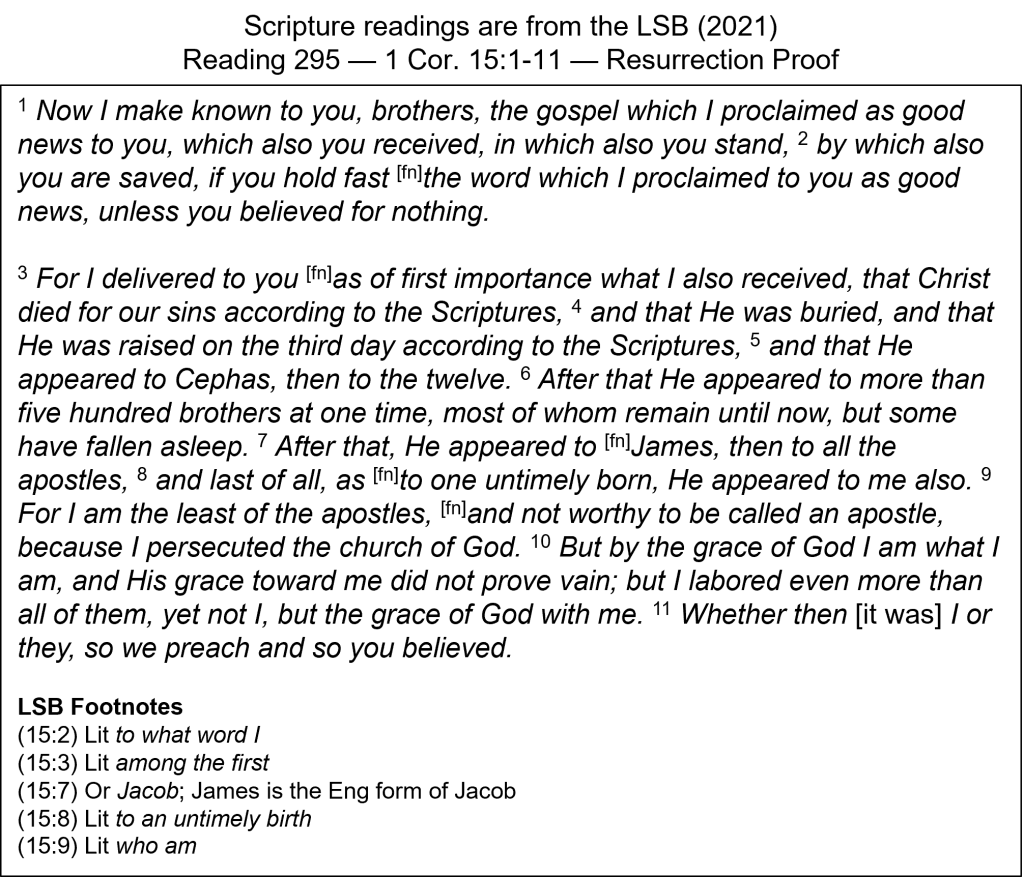
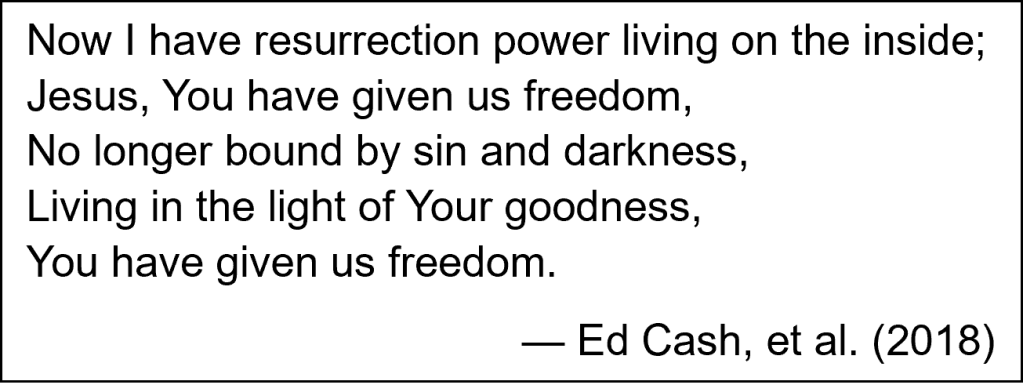
Resurrection Power — Paul began this chapter by showing that the resurrection of Jesus was the centerpiece of the powerful message of the gospel. He summarized the post-resurrection appearances of Jesus in order to present verifiable proof that He had literally been raised from the dead. Most of those to whom Jesus appeared after His resurrection were still alive at the time of Paul’s writing, so they could be interviewed. The fact of His resurrection is so important that Paul wrote later that “if Christ has not been raised, then our preaching is vain, your faith is also vain” (v. 14). Paul knew that Jesus was alive because He had seen Him and had been taught by Him. He seems to be the only non-believer to whom Christ revealed Himself in a physical form after He had been raised. The gospel message was summarized by these four important actions of Jesus: He died, was buried, was raised, and appeared to many (vv. 3-8). His death was necessary because it paid the penalty for the sins of mankind, and His resurrection was necessary because it demonstrated that Jesus was God, that His sacrifice was effective, and that His promise of our future resurrection is true.
XXX
October 23, Monday
An audio recording of the following reading is available below.
XXX
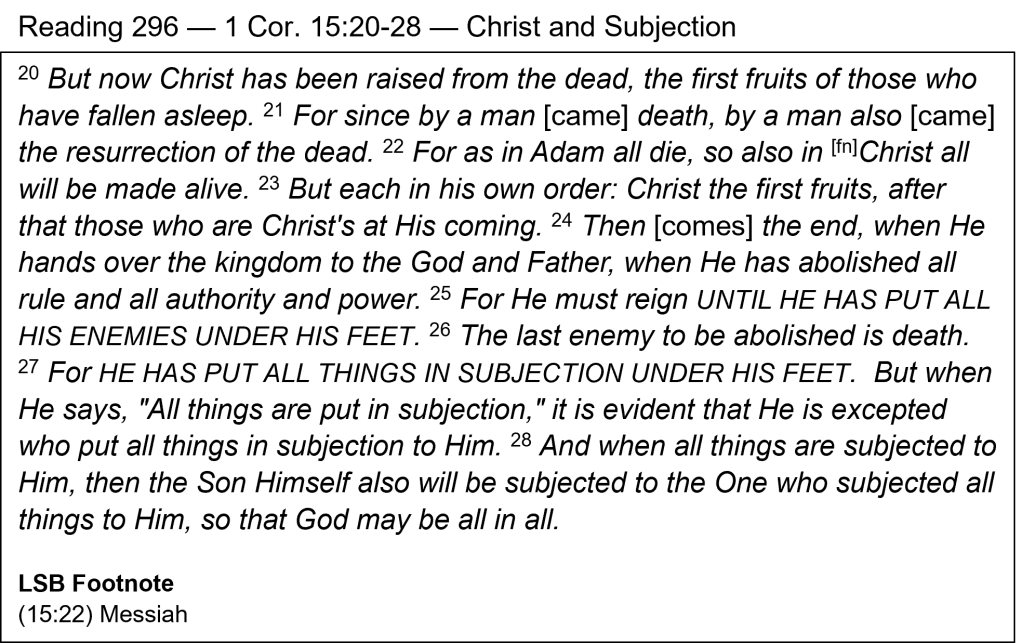
Subjecting and Subjected — We see two pictures of Jesus in this passage with respect to the verb “to subject,” a word used six times in the last two verses. First, we see Him as subjecting all things to be under His ruling control: “For He must reign until He has put all His enemies under His feet” (v. 25). That is being done in one sense even now, as people are being brought into His kingdom through faith. His reign won’t be realized completely, however, until His Second Coming when He appears for judgment. It is at that time that the final enemy of death will be abolished through the resurrection of the dead (v. 26). That is the “subjecting” Christ. Second, we see Him as subjecting Himself to the Father. He did that throughout His life on earth. Finally, at His return, “He hands over the kingdom to the God and Father…” (v. 24), and “then the Son Himself also will be subjected to the One who subjected all things to Him” (v. 28). That is the “subjected” Christ. He is our model of subjection, too. Although Jesus was God, He willingly submitted Himself to the Father. Sometimes we may resist submitting to God because it grates against what we feel is within our “rights.” If anyone had rights, it was Jesus, who was God; yet He voluntarily yielded Himself to the Father. Although He ruled, He submitted. Since He saved us, we ought to yield in submission to Him.
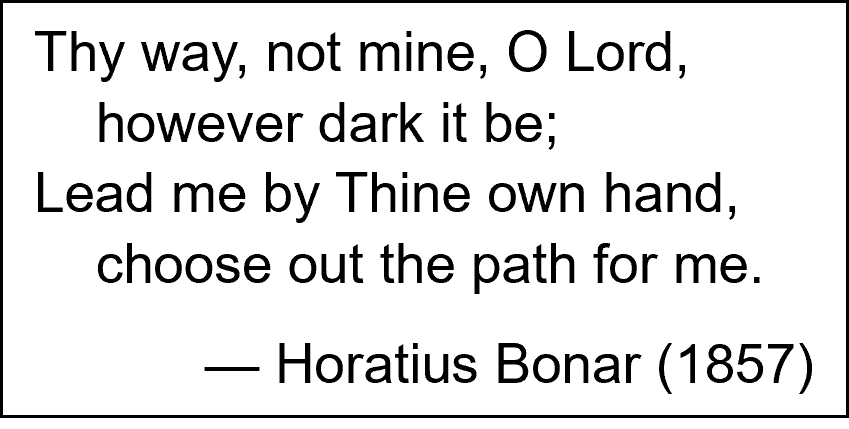
Thy Way, Not Mine, O Lord – YouTube
XXX
October 24, Tuesday
An audio recording of the following reading is available below.
XXX
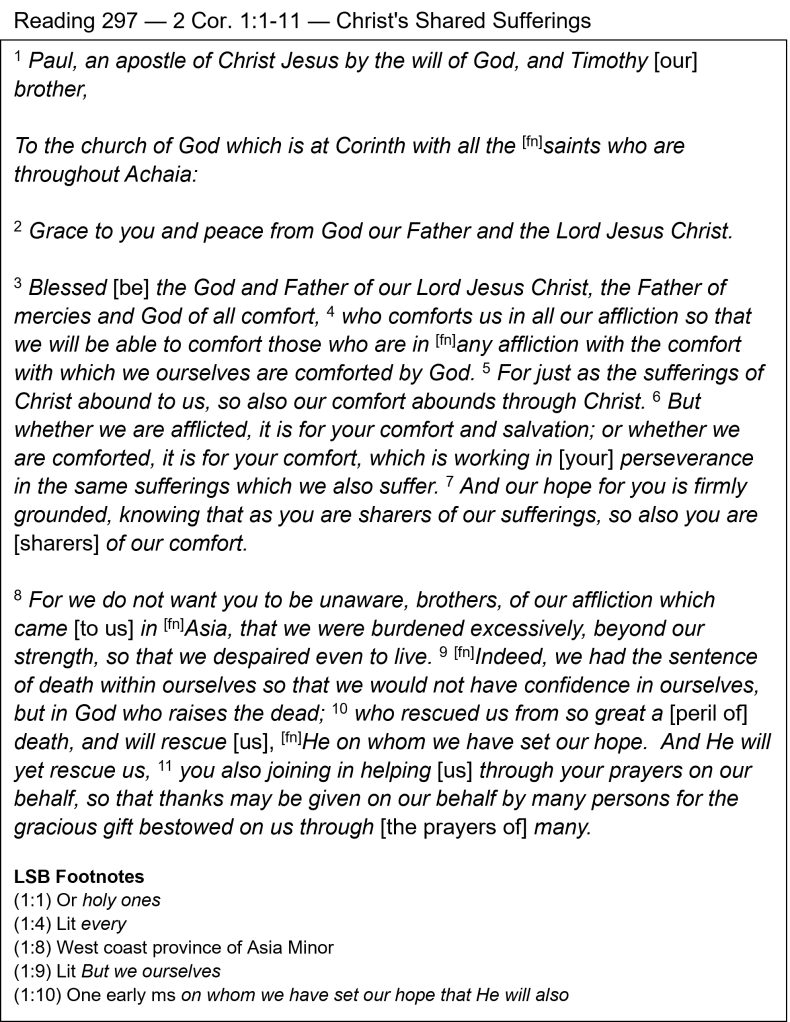
Comfort in Suffering — Following Christ is not an easy road. He challenged us to take up the cross of suffering to follow Him. Jesus told Ananias that Paul was “a chosen instrument of Mine … for I will show him how much he must suffer for My name” (Acts 9:15-16). Paul said that when he was in Asia (probably Ephesus), “we were burdened excessively, beyond our strength, so that we despaired even to live” (2 Cor. 1:8). Most of us have suffered very little because of our relationship with Christ—maybe occasional ridicule. Perhaps that is because of our rather tolerant culture or even because of our hesitancy to boldly proclaim the Good News. All of us avoid suffering because it is painful, but we Christians should anticipate it and accept it when it comes in opposition to our faith in Jesus. The positive side of suffering is that in it, “our comfort abounds through Christ” (v. 5). When we suffer for Christ, He will bring us spiritual comfort. Paul concluded this discussion with the importance of praying for those who are suffering for their faith: “…you also joining in helping us through your prayers on our behalf, so that thanks may be given … for the gracious gift bestowed on us through the prayers of many” (v. 11). When we hear of someone who is suffering because of their stand for Christ, we should bring them and their needs to God in prayer. He will bring comfort in the time of their suffering.
It’s Not an Easy Road – Bing video

XXX
October 25, Wednesday
An audio recording of the following reading is available below.

XXX
Christ Fulfills God’s Promises — There were many significant problems within the Corinthian church. Some of their people questioned Paul’s leadership. Here, they were accusing him of vacillating in his plans regarding how he was going to visit them again, or even worse, saying “yes” when he meant “no,” and vice versa. Paul’s plans did change, but as he indicated at the end of the chapter, it was “to spare you” punishment (v. 23), and it was ultimately “for your joy” (v. 24) that he didn’t come when he had planned to. To some of the Corinthian Christians, Paul was not keeping his promises. In contrast, in the middle of this discussion, Paul focused on the faithful promises of God: “…as many as are the promises of God, in Him they are yes” (v. 20) or as the ESV translates it, “…all the promises of God find their Yes in him.” All the OT promises God made concerning the Messiah’s first coming were fulfilled as predicted during Jesus’ life on earth. All the promises Jesus made to His disciples have come true or are still awaiting fulfilment. All the promises made by God through His inspired writers of the New Testament can be trusted. Those promises were made by the infinitely knowledgeable Yahweh, who can already see how things will turn out in the future. We can trust His promises.

XXX
October 26, Thursday
An audio recording of the following reading is available below.
XXX
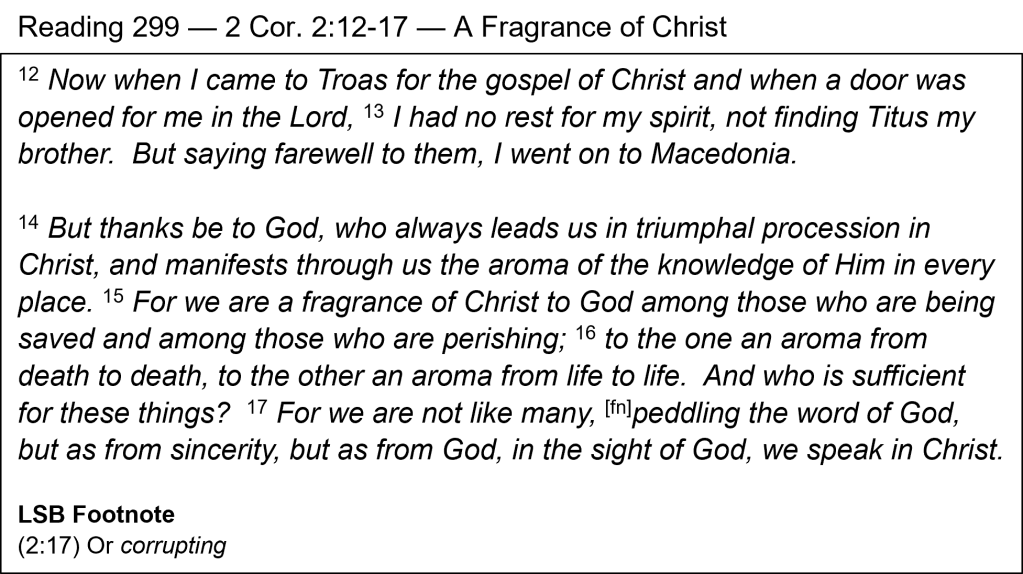
Sweet-smelling Victor — Instead of going directly to Corinth from Ephesus, Paul sent Titus to them, apparently with the “tearful letter” (mentioned earlier in vs. 4), and then Paul travelled north to Troas where Titus was supposed to meet him. With growing concern, Paul sailed across to Philippi in Macedonia, where he finally found Titus, along with the good news that the Corinthians had responded well. This is why Paul wrote here, “thanks be to God” (2:14). He was encouraged by the subtle work of Christ despite all his concern. In response, Paul presented two pictures of Christ. The first was that of Jesus being at the center of a victory celebration, a “triumphal procession in Christ” (v. 14). Although Paul felt concern, Christ was not only always in control, but He was victorious. We should also remember that in our times of discouragement or not seeing things happen as we think they should. Our Leader is working out His victorious plan in our lives and in our circumstances. The second picture of Christ is one of being a pleasing sacrifice, presenting “a fragrance of Christ to God” (v. 15). As the OT sacrifices were accepted by God as a pleasing sacrifice, so the Lamb of God and His work through the Church was bringing pleasure to the Father. What does it smell like to humans? To the unbelievers, it stinks, and will result in their eternal destruction, but to believers, it is the breath of life.
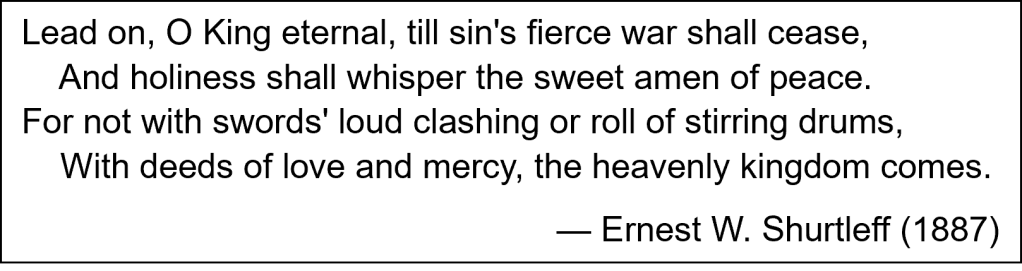
Lead On, O King Eternal – YouTube
XXX
October 27, Friday
An audio recording of the following reading is available below.

XXX
With Unveiled Face — When Moses came down from hearing the commands of God on Mt. Sinai, “his face shown, and they were afraid to come near him” (Ex. 34:30), so Moses put a veil over his face. The veil hid God’s glory. Paul took this purpose one step further in our passage by saying that the veil was not only still hiding the glory of the old covenant’s message, but also hides the fact that it was gradually fading, symbolizing the temporary nature of the old covenant. The OT pointed to the coming Messiah, but most first-century Jews did not recognize or accept Jesus as the fulfillment of those prophecies. When anyone does accept Christ, however, “THE VEIL IS TAKEN AWAY” (2 Cor. 3:16). Paul describes us NT believers as those “with unveiled face” (v. 18). There is no shield to our being exposed to all the glory God wants to show us in His Word. As a bonus, God uses our focus on Him to have a transforming effect on our lives as we are gradually being changed into the godly person He wants us to be—like His Son.
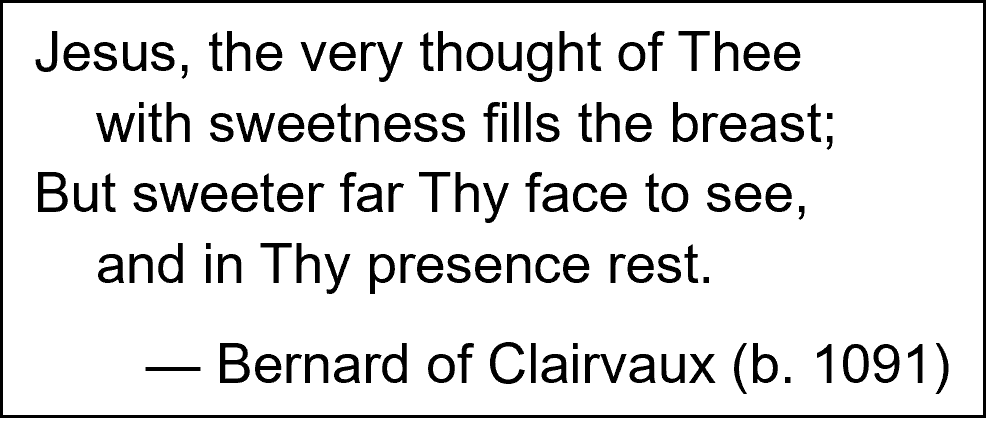
Jesus, the Very Thought of Thee – YouTube
XXX
October 28, Saturday
An audio recording of the following reading is available below.

XXX
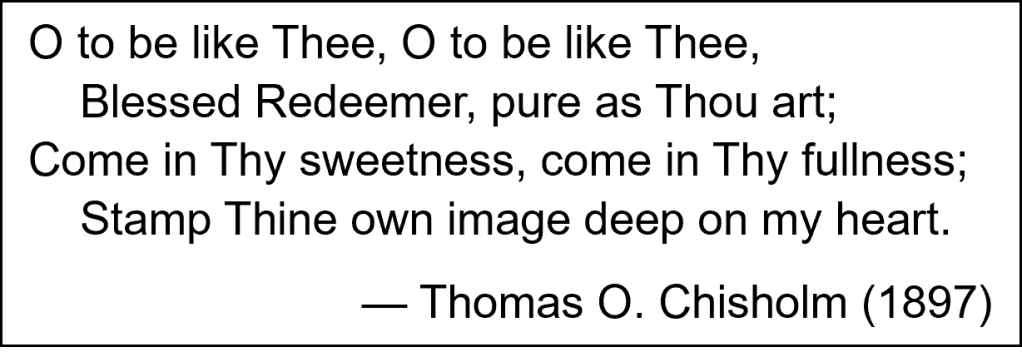
Jesus, the Light — There is much about light and sight in this passage. Paul showed the importance of living openly “in the sight of God” (v. 2). This is a statement about honesty; we are not to try to impress or deceive others. On the negative side, there is the Satan-caused blindness of most of the world, which prevents people from seeing “the light of the gospel … the glory of Christ … the image of God” (v. 4). The Lord wants people to see Him, to discover the brilliance of who He is. Jesus is the image of God, as He told Philip earlier, “He who has seen Me has seen the Father” (John 14:9). The Creator of light wants us to see Him in the Person of His Son, so He shines His light into our hearts to spotlight divine knowledge so we can see “the glory of God in the face of Christ” (2 Cor. 4:6). We must seek that light, recognize its divine nature, and glean from what it reveals to us. We are to be like Him who is the image of God.
 accbibleread.com