Save or print this page by clicking on “Download” below:
October 15, Sunday
An audio recording of the following reading is available below.

XXX
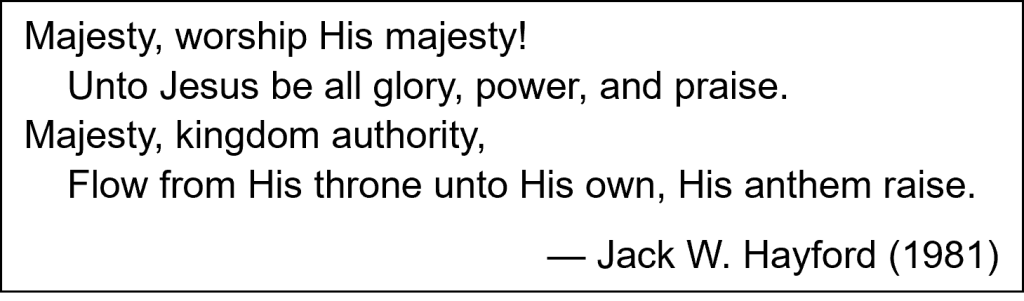
Majesty and Power — In addition to preaching the gospel to all people groups, here is another event that must occur before Christ’s return because this passage states that “…the coming of our Lord Jesus Christ … has not come unless the apostasy comes first” (vv. 1, 3). This “man of lawlessness” will exalt himself as being the ultimate “object of worship” (v. 4), presenting the final human “showdown” against God. The glory and majesty of Jesus in His coming will so brilliantly outshine the human imposter, that people who have followed him will immediately recognize their error and that their judgment is deserved. This will clearly separate those who “did not receive the love of the truth so as to be saved” (v. 10). Then, this “lawless one” will be exposed and slain with ease by Jesus at His coming. Slaying him by “the breath of His mouth” (v. 8) shows the infinite power of Christ.
XXX
October 16, Monday
An audio recording of the following reading is available below.
XXX
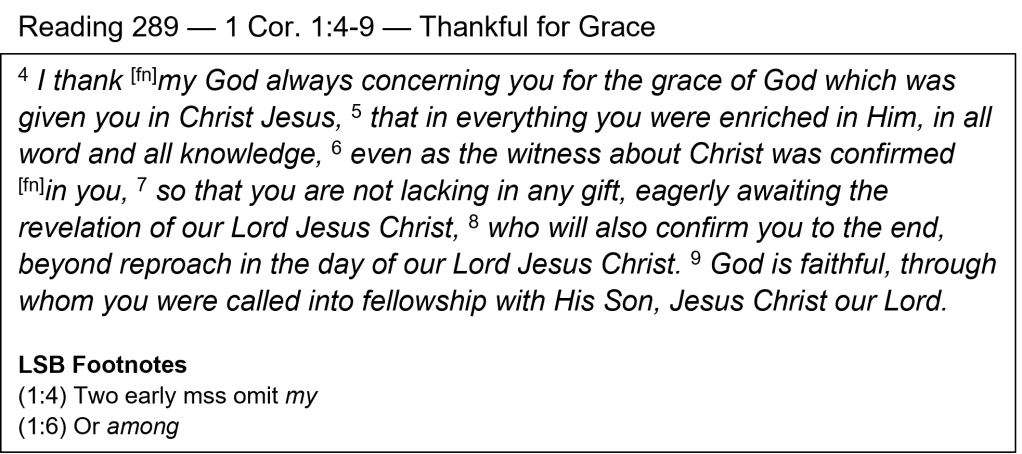
Enriched and Confirmed — The Corinthian Christians were given spiritual gifts just as we have, but they often misused them in selfish and prideful ways that created conflicts within the church. They “were enriched” by these gifts (v. 5). The Greek word for “enriched” is used only two other times in the New Testament, both in 2 Corinthians. One shows contrasts going on in a Christian’s life: “… sorrowful but always rejoicing, as poor but making many rich, as having nothing and yet possessing all things” (2 Cor. 6:10, emphasis added). Although we may be poor materially, we can enrich others by giving to them spiritually. We can also give to others materially, as Paul mentions in the context of the Corinthians’ responsibility to support those who minister to them professionally: “you will be enriched in everything for all generosity” (2 Cor. 9:11). Jesus enriches us so that we can enrich others. In this passage, Jesus not only enriches us, but He also confirms us, mentioned twice here. It is sometimes translated, “establish,” “make firm,” or “make sure.” The first confirmation mentioned here is that “the witness about Christ was confirmed in you” (v. 6). The message took root and produced fruit, proving that Jesus was dwelling within them. We also receive that confirmation when we are born again by the Spirit. Paul said that “our Lord Jesus Christ … will also confirm you to the end” (v. 8). That indwelling confirmation of our salvation will stay with us forever because we are secure in Christ’s righteousness. We are established, made firm, and made sure in Him.
I Know Whom I Have Believed – YouTube

XXX
October 17, Tuesday
An audio recording of the following reading is available below.

XXX
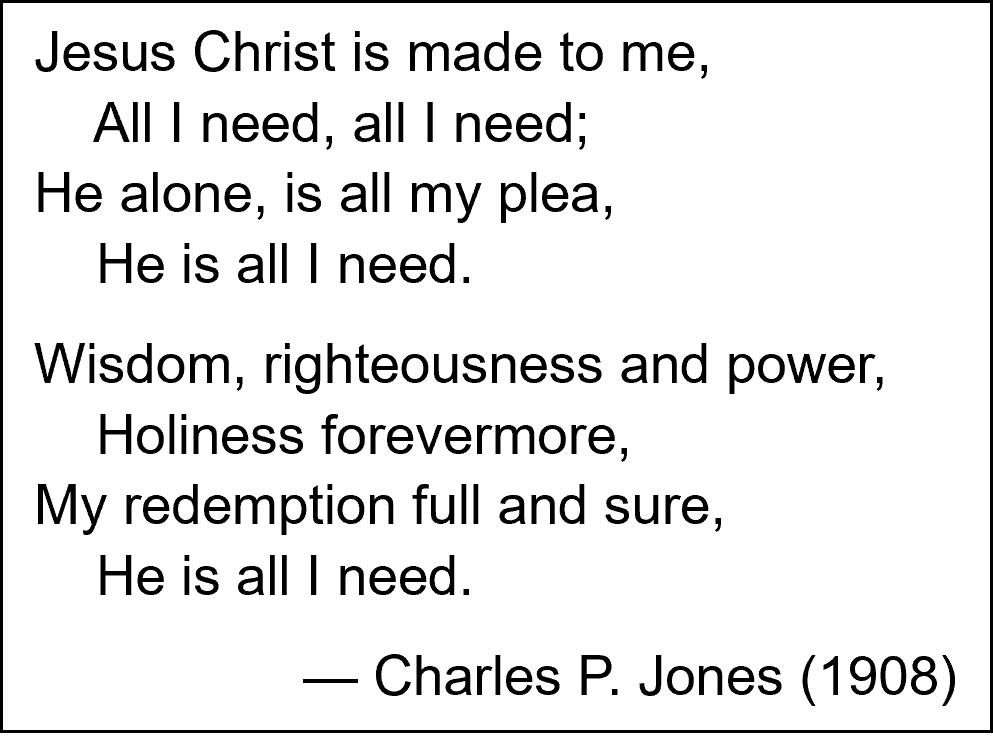
Upside-Down Choices — God intentionally chooses things that are not seen as valuable to the world. He chose His Messiah to be born where animals spend the night. He had the King of kings sacrificed on a cross by evil men, which is “foolishness” to the world (v. 18). He also chose us, and many of us came to trust in Him when we were still “unwise” but humble children. He passed over most Greeks, who prided themselves in their cultured wisdom, and He chose us simply because we believed “the message preached” (v. 21). All this was “by His doing” (v. 30) so that “no flesh may boast before God” (v. 29). All this was done so that Christ might become “to us wisdom from God, and righteousness and sanctification, and redemption” (v. 30). We exchange our own claim to wisdom with wisdom that comes only from God. We exchange our own attempts to do what is right with Jesus’ righteousness. Our own attempts to be holy are abandoned in favor of accepting His sanctification. We exchange our own efforts to do enough good things to gain God’s acceptance with the purchase of redemption that Jesus paid on the cross. The world’s values are diametrically opposite what is valuable to God because the world is led by the efforts of Satan, who intentionally opposes what God values.
XXX
October 18, Wednesday
An audio recording of the following reading is available below.
XXX
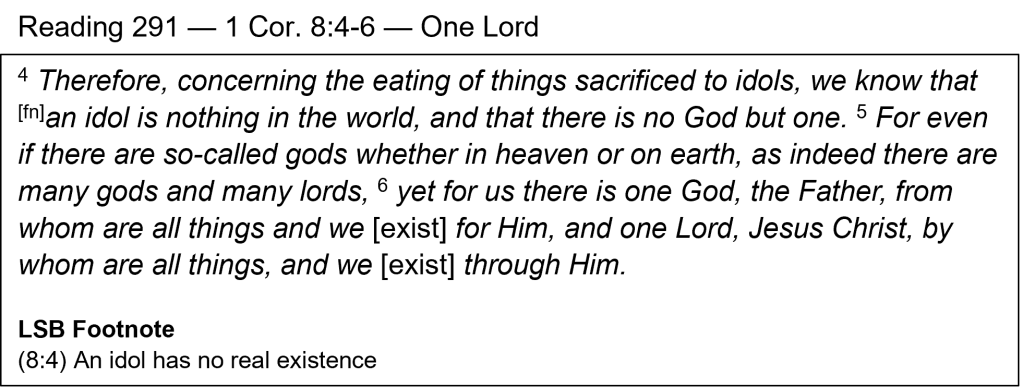
For God, Through Christ — The Corinthian Christians had asked Paul whether it was acceptable to eat meat that had been sacrificed to a pagan god and then sold in the marketplace. He will later explain that it is not wrong to eat that meat unless, by your public eating of it, other believers are offended because they consider it to be wrong. In our paragraph for today, Paul emphasized the unity of the Godhead—one complex God (“…there is one God, the Father … and one Lord, Jesus Christ”—v. 6). There are some interesting and important uses of prepositions in verse 6. All things come from the Father and all things come by Christ, i.e., the Father is the source of Creation, and the Son is the means of Creation. Since we are part of Creation, we exist for the Father and through the Son. The Father caused us to be created for His own glory, and Christ gave us both physical life and spiritual life. Please meditate on this today: through Christ, I exist for God. We don’t exist for our own pleasure, for our position in our family, for our occupation, or even for our ministry; we exist for God.

XXX
October 19, Thursday
An audio recording of the following reading is available below.

XXX
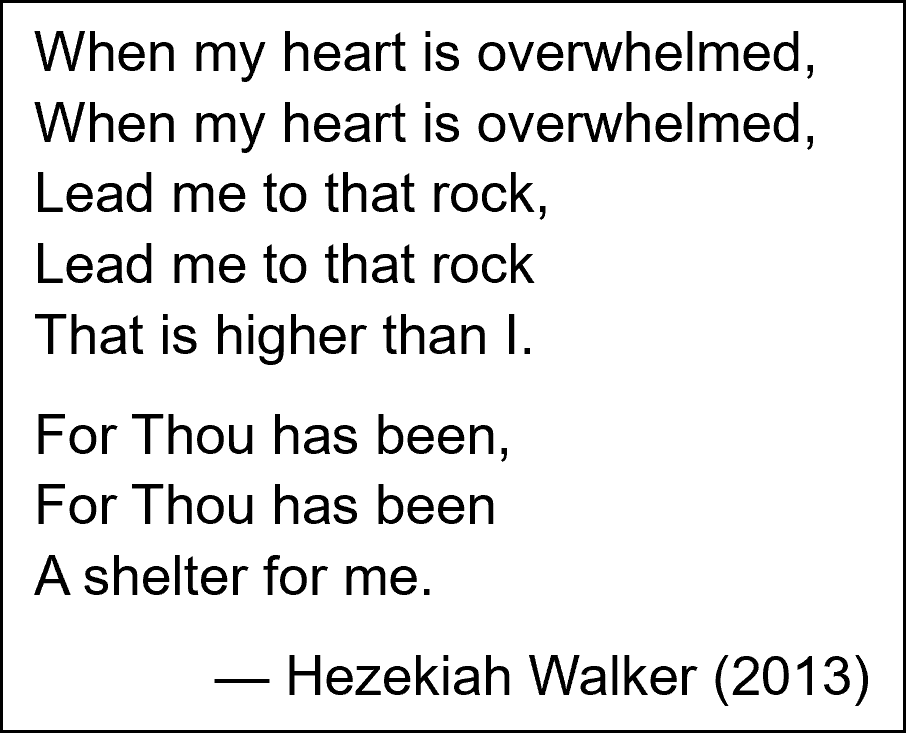
Christ’s Presence and Provision — When the people of Israel escaped slavery in Egypt, God led them by means of a moving cloud and by opening the Red Sea. The cloud was not only their guide but also a symbol of God’s presence. God also miraculously provided manna to eat and water to drink, which was evidence of God’s provision. Twice during their 40-year wandering, Moses caused water to pour out from a rock by striking it with his staff, once near the beginning of their wanderings (Ex. 17:6) and again near the end (Num. 20:11). In today’s reading, Paul identified this water-giving Rock as Christ (1 Cor. 10:4), who “followed them,” showing both His presence and His provision. Jesus continues to walk with us and provide for us today. Drinking from the living water of His Word gives us what we need and protects us from the rebellious and disobedient attitudes that plagued the wandering Hebrews. God is often referred to as a rock in the OT, six times being called, “the rock of … salvation.” David prayed, “Lead me to the rock that is higher than I” (Ps. 61:2). He is our source.
Lead Me to That Rock – YouTube
XXX
October 20, Friday
An audio recording of the following reading is available below.
XXX
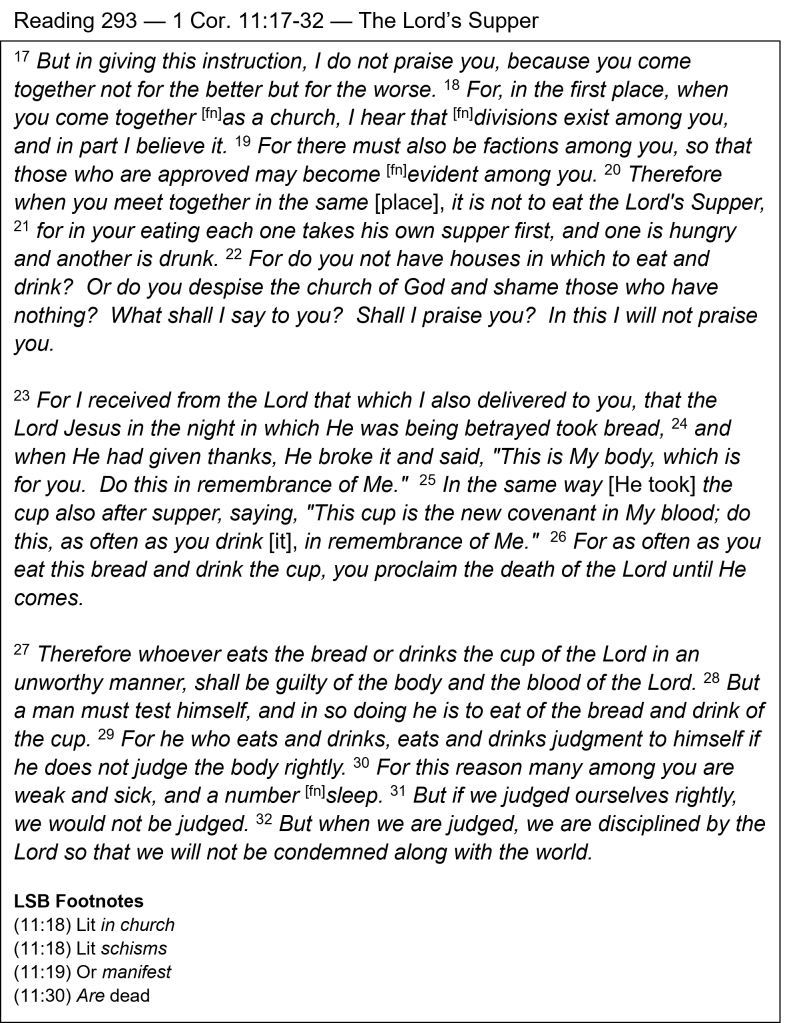
Sacred Table — Paul’s review of Jesus’ institution of the Lord’s Supper emphasized the sacredness of the event. First, he said that it should reflect unselfishness. The Corinthians had let it develop into a party time, focusing on themselves to the neglect of poorer people who came with little or no food. It was a non-sharing potluck meal. Everything about Christ’s death on the cross displayed sacrifice, unselfishly doing something good for others. It was shameful to celebrate Christ’s sacrifice with a selfish meal. The Lord’s Supper was meant to be a sacred ceremony. Second, Paul said it should reflect thanksgiving. It should be done “in remembrance of Me” (vv. 24-25). Jesus died for me! His love, willingness to suffer, and forgiveness were all involved in His death. He paid my penalty! Our participation in this regular ceremony should be done with deep gratitude for what He did for us. Third, Paul said that it should reflect the message because through it we “proclaim the death of the Lord” (v. 26). It is evangelistic, demonstrating to those uncommitted people in attendance that Jesus died for sinners, and forgiveness is offered through His sacrifice. Fourth, Paul said that it should reflect sincerity. We are not to partake of it “in an unworthy manner” (v. 27), but each one “must test himself” (v. 28) and “judge … rightly” (v. 29). It should be a time of confession and repentance. It is more than a religious ceremony; it is a sacred time for sincere turning, for appreciating His loving, unselfish sacrifice for us. It is a sacred event.

XXX
October 21, Saturday
An audio recording of the following reading is available below.

XXX
Many Members — The unity of the Church of Christ is the focus of this passage, and it is based on the oneness of Christ. The Church should be composed of harmoniously functioning races and social classes (“Jews or Greeks … slaves or free”—v. 13). Believers are given spiritual gifts, not to stand out as special, but to unite. As Christ is one, so is His body, the Church, to be one (v. 12). Some of His gifts result in certain believers being more obvious or public, like gifts of evangelism, leadership, or teaching. That doesn’t make them better than others, however. Gifts like service (or helps) and encouragement are normally used behind the scenes, but that doesn’t make them less valuable. Jesus unites believers together to make our fellowship and ministry more cooperative and effective. We are one in Christ. How has God gifted you? You have natural gifts as well as spiritual gifts. Have you found a ministry niche in which to use them? We need to use our gifts to enhance the effective function of His Church.
Your Hand, O God Has Guided – Bing video

 accbibleread.com