
Save or print this page by clicking on “Download” below:
August 6, Sunday
An audio recording of the following reading is available below.
xxx
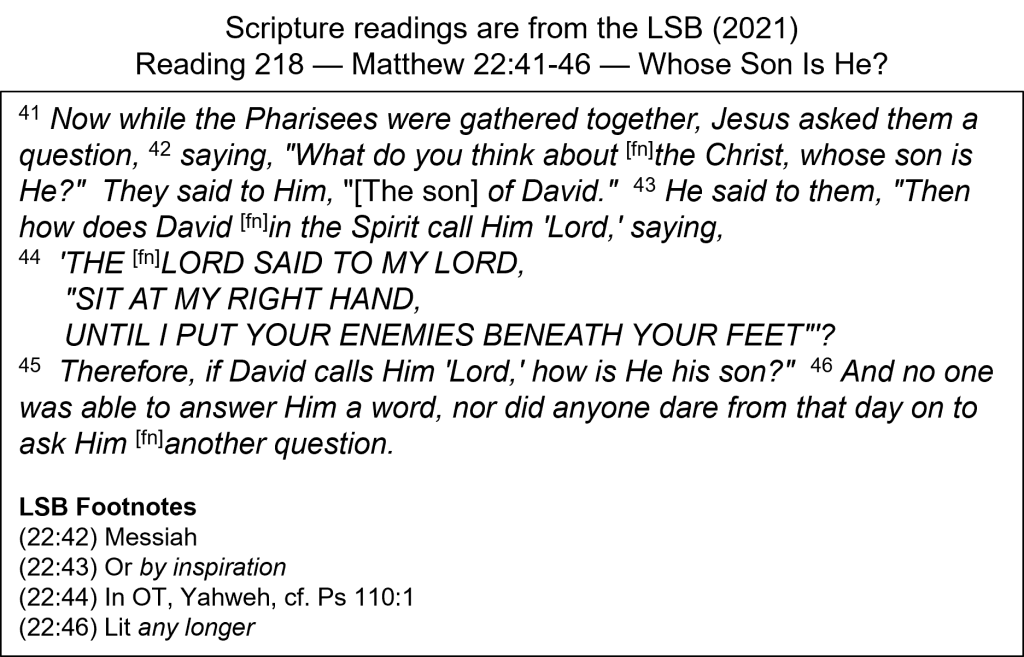
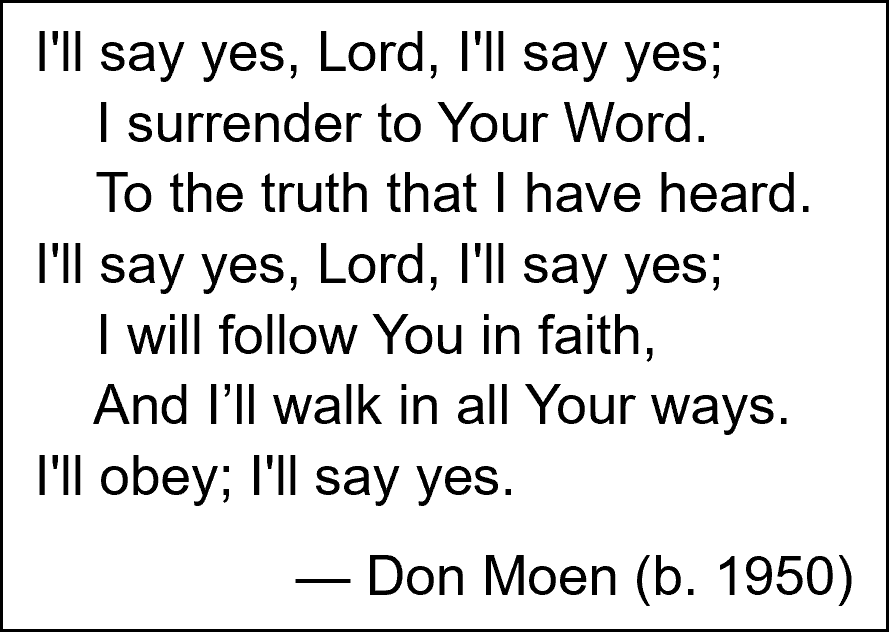
Not a Word — After the Jewish leaders asked Jesus difficult questions, He took the offensive and asked them this basic question: “How can David call his own son ‘Lord’?” Jesus reminded them that David spoke this “in the Spirit” (v. 43), so that statement (from Psa. 110:1) was inspired by God and could not be refused. They could not doubt the truth of what David wrote. David could call his son “Lord” only if his son were above him. The correct answer would have been that David’s predicted descendant would not only be the Messiah but would also have to be divine. He would be God in the flesh. The Pharisee group was stumped (“…no one was able to answer Him a word”—v. 46). They had been stopped, not simply by a very smart teacher but by the Son of God Himself. It is sometimes tempting for us to question some things we read in Scripture that are difficult to understand or difficult to do. We want to say, “Yes, but…,” and offer our excuses when we should remain silent. Our “Yes, but…” should become, “Yes, Lord.”
xxx
August 7, Monday
An audio recording of the following reading is available below.
xxx
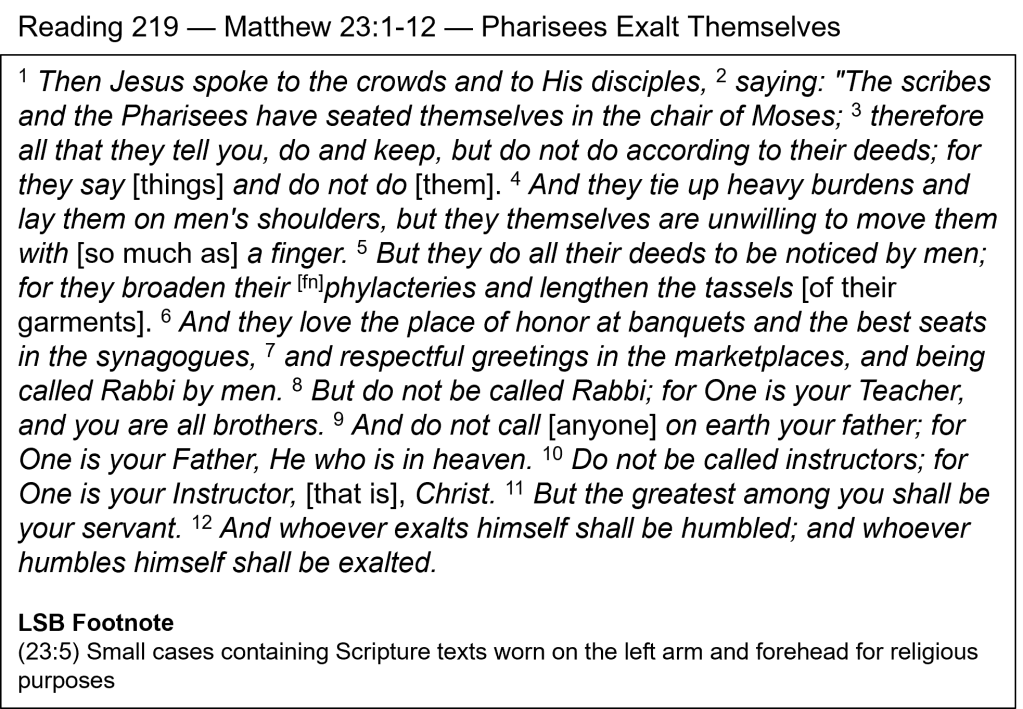
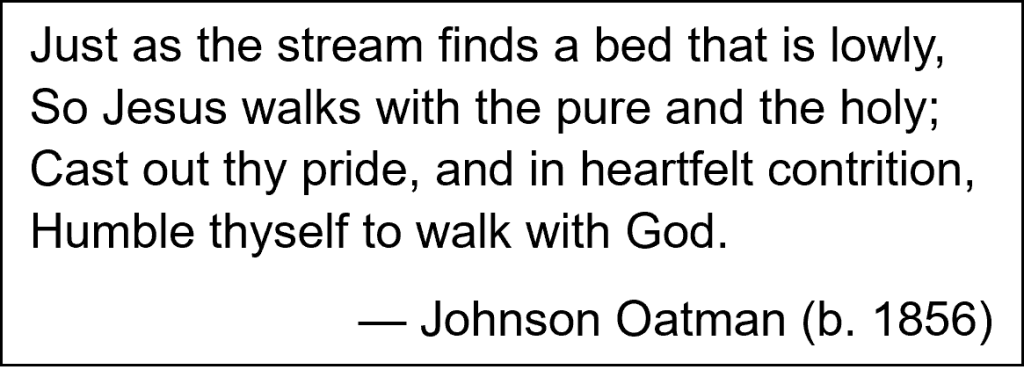
All About Pride — As we will read tomorrow, some of the scribes and Pharisees were apparently still present when Jesus told the “crowds and … disciples” (v. 1) about how they should relate to those leaders. Jesus had called them hypocrites to their faces, and now He shows His followers additional evidence. They should follow the leaders’ teaching regarding what Moses wrote, but not about what they had added in the form of tradition. They also should not follow their example because they were hypocrites, putting on a false show of superior righteousness and status. Motivated by pride, they scrambled for honor. That attitude is certainly prevalent in our modern culture, too. We sometimes even see it within our churches, which is directly disobedient to Christ’s command. When it happens, it is because we have allowed our sinful nature to rise above Jesus’ instruction, and it has negative consequences, i.e., “whoever exalts himself shall be humbled” (v. 12a). Do we really want to be publicly shamed? What Jesus wants us to do is to purposely and willingly humble ourselves, so He can exalt us (v. 12b). We must place Jesus as our perfect example. He said, “I am gentle and humble in heart” (Matt. 11:29).
Humble Thyself and Walk with God – YouTube
xxx
August 8, Tuesday
An audio recording of the following reading is available below.
xxx
xxx
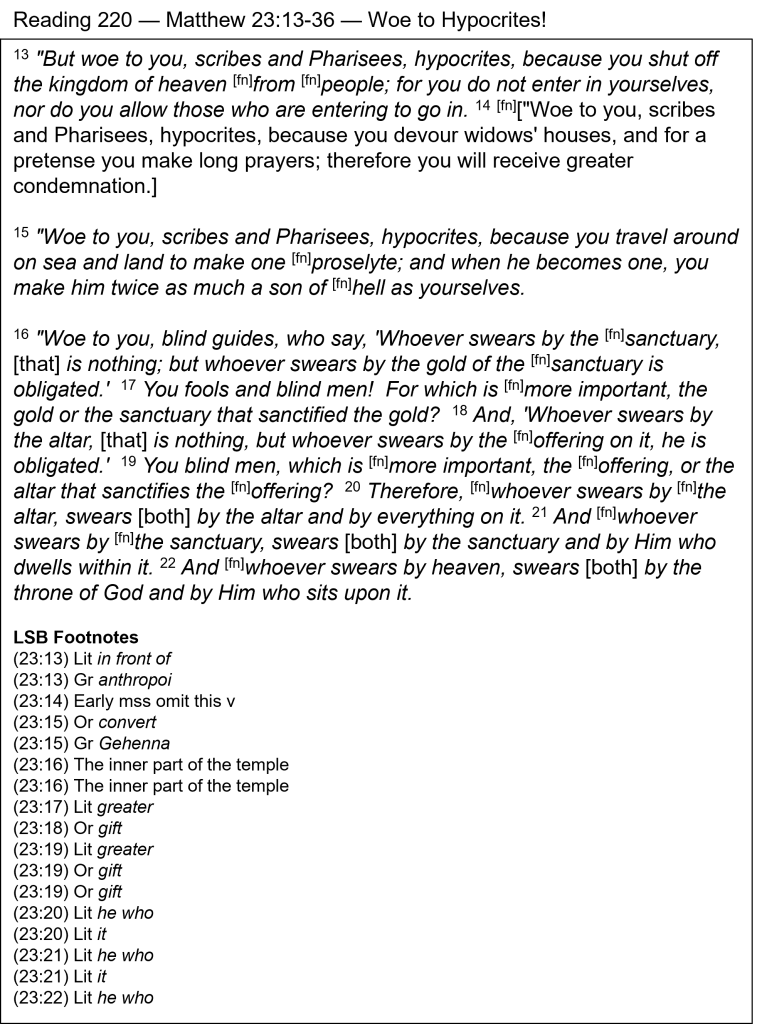
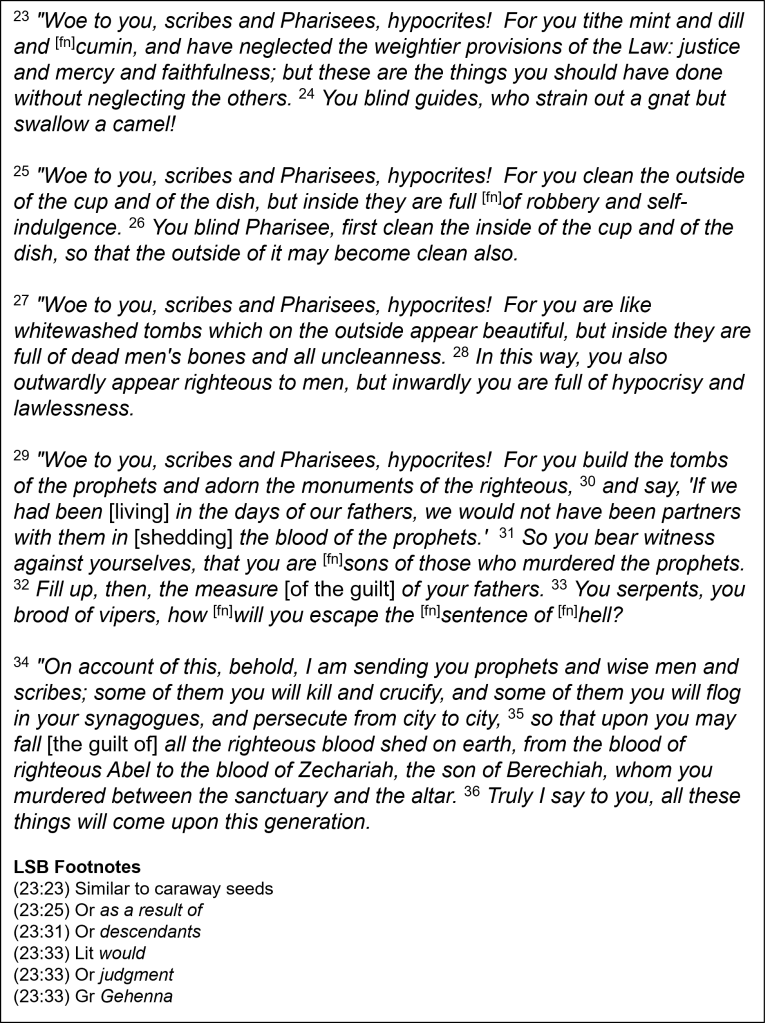
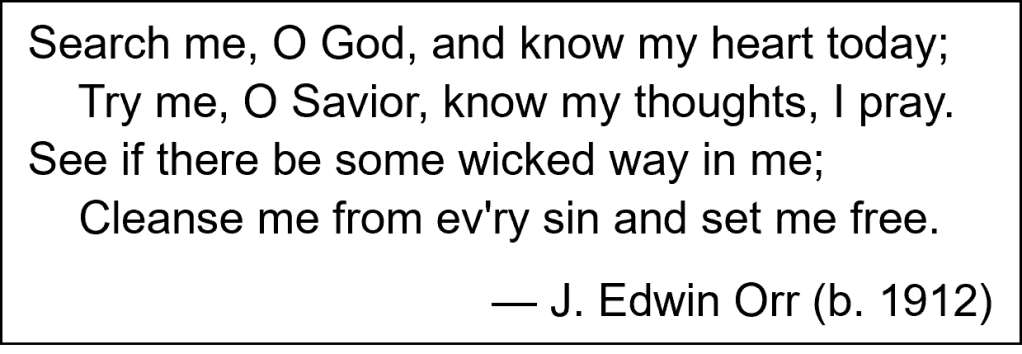
The Lion of Judah — We read yesterday that Jesus was gentle and humble at heart. With the lost and hurting, He was like a lamb. On the other hand, He was also aggressively bold and accusing at times. With the Jewish leaders, He was like a lion. Seven times in today’s passage, He declared, “Woe to you!” This expression contains sorrow as well as condemnation. He cared for these hardened opponents, but He had to use painful words of warning to try to wake them up to the truth. It was like crying out, “Please stop it!” He was speaking to the religious leaders of the people, and they were leading the people astray rather than toward God. They were burdening them with nonessential requirements and focusing on minute details, rather than much more important things that God commanded. Their hypocrisy was like dressing up pigs, futilely attempting to appear better than they were. In the end, they were murderous. Like their fathers, they were in the process of scheming to kill Jesus, the most righteous man who ever lived. They would do the same to Jesus’ followers later. I wonder if Saul was in the crowd that day. If so, he didn’t take the warning to heart until Jesus met him on the road to Damascus several months later. If you have time, read through this passage again and see to what degree you see yourself in some of those hypocritical attitudes the scribes and Pharisees had. Ask God to show you where you are lacking and to help you change.
xxx
August 9, Wednesday
An audio recording of the following reading is available below.
xxx
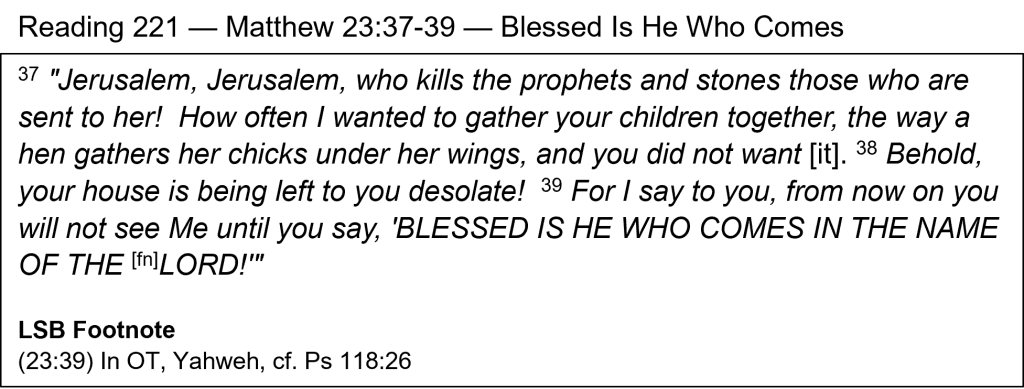
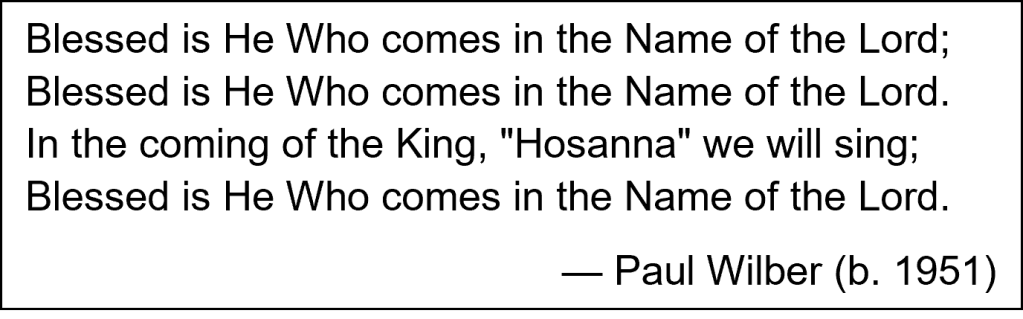
Left Desolate — This is the second time Jesus made this statement about wanting to gather the people of Jerusalem under His wings for comfort and protection (cf. Luke 13:31-35). He repeated it again as He approached His death. It shows the sad, but loving, heart of Jesus. He came to offer salvation to the Jewish people, but most of them refused the offer. The psalmist said, “The stone which the builders rejected has become the chief cornerstone” (Psa. 118:22). The stones of the beautiful temple Herod had built for the Jews would be destroyed in A.D. 70 by the Romans, and the spiritual “house” of Israel would be left desolate (Matt. 23:38). The final quote from Jesus in today’s paragraph comes a few verses later in the same psalm: “Blessed is the one who comes in the name of Yahweh” (Psa. 118:26). There will be a great turning of the Jews to Christ at the end, and when He returns, many of them will be exclaiming praise to the One whose fathers had rejected Him in Jerusalem.
This song was written by a Jewish Christian
(In the song, baruch haba = welcome; Yeshua = Jesus)
Blessed Is He Who Comes – YouTube
xxx
August 10, Thursday
An audio recording of the following reading is available below.

xxx
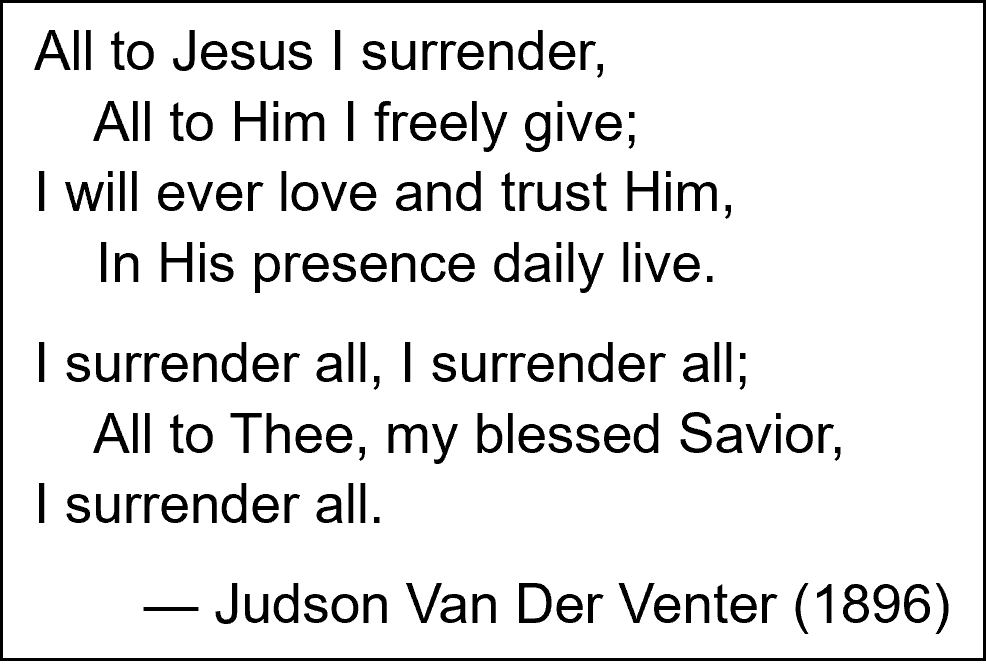
Surplus or Sacrifice? — The treasury was in the women’s section of the temple, where people voluntarily contributed money to pay for things needed for worship, like wood for the altar sacrifices. Jesus showed Himself to be an omniscient teacher in this story. He intentionally sat down to watch “how the crowd” was giving (v. 41), with the apparent purpose of teaching His disciples about sacrifice. Notice these contrasts: 1) “many rich people” vs. one “poor widow,” 2) “large sums” vs. “two lepta” (small Greek coins), and 3) “surplus” vs. “all she had.” The rich people were probably obvious from their clothing, and it would be assumed that the large amounts they were giving came from their surplus. The widow-status of the woman may also have been obvious by peculiar clothing worn only by widows, but only she and Jesus would have known that she “put in all she owned, all she had to live on” (v. 44). He was omniscient, knowing all things. Most people were giving from their surplus, while she was giving sacrificially out of her poverty. The fact that Jesus called His disciples together to point this out to them was intended both to praise her action and to teach them the value of sacrifice. Have you given sacrificially? I don’t remember ever emptying my wallet through giving. The greatest sacrifice most of us make is probably to intentionally give what we planned to use for ourselves. We need to remember that Jesus praised sacrificial giving. It still pleases Him.
All to Jesus I Surrender – YouTube
xxx
August 11, Friday
An audio recording of the following reading is available below.

xxx
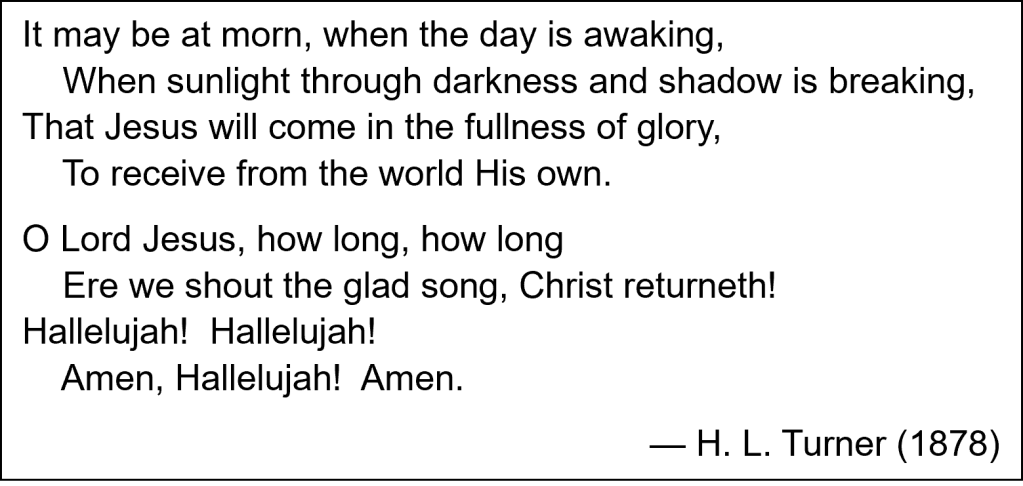
What and When — The first temple in Jerusalem was built by King Solomon, and it was beautiful. It was destroyed almost 400 years later by the Babylonians. After Israel’s captivity, Ezra organized the building of the second temple, which was much smaller than the first one. About 500 years later, King Herod rebuilt and greatly expanded that temple area. This magnificent structure was essentially complete by the time of Jesus’ death. No wonder one of the disciples declared, “what wonderful buildings!” Then Jesus burst his bubble by predicting its complete destruction, so that “Not one stone will be left upon another” (v. 2). He must have been referring to the temple building itself, because there remains even today the Wailing Wall, part of the western wall that surrounded the Temple Mount. Jesus could see that event in the future. That prophecy’s fulfillment of destruction would come about 40 years later when Titus led the Roman army to tear down the temple as a part of squashing a rebellion of the Jews. The other disciples heard His reply, as shown by their follow-up question about when it would happen. What follows, in our next several readings, is a lengthy message regarding not only the near-future destruction of the temple in judgment, but also the still-future judgment that will accompany the return of Christ. Jesus could see the end, so He began to tell His disciples much about what will happen and when. We are still waiting for much of that, and it seems to be getting very close.
xxx
August 12, Saturday
An audio recording of the following reading is available below.

xxx
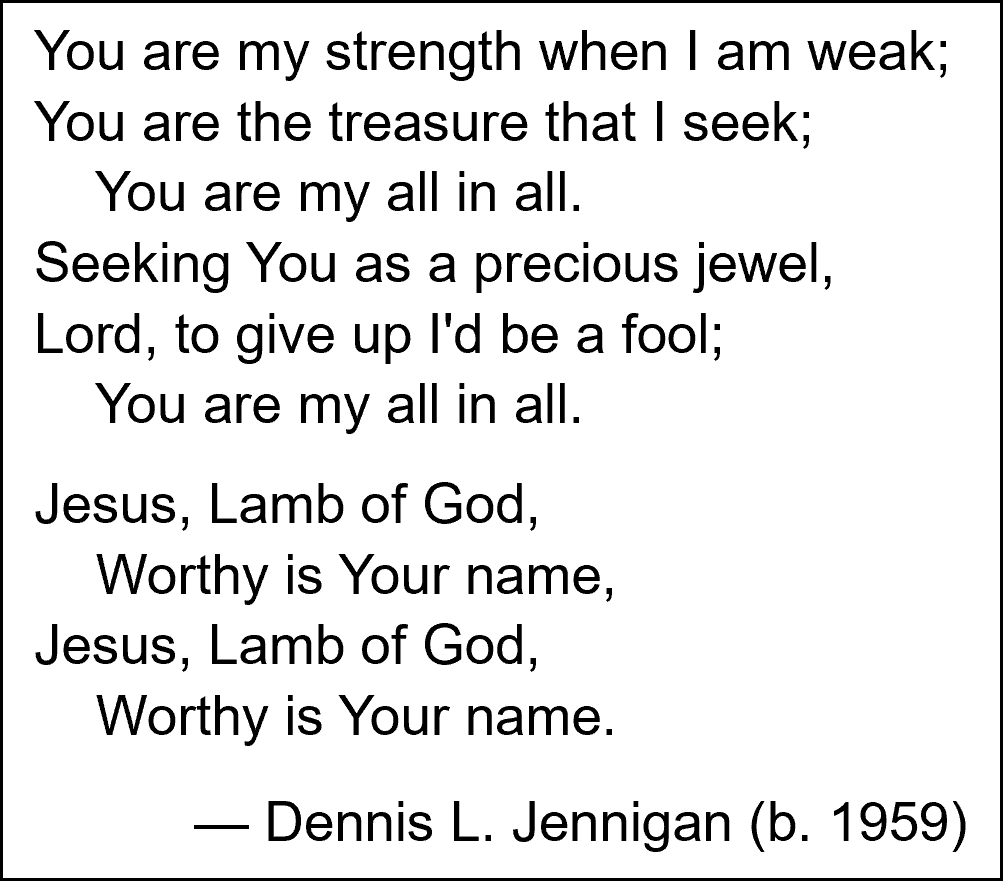
My Name — This passage shows that the name of Jesus will be significant as the End Times approach. First, it will be used by deceivers to draw people away from the truth toward falsehood: “For many will come in My name, saying, ‘I am the Christ,’ and will deceive many” (v. 5). These deceivers will be motivated by selfishness and pride, wanting to draw a following, but it will also be driven by Satan in his concerted attempt to weaken the cause of Christ. Second, the name of Jesus will increasingly generate hatred toward those who follow Him in faith: “…you will be hated by all nations because of My name” (v. 9). We can already see that negative attitude increasingly in American culture and more severely in other areas of the world. It was reported recently that someone in North Korea was imprisoned because a Bible was found in their house. That attitude will spread until it affects “all nations.” The third way the name of Jesus enters the events of the last days is that faithful Christians will continue to spread the good news about Christ until all nations will hear the name of Jesus: “And this gospel of the kingdom shall be proclaimed in the whole world as a witness to all the nations, and then the end will come” (v. 14). This is a requirement before Christ returns to earth. How is the church doing in bringing the gospel to the whole inhabited world? According to the latest statistics, 42.3% of the world’s people groups are still classified as “unreached” (Joshua Project: People Groups of the World). Many mission organizations are now shifting their focus to emphasize outreach to areas of the world that have yet to hear the name of Jesus. Pray for them! Give to them! Go with them!
You Are My All in All – YouTube
 accbibleread.com