
Save or print this page by clicking on “Download” below:
July 30, Sunday————————-ACCOUNTABILITY REMINDER
An audio recording of the following reading is available below.

XXX
Answer Me! — Earlier this year, we read about Jesus cleansing the temple near the beginning of His ministry. At that time, He was asked by the Jewish leaders, “What sign do you show us as your authority for doing these things?” (John 2:18). In today’s reading, it sounds like nearly the whole Sanhedrin court came to Him (“the chief priests and the scribes and the elders”—Mark 11:27). They asked the same question about authority because they considered themselves to be the ultimate authority over the temple and all that happened there. Jesus demonstrated His superior authority by how He responded to them. He knew their previous attitudes about John the Baptist; they had rejected him because their hearts were wicked. So, He asked, was John’s ministry from heaven (divine) or from men (human)? After His question, Jesus authoritatively said, “Answer Me” (v. 39). They had to consult with each other before responding (“if we say…”—vv. 31, 32). They were not discussing what they believed; they were considering what answer to give because of the consequences of what they would say. They couldn’t give their true answer because “they were afraid of the crowd” (v. 32). That sounds like the crowd was the real authority, not them! So, they lied, saying “We do not know” (v. 33). If they had told the truth, they would be proving to the crowd that, since they couldn’t recognize John as a prophet, they had no ability to recognize Jesus as the Messiah. Jesus was the real authority.
ACCOUNTABILITY REMINDER — If you are up to date in your reading as of today,
but did not report yesterday, please click here to leave your email address
or let me know at accbibleread@gmail.com.
XXX
July 31, Monday————————-ACCOUNTABILITY FINAL DAY
An audio recording of the following reading is available below.
XXX
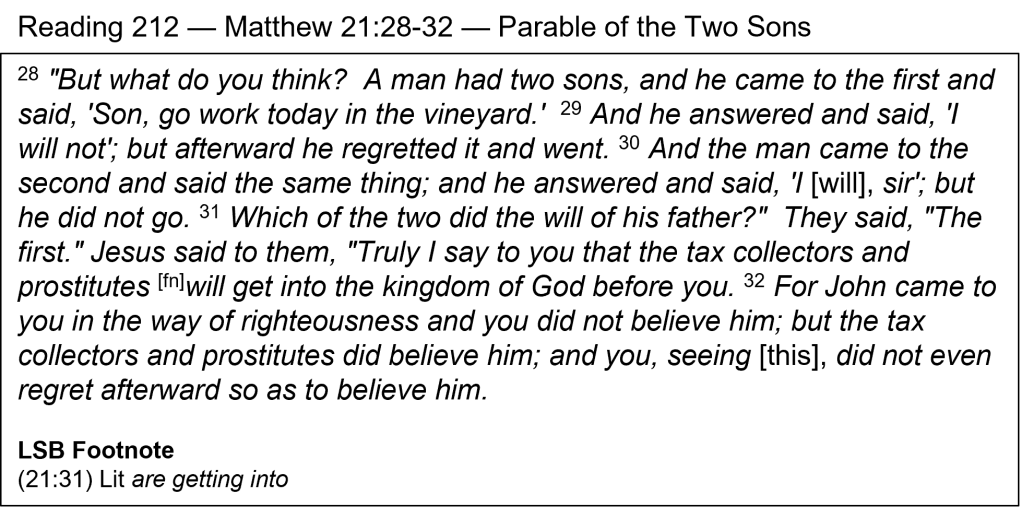
Exposing Hypocrisy — This parable immediately follows the question Jesus asked the Jewish leaders about John the Baptist. They had refused to admit that they believed John’s baptism was not from God. So, in today’s reading, we see Jesus exposing their hypocrisy. The son who first refused, but regretted it and went to work, was like the sinful tax collectors and prostitutes who believed John and repented. The second son had the talk but not the walk, like the Jewish leaders who claimed that they believed God, but their lives didn’t show it. They would not acknowledge their sin and turn to follow those whom God sent to them. Jesus was hard on hypocrites because He knew their hearts.
Jesus, I Come to Thee – YouTube

ACCOUNTABILITY FINAL DAY! If you have not yet reported for this month,
please let me know your reading status today at accbibleread@gmail.com.
XXX
August 1, Tuesday
An audio recording of the following reading is available below.
XXX
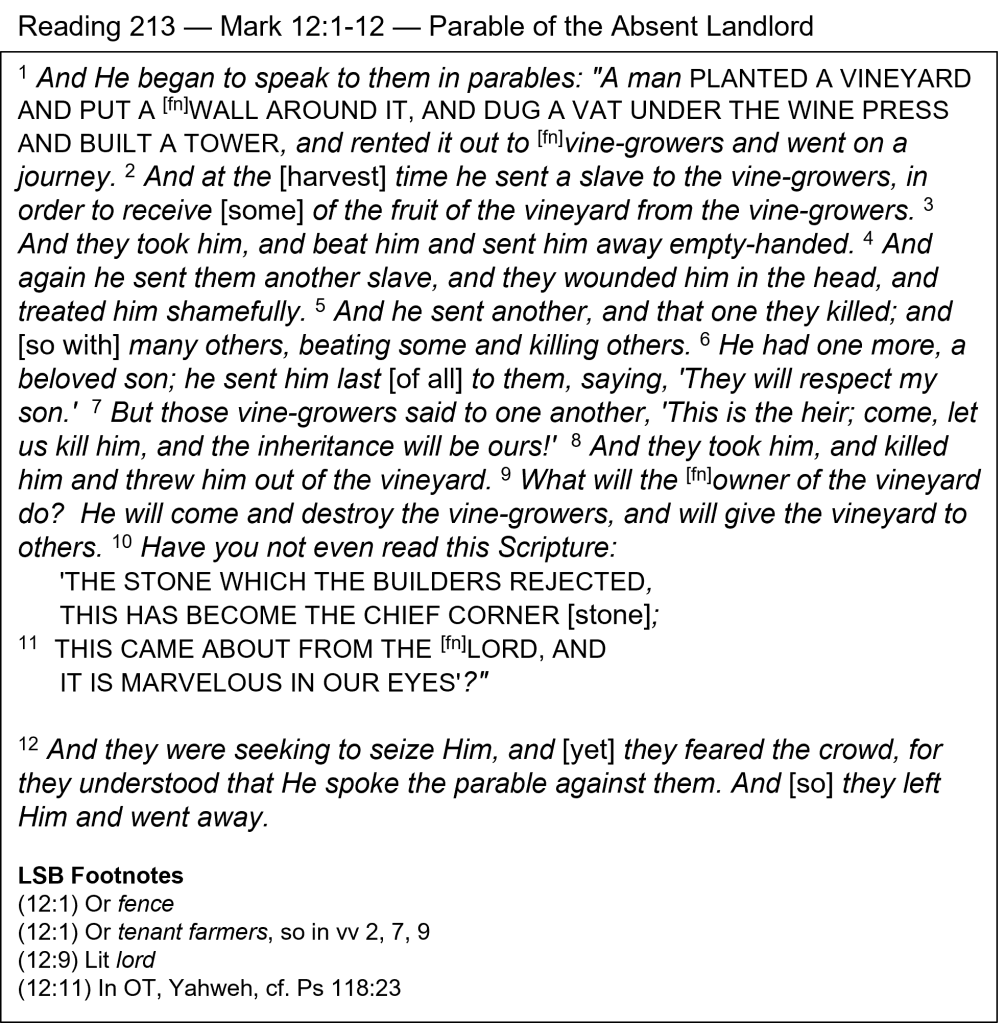
Blatant Rejection — The Jewish leaders who challenged Jesus were still present, so Jesus told another parable that was directed “to them” (v. 1). The vineyard often represented Israel in the OT, so the parable’s tenant vine growers were Israel’s religious leaders, the owner was God, the sent slaves were God’s mistreated prophets, and the “beloved son” (v. 6) was the Messiah, Jesus. The rejected “stone” (a quote from Ps. 118:22-23), would become the chief cornerstone of a new building, not primarily for Jews but for all peoples. In the parable, after killing his son, the owner would “give the vineyard to others” (v. 9), which would be mostly Gentiles. The Jewish leaders “understood that He spoke the parable against them,” but it didn’t change their evil intentions toward Jesus, and “they were seeking to seize Him’ (v. 12). Notice that they again showed cowardness toward the people: (“they feared the crowd”). Psalm 118 served as a warning, predicting their rejection, but instead of recognizing their wrong direction and turning from it, they plowed ahead to do what would ultimately fit perfectly into God’s plan of sacrificing Himself as the final Paschal Lamb.
The Stone Which the Builders Rejected – YouTube

XXX
August 2, Wednesday
An audio recording of the following reading is available below.
XXX
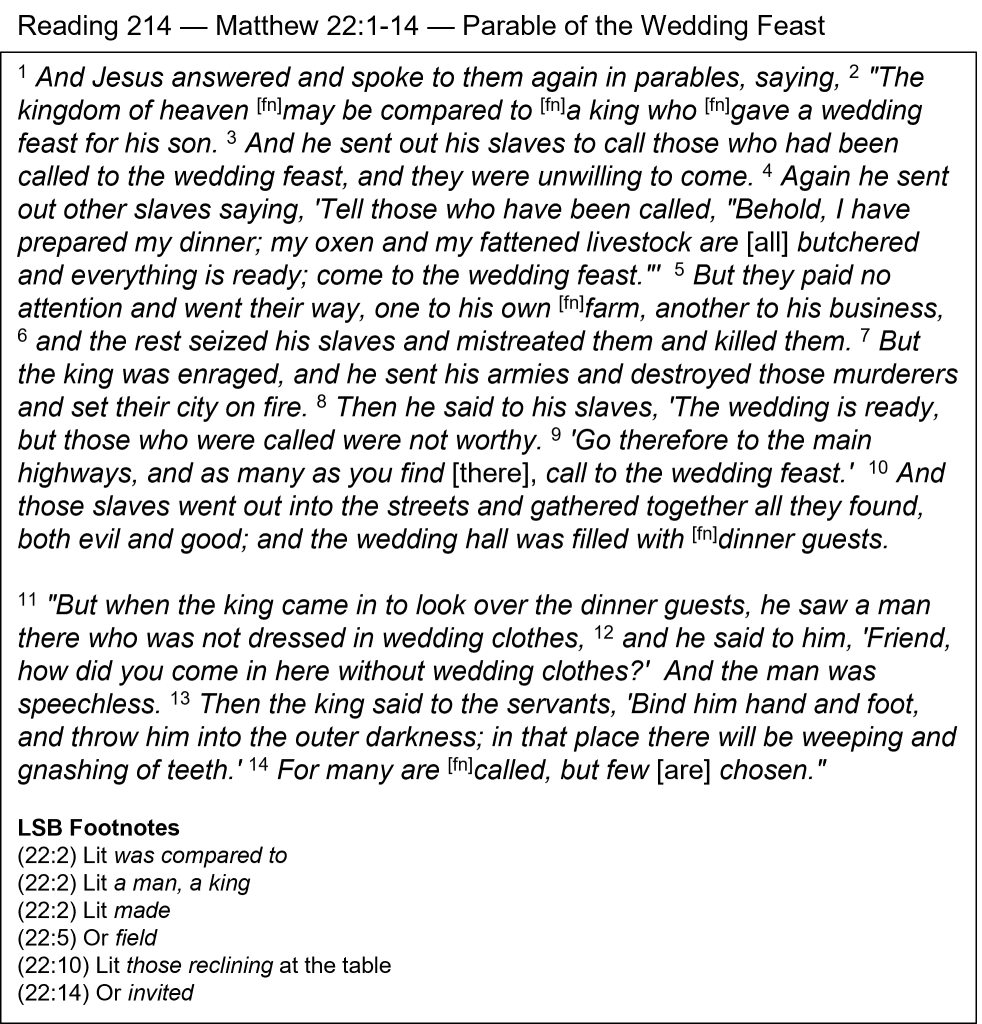
Called vs. Chosen — Even after the Jewish leaders left, Jesus continued to teach about God’s kingdom being expanded to the Gentiles following its general rejection by the Jews. In this parable, the king represents God, and the wedding feast is defined as the “kingdom of heaven” (v. 1). It is like the “marriage supper of the Lamb” described in Rev. 19:7-9, where the church, His bride, was given clothing of “fine linen, bright and clean … [which] is the righteous acts of the saints.” In Jesus’ parable, therefore, although both “evil and good” people were brought to the feast (Matt. 22:10), the improperly dressed man showed no repentance or evidence that he had been converted. He was called but not chosen; he was in the church building but not in the church family. The first call went out to Israel, but they were “unwilling” (v. 3) and “paid no attention” (v. 5). The second call was broader, going into “the main highways … streets … and [they] gathered together all they found” (v. 9-10), probably referring to Gentiles. At the time Jesus told the parable, His audience was composed of Jews. Would they continue to be unwilling and pay no attention to the call, or would they be changed by the Messiah?
When the Roll Is Called Up Yonder – YouTube

XXX
August 3, Thursday
An audio recording of the following reading is available below.

XXX
Render to God — All the Jewish religious leaders joined forces with their frequent political opponents, the Herodians, to trap Jesus. All their best minds and careful plans were no match for the Son of God. When the interchange was over, “they marveled, and … went away” (v. 22). Jesus was not only infinitely smarter and wiser than they were, but He also knew their hearts (“…knowing their wickedness”—v. 18). They had also been deceptive in that they “sent their disciples” (v. 16) rather than going themselves and being recognized. As usual, Jesus didn’t hold back in rebuking them, calling them hypocrites (v. 18). They were pretending to be impressed with Jesus’ truthfulness and even-handed dealings with people (v. 16). They hated to “render to Caesar” the high taxes forced on them, but they did not “render to God” what He requires, including truthfulness, humility, and seeking the wellbeing of others. Are we? The Bible tells us clearly that what we should be rendering to God are things like prayer, obedience, gratitude, giving financially to His work on earth, and joining together with other believers to worship.
How Pleased and Blessed Was I – YouTube

XXX
August 4, Friday
An audio recording of the following reading is available below.
XXX
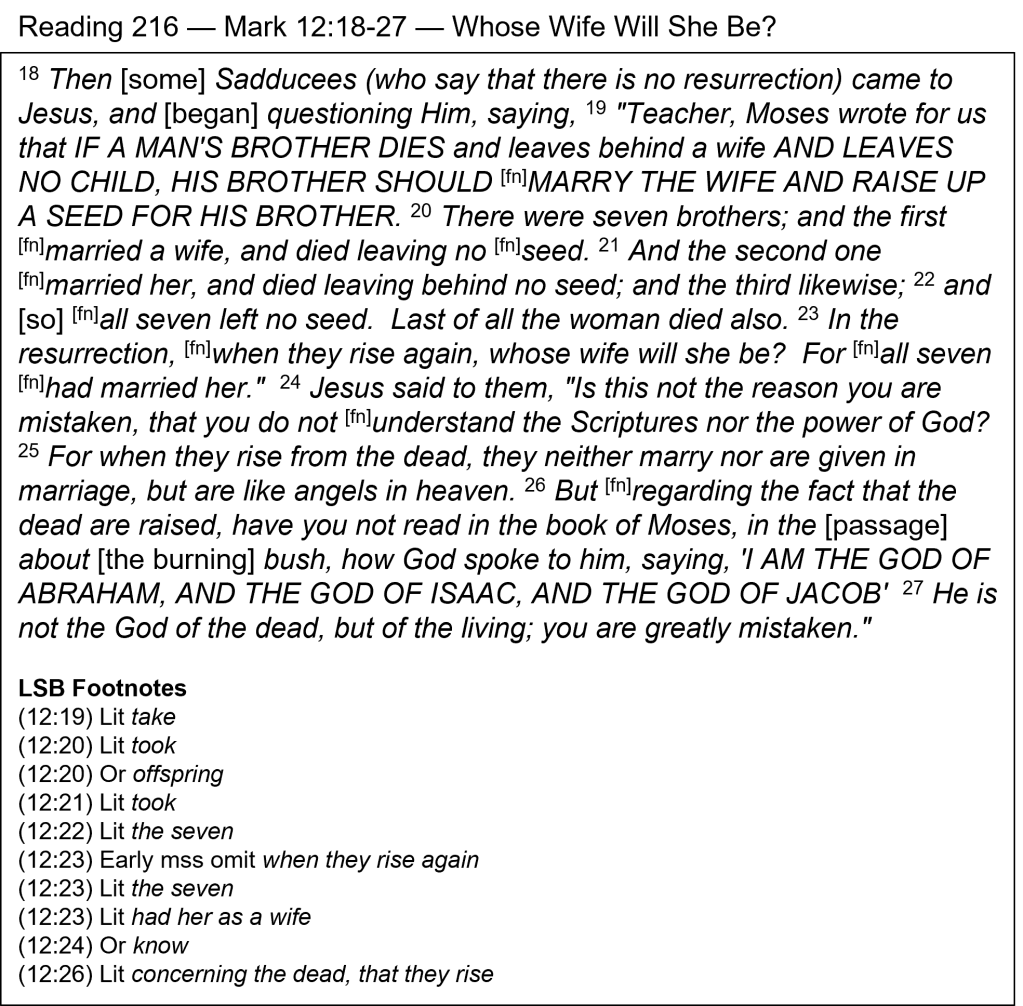
Better Than Marriage — The Sadducees were a smaller, but powerful, Jewish group; the chief priests came from that political unit, and they seemed to trust only the OT books of Moses. They didn’t believe in the resurrection or in angels. Like the Pharisees and Herodians in yesterday’s reading, the Sadducees also came to Jesus deceptively, trying to outsmart and trap Him. After presenting their exaggerated hypothetical case, they asked, as if they believed in the resurrection, “In the resurrection, when they rise again…” (v. 23). Jesus said they were mistaken for two reasons. The first, He said, was because “you do not understand the Scriptures” (v. 24). Although the five books of Moses don’t directly mention the resurrection, the prophet Daniel clearly said that “many of those who sleep in the dust of the ground will awake, these to everlasting life, but the others to reproach [and] everlasting contempt” (Dan. 12:2). The Sadducees were mistaken because they did not understand that “All Scripture is God-breathed and profitable for teaching …” (2 Tim. 3:16). The second reason Jesus said they were mistaken was because they did not understand “the power of God” (Mark 12:24). That was not only resurrection power, but it also included His ability to create relationships in heaven that will be far better than the best of those on earth, including marriage.
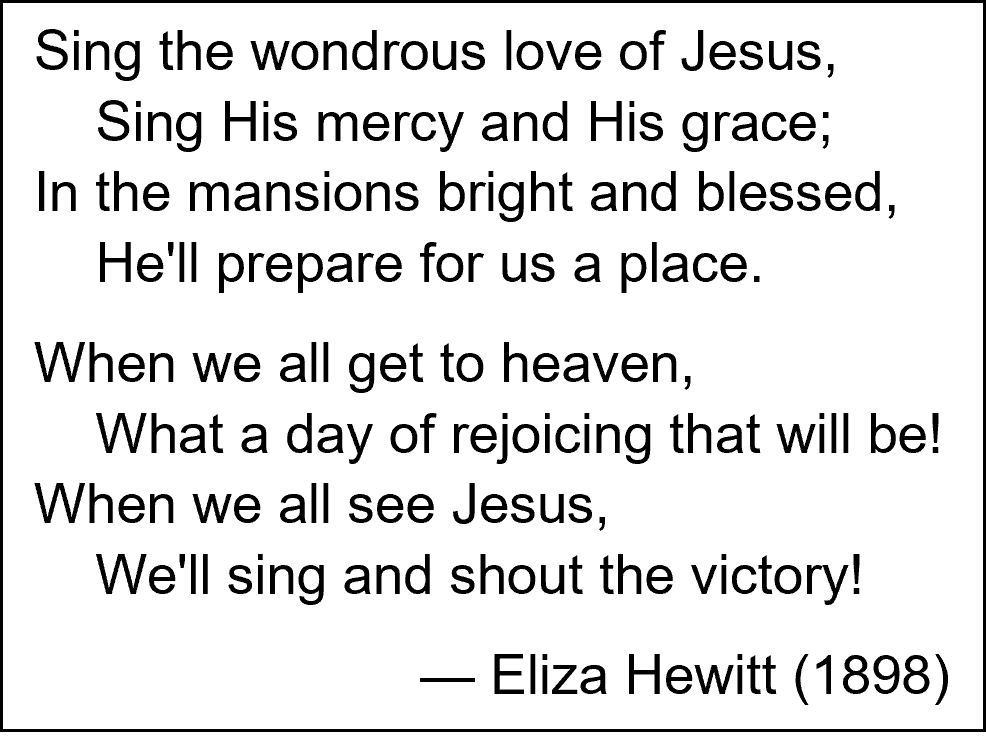
When We All Get to Heaven – YouTube
XXX
August 5, Saturday
An audio recording of the following reading is available below.
XXX
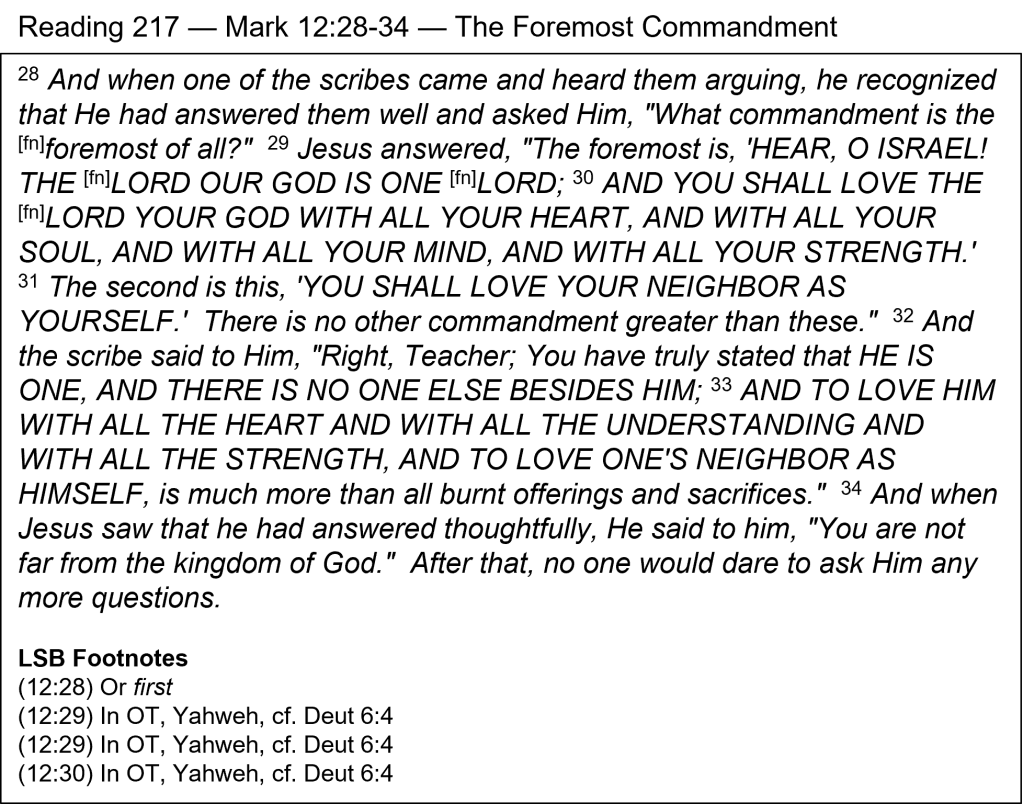
Not Far — Like the interview with Nicodemus, this is a rather rare, more positive encounter Jesus had with one of the religious leaders of the Jews. Jesus saw his honesty and openness, that “he recognized” that Jesus had answered the Sadducees well (v. 28a). His question was not a constructed trap, and it seriously sought a truthful answer: “What commandment is the foremost of all?” (v. 28b). Jesus was also straightforward in His answer, which was to wholeheartedly love God and one’s neighbor. The most important thing we can do to please God is to love—love Him and love others. The scribe affirmed Jesus’ answer, summarizing it in his own words, and adding that loving God was even more important than the worship activities of offering sacrifices (v. 33). John Piper has said, “Take more delight in the Savior than in His service.” Jesus saw that this scribe was close to the Kingdom because “he had answered thoughtfully” (v. 34). He was not quite there, however. What was he lacking? He had probably not yet recognized that Jesus was the Messiah, the Savior for the world. Close, but not quite. He had grasped it intellectually but needed to experience it relationally. My guess is that he, like Nicodemus and Joseph of Arimathea, came to faith in Jesus after His resurrection.

 accbibleread.com