
Save or print this page by clicking on “Download” below:
July 23, Sunday
An audio recording of the following reading is available below.
xxx
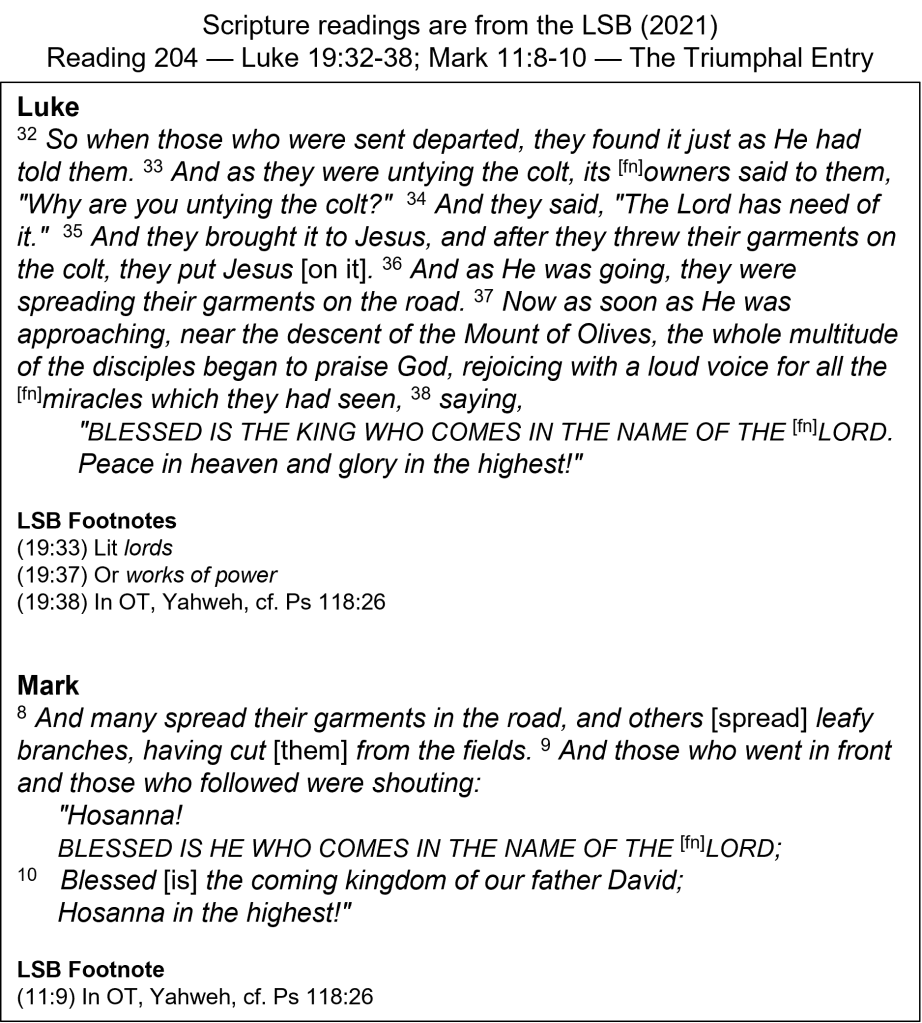
A Premature Celebration — Several months ago, I watched the television coverage of the coronation of the British King Charles III. It was very orderly and formal, with a great display of the wealth of carriages and crowns. The Triumphal Entry of Jesus was much different. It was a noisy, crowd-participation celebration with donkeys and tree branches. People were removing their outer cloaks to put on the colt and on the ground in honor of their arriving King, the Messiah. Mark records that crowds surrounded Jesus, anticipating “the coming kingdom of our father David” (Mark 11:10). They were thinking that now was the time the Messiah would establish His earthly kingdom and free them from the oppression of the Romans. After all, it was the beginning of Passover Week, which celebrated the Hebrews being freed from Egyptian bondage. They knew that this was a divinely ordered event, so they shouted “Hosanna!” (Hebrew: “please save!”) and “Hosanna in the highest!” Luke wrote that “the whole multitude … began to praise God, rejoicing … for all the miracles which they had seen, saying … Peace in heaven and glory in the highest!” (Luke 19:37-38). All their dreams would be shattered at the end of Passover Week when their celebrated hero would die on a cross. The timing was wrong. The King riding into Jerusalem was bringing a spiritual kingdom to rule in the hearts of people; His physical reign on earth is yet to come.
Praise Him, Praise Him – YouTube

xxx
July 24, Monday
An audio recording of the following reading is available below.

xxx
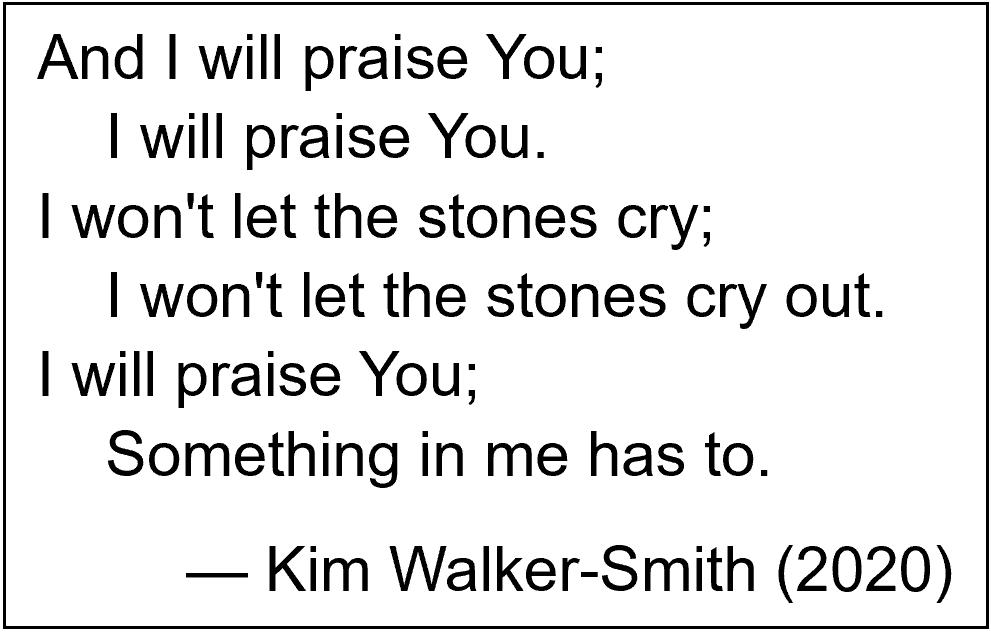
Shouting Praise — Jesus received the praise of the crowd that accompanied Him as He rode toward Jerusalem. When the Pharisees wanted Him to silence the crowd, Jesus said that “if these were silent, the stones will cry out!” (Luke 19:40). All of creation was made to praise the Creator. We read earlier that Jesus wept with the mourners on the way to Lazarus’ tomb, and here, only Luke recorded a second time Jesus cried. He was concerned about the feelings of others, and He was saddened about the city that had generally rejected Him. He exclaimed, “If you knew…” (Luke 19:42), but even though they had seen the coming of their Messiah, they “… did not recognize … [their] visitation” (v. 44). Jesus is moved by those who mourn and by those who are lost. We also see here the ability Jesus had to predict the future. Because of Jerusalem’s rejection of their Messiah, He described the coming destruction of the city in 70 A.D. by the Romans. That destroyed temple has never been rebuilt; there is a severe penalty for rejection. Even after seeing “the marvelous things which He had done” (Matt. 21:15), the Jewish religious leaders rejected Jesus and expressed indignation at the praise Jesus was receiving from the children. Even the stones and the children would praise Him.
xxx
July 25, Tuesday
An audio recording of the following reading is available below.
xxx
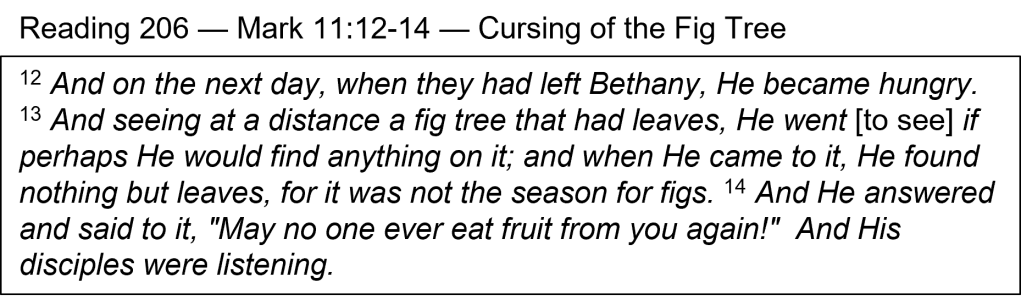
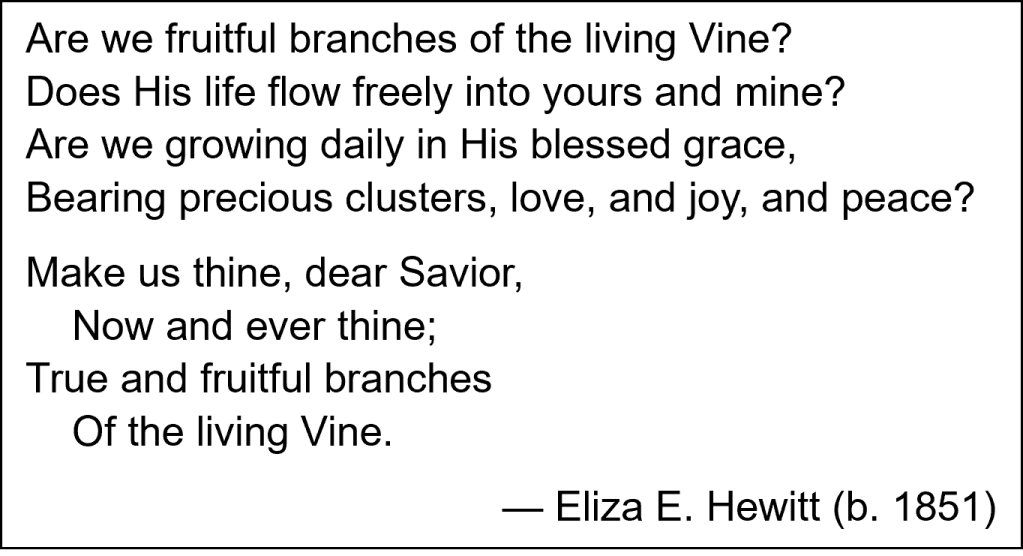
Nothing but Leaves — In a few days, we will read about the lesson Jesus taught His disciples from this miracle, but there also seems to be an intended figurative meaning involved. Yesterday, we read that Jesus wept about the coming destruction of Jerusalem because the people had generally rejected their Messiah. In today’s reading, God’s judgment on His people also seems to be included, but this time it was because of their hypocrisy. They had the appearance of godliness (the fig leaves), but they were not bearing the fruit of righteousness. The fig tree is used in the OT to represent Israel, and God spoke through Jeremiah of their judgment: “‘I will surely gather them up,’ declares Yahweh; ‘There will be no grapes on the vine and no figs on the fig tree, and the leaf will wither; and what I have given them will pass away’” (Jer. 8:13). Are there more than leaves on the tree of our own lives? Are we bearing fruit that is pleasing to God and useful to others?
I couldn’t find a good video of the music for this hymn,
but it has a great message about being fruitful.
xxx
July 26, Wednesday
An audio recording of the following reading is available below.

xxx
Power and Purity — This is the second time Jesus dramatically cleansed the Gentile section of the temple during Passover Week (cf. John 2:13-22). It is hard to imagine the immense power He exhibited in both purifying events. There were likely hundreds of people occupying this area, not only the merchants who were selling, but also the buying pilgrims who had traveled to Jerusalem to offer sacrifices (v. 15). A single man dramatically drove them all out. Why didn’t some of them stubbornly refuse to go? Why didn’t they physically gang up on Him? It was a demonstration of incredible power and the people cowered and obeyed. Jesus possessed divine authority. Even the chief priests and the scribes, representing the 71-man Sanhedrin, “were afraid of Him” (v. 18). His power came from the Father and from the authority of His Word. Jesus asked, “Is it not written…?” (v. 17), before quoting from Isaiah 56:7. The temple was supposed to be a place of worship, and that purity of purpose should be maintained.
xxx
July 27, Thursday
An audio recording of the following reading is available below.

xxx
Door for the Gentiles — This is a significant turning point in the ministry of Jesus. It appears to be no accident that this encounter with the Greeks happens at this point, just after Jesus cleansed the Gentile quarter of the temple area. The Greeks who came to Philip may have been some of the Gentiles trying to worship in the only part of the temple they were allowed to enter. They may have witnessed that powerfully dramatic effort of Jesus to keep the Gentile court as a holy place for them to worship. Up to this point, His ministry had focused almost entirely on Jews, but after His death on the cross a few days later, His outreach would become universal. The voice from heaven was intended for all who were there: “This voice has not come for My sake, but for your sake” (v. 30). Many, however, heard it only as thunder, with others thinking that an angel spoke to Him (v. 29). Apparently, those who believed in Jesus did understand these words: “I have both glorified it and will glorify it again” (v. 28). This is the third time we have read about God’s voice from heaven, the others being at Jesus’ baptism and at the Transfiguration. All three came at significant turning points in Jesus’ ministry. The door was opening to the Gentile world. At His crucifixion, He would begin His ministry to “draw all men [i.e., all kinds of men] to Myself” (v. 32), so that we (mostly Gentiles) would be able to see Jesus.
Open Our Eyes, Lord, We Want to See Jesus – YouTube

xxx
July 28, Friday
An audio recording of the following reading is available below.

xxx
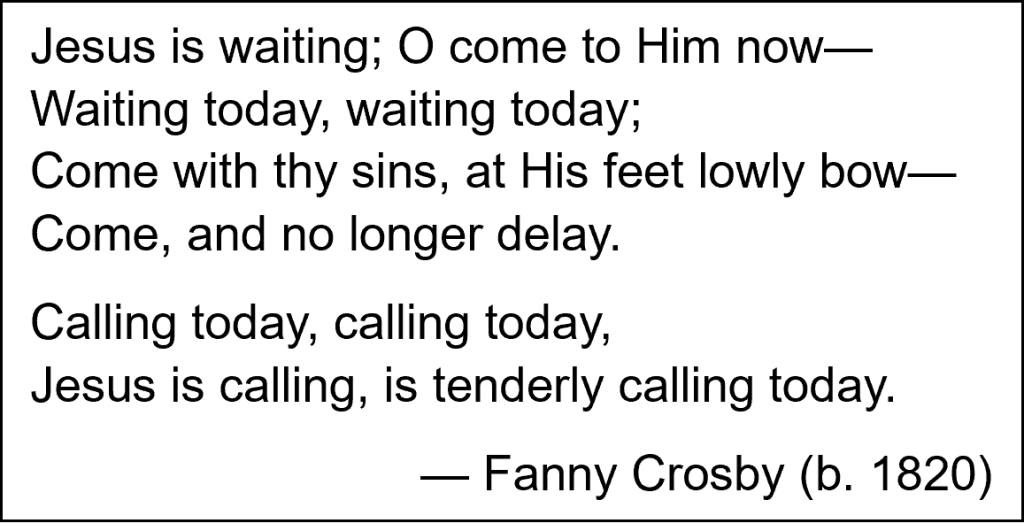
Believing or Blinding — Human responsibility is emphasized in this passage: “But though He had done so many signs before them, they [still] were not believing in Him” (v. 37). Jesus’ miracles were signs that pointed to the fact that He was the Messiah sent from God. It was all the evidence they needed to bring them to faith. Their unbelief had failed the test of responsibility. The result was that God hardened their hearts so that “they could not believe” (v. 39). They had crossed the line in stubborn unbelief. It was like the Pharaoh in Moses’ time when God hardened his heart after he had hardened his own heart. God is patient but He has His limits. Isaiah also warned, “Seek Yahweh while He may be found; Call upon Him while He is near” (Isa. 55:6). Referring to Jesus’ first coming, He said, “I did not come to judge the world, but to save the world” (v. 47). He is still calling today, but the door will be closing for good when He comes as the Judge at His Second Coming.
Jesus Is Tenderly Calling – YouTube
xxx
July 29, Saturday——————————–ACCOUNTABILITY TIME!
An audio recording of the following reading is available below.

xxx
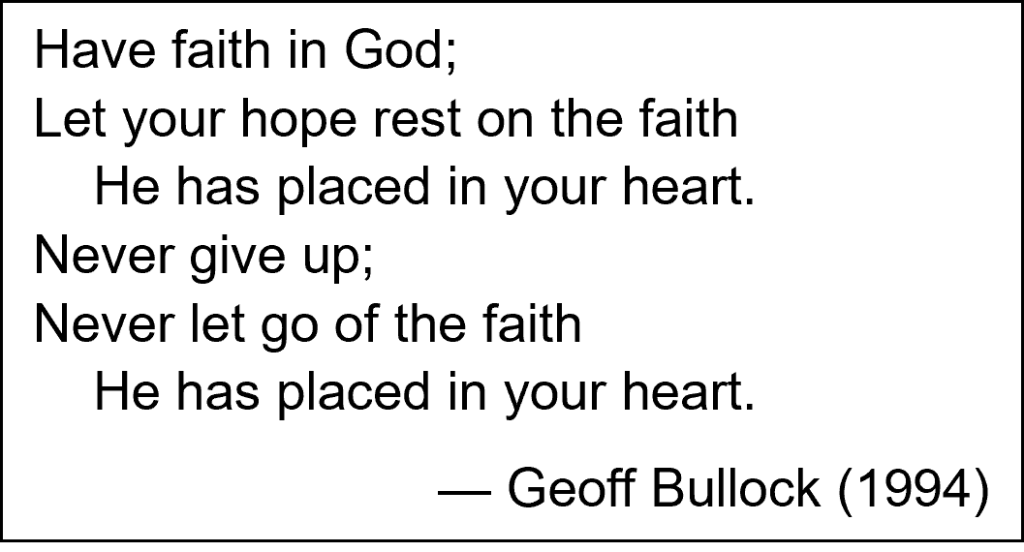
Faith and Forgiveness — Peter seemed surprised to see the miraculously-withered fig tree, so Jesus used the opportunity to teach the disciples this lesson about faith: “Have faith in God” (v. 22). That is the unavoidable theme of His lesson. Yes, we are told in other places that our requests to God must be unselfish and in keeping with His will, but we often use those limits as excuses for not asking with faith. Jesus often criticized His disciples for their weak faith. This passage stresses our need for bold faith. His lesson applies to all of us (“…whoever says…”—v. 23), and it also applies to every subject (“…all things for which you pray”—v. 24). The great obstacle to faith is doubt (“…and does not doubt in his heart”—v. 23). Why do we doubt? Is it because we don’t think God can do it or is it more that we don’t think that God will do it? We also might have doubts because we have asked many times in the past without seeing answers to things we requested. We need to remember the fig tree and Jesus’ mountain-moving challenge. Jesus then tagged on another reminder of something He mentioned earlier: forgive before you pray (v. 25). If we want to be forgiven, we must learn to forgive. An unforgiving spirit could also be a hindrance to receiving what we ask for, even with faith.
ACCOUNTABILITY TIME! If you are up to date in your reading as of today, please click here to leave your email address or let me know at accbibleread@gmail.com.
 accbibleread.com