
Save or print this page by clicking on “Download” below:
July 16, Sunday
An audio recording of the following reading is available below.
xxx
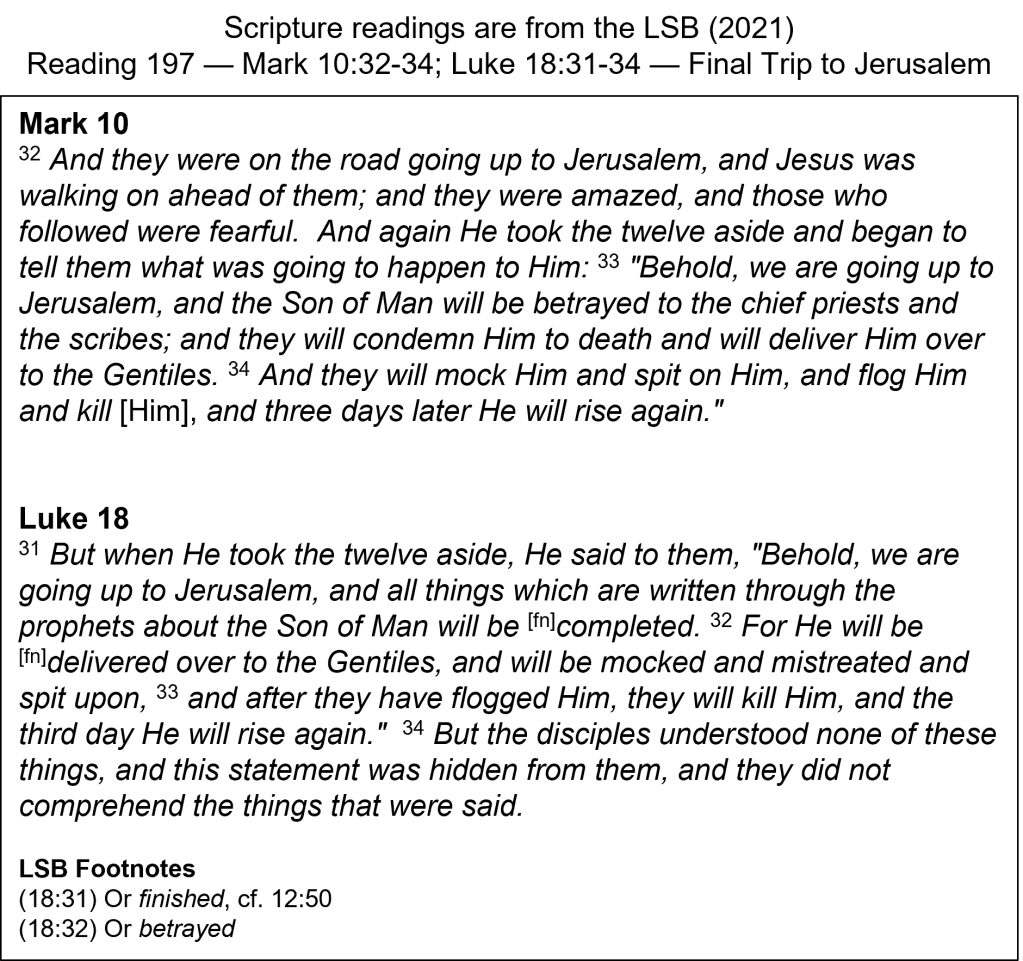
Christ’s Sacrificial Purpose — This is the third time it is recorded that Jesus told His disciples about His coming death. The fact that at one of those times Peter took Him aside to rebuke Him, shows that they understood the basic meaning of His words (Mark 8:32). Later, when they were going to Bethany to raise Lazarus from the dead, Thomas replied, “Let us also go, so that we may die with Him” (John 11:16). They understood that He was going to die. What apparently confused them was that this talk of death conflicted with their own anticipation of a conquering, ruling Messiah. God had hidden His sacrificing purpose from them until Jesus rose from the dead. When His disciples saw the determination of Jesus as He “was walking on ahead of them” (Mark 10:32a) to Jerusalem, “they were amazed, and those who followed were fearful” (v. 32b). Why would He walk toward danger with such resolve? They probably also feared for themselves that they might share in the troubles awaiting Jesus. We read earlier about the Suffering Servant who said, “Even now Lord Yahweh helps Me … Therefore, I have set My face like a flint” (Isa. 50:7). Jesus knew His sacrificial purpose, yet He faced it willingly and with determination. The cross was not a dreadful end; it was God’s predicted solution for the penalty for sin.
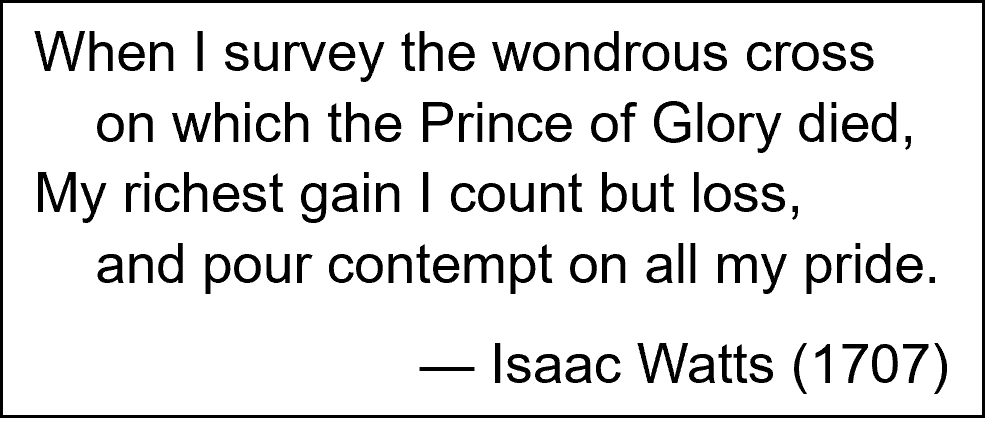
When I Survey the Wondrous Cross – YouTube
xxx
July 17, Monday
An audio recording of the following reading is available below.
xxx
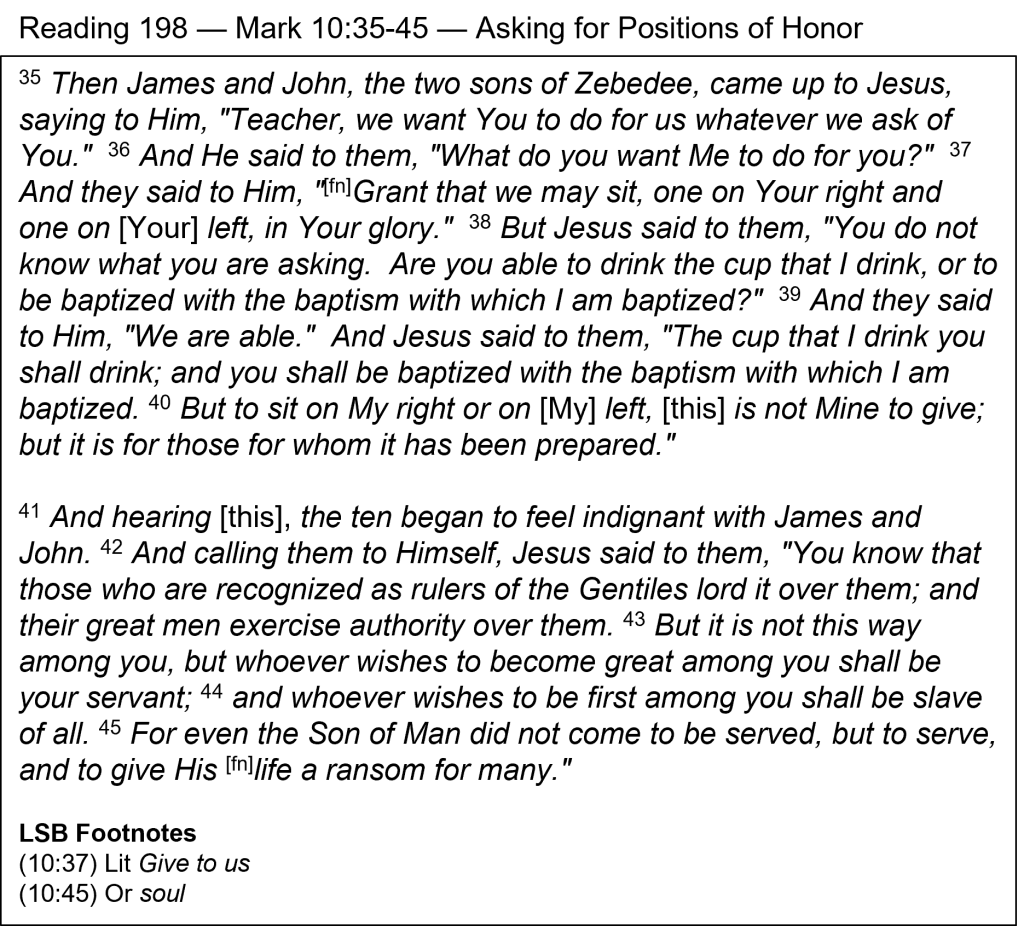
Selfishness or Service — All of the Twelve showed selfishness in this story. Although James and John belonged to Jesus’ inner circle (along with Peter), they wanted more—to go from a trio to a duo. This is another example of unfulfilled striving for greatness; it never satisfies, but always wants more. The other ten disciples then showed their selfishness by being indignant with James and John, probably out of their own desire and jealousy. Jesus took this exchange as an opportunity to teach an important lesson about honor and glory, which should come only through humble and loving service. Our sinful human tendency is to rule over others, but God’s way for us is to serve others. Jesus offered Himself as the supreme example: “The Son of Man did not come to be served, but to serve and to give His life a ransom for many” (v. 45). We all like to be served, but that was not Jesus’ purpose for coming. He came “to serve and to give…” Serving others involves giving to others. Jesus gave the ultimate human gift—His life. Serving involves unselfish sacrifice.
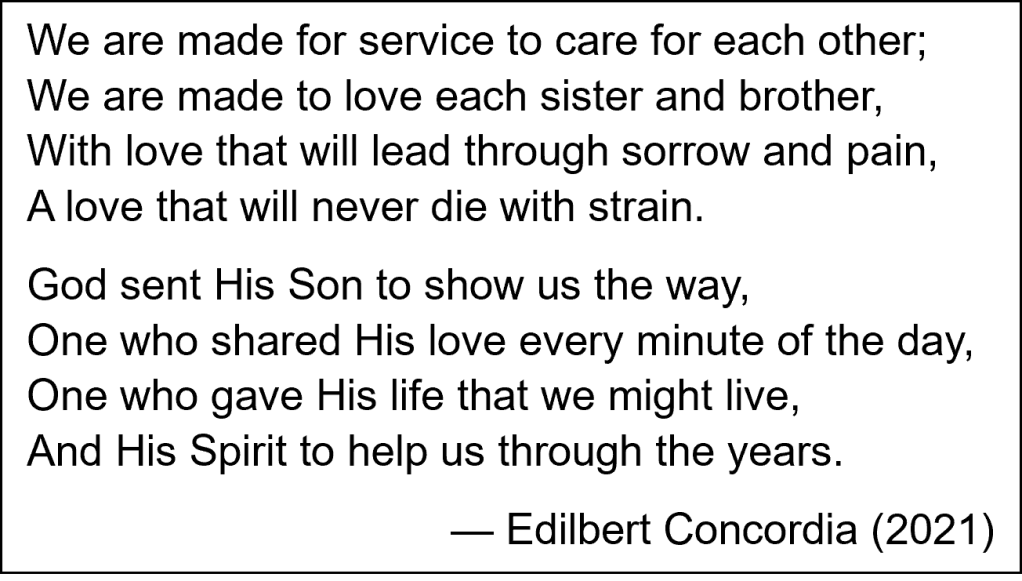
We Are Made for Service – YouTube
xxx
July 18, Tuesday
An audio recording of the following reading is available below.
xxx
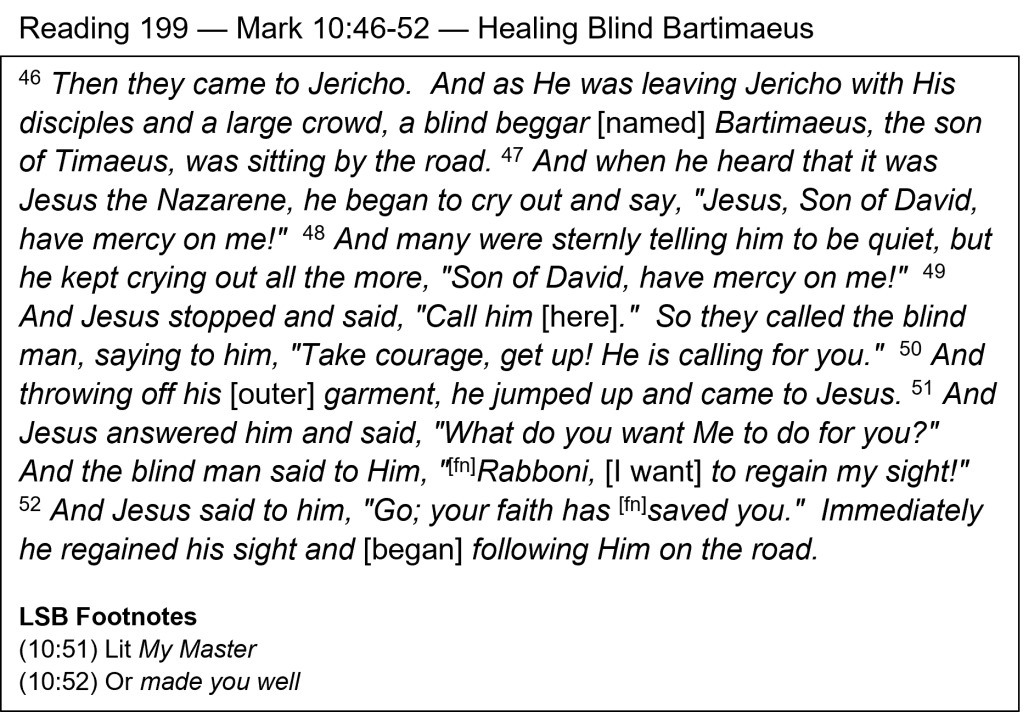
From Beggar to Disciple — Jesus was on His way to Jerusalem to die, yet He stopped to show compassion toward this blind man. The crowd with Him didn’t have compassion but told Bartimaeus to be quiet. They thought he was too insignificant to bother Jesus. That is the same kind of attitude the Twelve had about children being brought for Jesus to touch them (Mark 10:13-16). The needy one was too insignificant and the Savior was too important. The statement that Bartimaeus “heard that it was Jesus the Nazarene” (v. 47), reveals how widely Jesus’ reputation of power and compassion had spread. The blind man knew Jesus’ name and that He was from Nazareth. He also believed that Jesus was the Messiah, calling Him “Son of David” (v. 47), the lineage through which the Messiah would come. Bartimaeus also showed great persistence and faith. When the crowd told him to be quiet, “he kept crying out all the more” (v. 48). He knew what he wanted, and he believed that Jesus was the solution to his problem. Then Jesus stopped at his cry for mercy. Merciful Savior! Jesus has time and concern for us as well. Keep crying out with persistence and faith! When Bartimaeus heard that Jesus was calling for him, he threw off his outer garment as he got up. Something more important than a robe was now involved. Giving him an opportunity to express his faith, Jesus asked him what he wanted. What he wanted was obvious, but he needed to express it, which he did, calling Jesus “Rabboni,” the Hebrew word meaning “my lord” or “my master” or “my teacher.” He was now committed to Jesus “and began following Him on the road” (v. 52). He went from a blind beggar to a physically and spiritually enlightened disciple.
Pass Me Not, O Gentle Savior – YouTube

xxx
July 19, Wednesday
An audio recording of the following reading is available below.
xxx
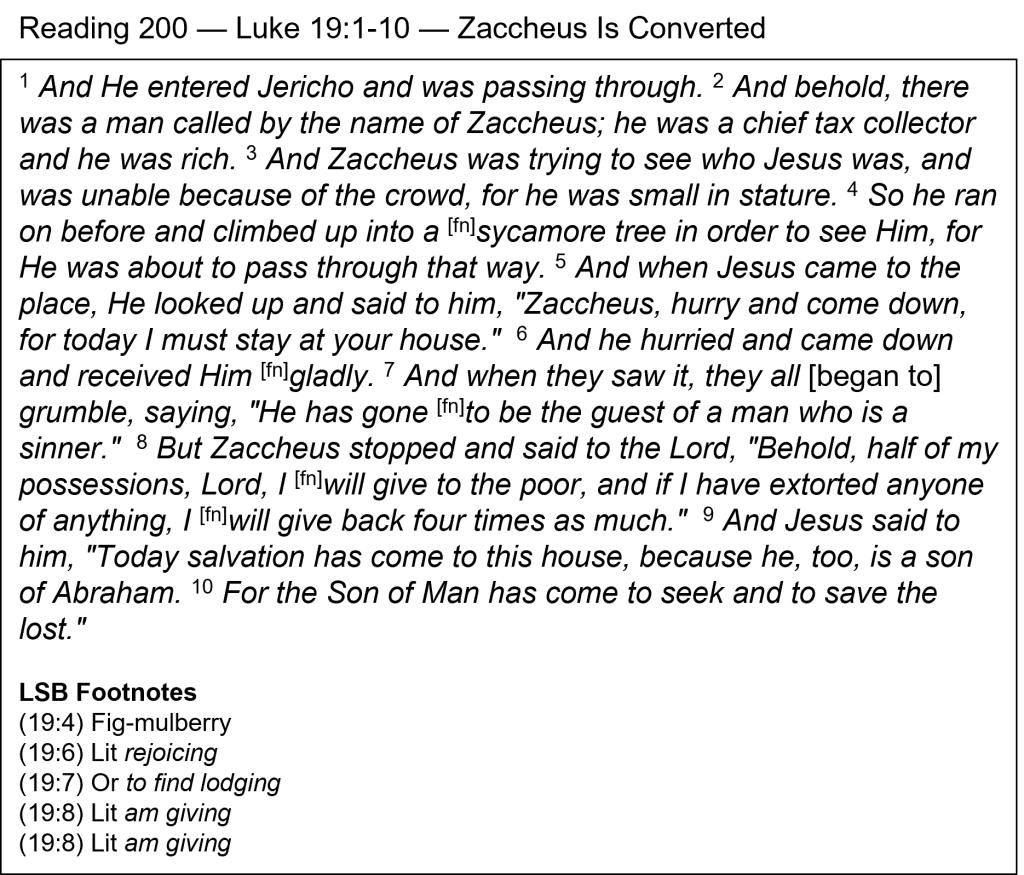
To Seek and Save — There were two Jericho cities in Jesus’ time. The OT Jericho was on the main road going to Jerusalem. Yesterday, we read that Jesus healed Bartimaeus as He was leaving that city. The Jericho He entered in today’s reading was a nearby modern city built by Herod the Great at the end of a different dead-end road that led from the main road. Jesus went out of His way to go there. Why? It was to meet and bring salvation to Zaccheus. He said, “I must stay at your house” (v. 5). That is a statement of necessity; He was being directed by the Father. He came to seek and save Zaccheus. A similar statement was made when Jesus was sent to the Samaritan woman at the well: “He had to pass through Samaria” (John 4:4). Zaccheus had obviously heard about Jesus but had never seen Him nor heard Him teach. On the other hand, Jesus knew Zaccheus’ name, calling him down from the tree (Luke 19:5). He showed that He was omniscient (all-knowing). Jesus then invited Himself to Zaccheus’ house, which upset the crowd following Him, because he was a known “sinner” (v. 7). Jesus knew that, too, but He was on a mission to save. Even before they got to his house, “Zaccheus stopped…” (v. 8). It was a point of decision. This sinful tax collector then told Jesus that he would give half of his possessions to the poor and pay back those he had defrauded. Between the tree and the house, he was converted. He was bearing “fruits in keeping with repentance,” as John the Baptist had challenged the Pharisees when he was baptizing (Luke 3:8). Jesus confirmed his conversion by saying, “Today salvation has come to this house” (19:9). Zaccheus had always been “a son of Abraham” physically, but now he had become “a son of Abraham” by faith, as Paul confirmed: “…those who are of faith … are sons of Abraham” (Gal. 3:6). Jesus is still going out of His way to seek and save the lost.
xxx
July 20, Thursday
An audio recording of the following reading is available below.
xxx
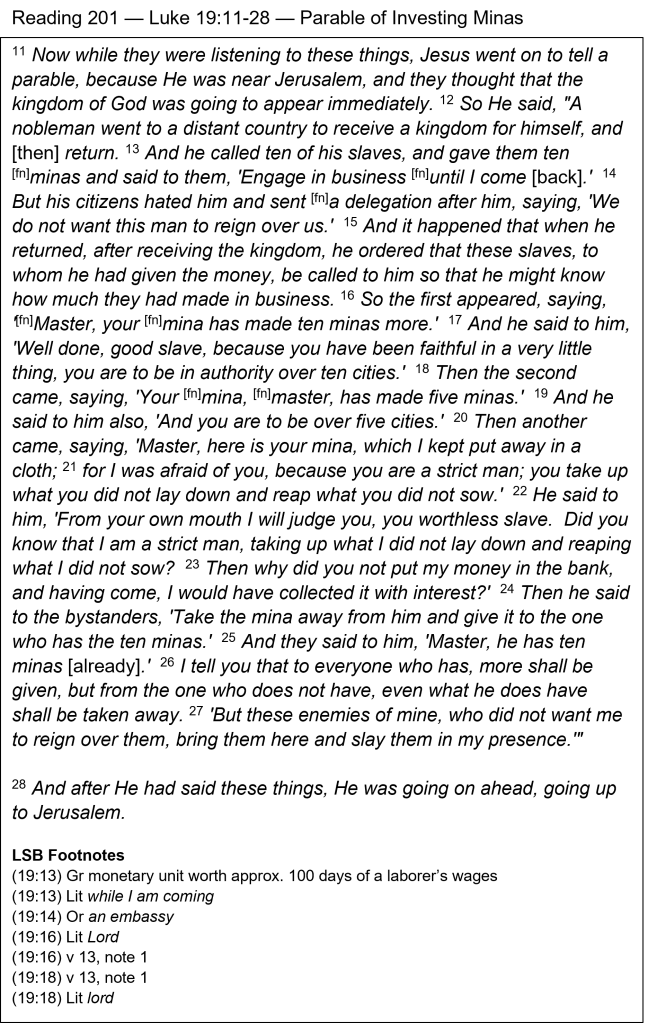
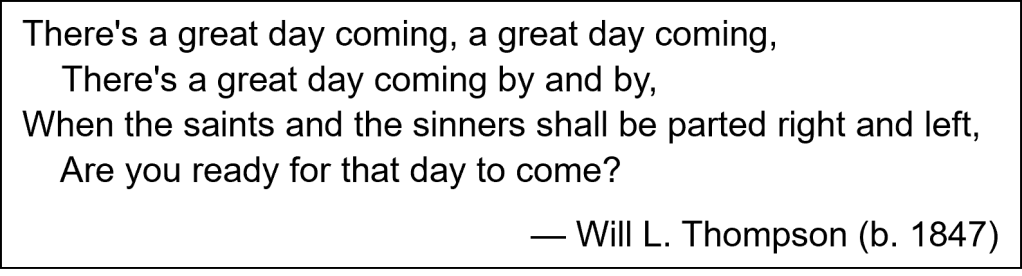
Receiving a Kingdom — The purpose for Jesus’ final trip to Jerusalem is nearing the end; the first and last verses of our reading today mention that fact. We learn Jesus’ purpose for telling this parable in the first verse, which was to correct the expectation “that the kingdom of God was going to appear immediately” (v. 11). That the nobleman “went to a distant country” (v. 12) indicates that it would be a long time before he returned. It seems that the nobleman represents Christ, the distant country is heaven, and receiving a “kingdom for himself” (v. 12) is the gradual process of people coming into the family of God since Jesus ascended into heaven. In the meantime, we, the members of that kingdom on earth, are to be busy and effective in being good stewards with what God has entrusted to us. When He returns at His Second Coming in judgment, we will be rewarded according to the quality of our stewardship, while the “enemies of mine, who did not want me to reign over them” (v. 27) will be punished eternally. We are surrounded today by those “enemies” who are choosing to rule their own lives, and they need to be warned about their destiny, and encouraged to enter God’s kingdom.
There’s a Great Day Coming – YouTube
xxx
July 21, Friday
An audio recording of the following reading is available below.
xxx
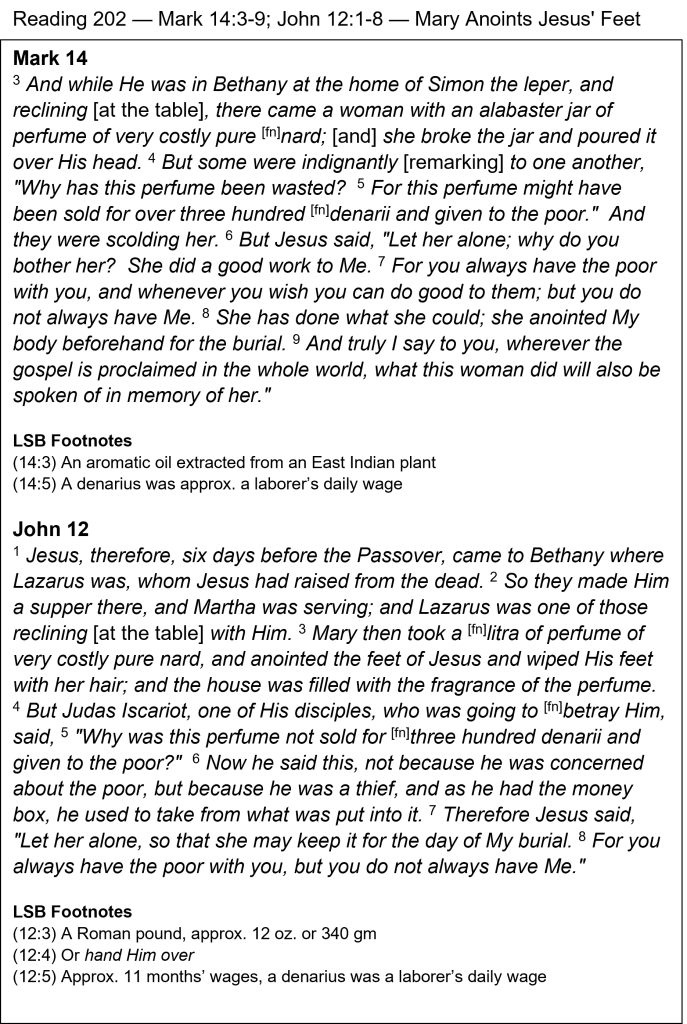
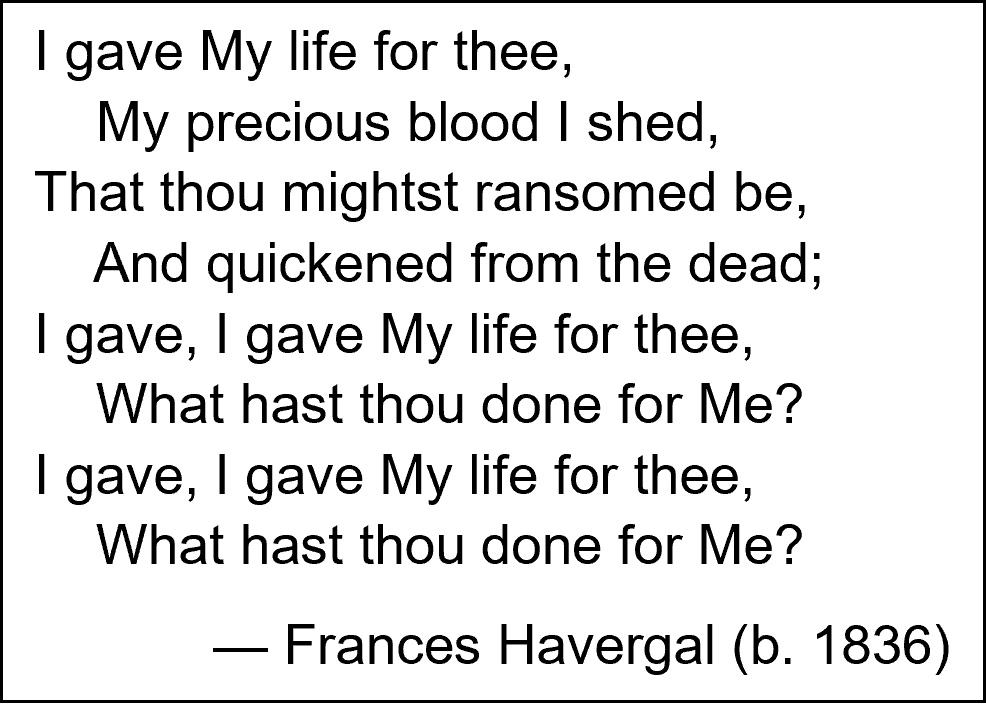
Let Her Alone! — We read earlier about a different woman, a “sinner,” who anointed Jesus’ feet with perfume, but today’s reading is a different person and event. Martha was serving at this dinner, but it was located at Simon’s house. Mark doesn’t mention that the woman anointing Jesus was Mary, and he recorded only that she poured the perfume over His head, while John’s account gives her name and that she also anointed His feet. I love Jesus’ response to the petty complaints of Judas and others: “Let her alone” (Mark 14:6 and John 12:7). They thought her actions were wasteful, but Jesus thought they were precious. Mary was making a huge financial sacrifice to demonstrate her love for Jesus. What kind of sacrifice are you giving to God because of your love and gratitude? Sacrifice is characteristic of deep love. Jesus also pointed to His coming death at this dinner: He said that Mary had “anointed My body beforehand for the burial” (Mark 14:8), and that some of it should be kept “for the day of My burial” (John 12:7).
I Gave My Life for Thee – YouTube
xxx
July 22, Saturday
An audio recording of the following reading is available below.
xxx
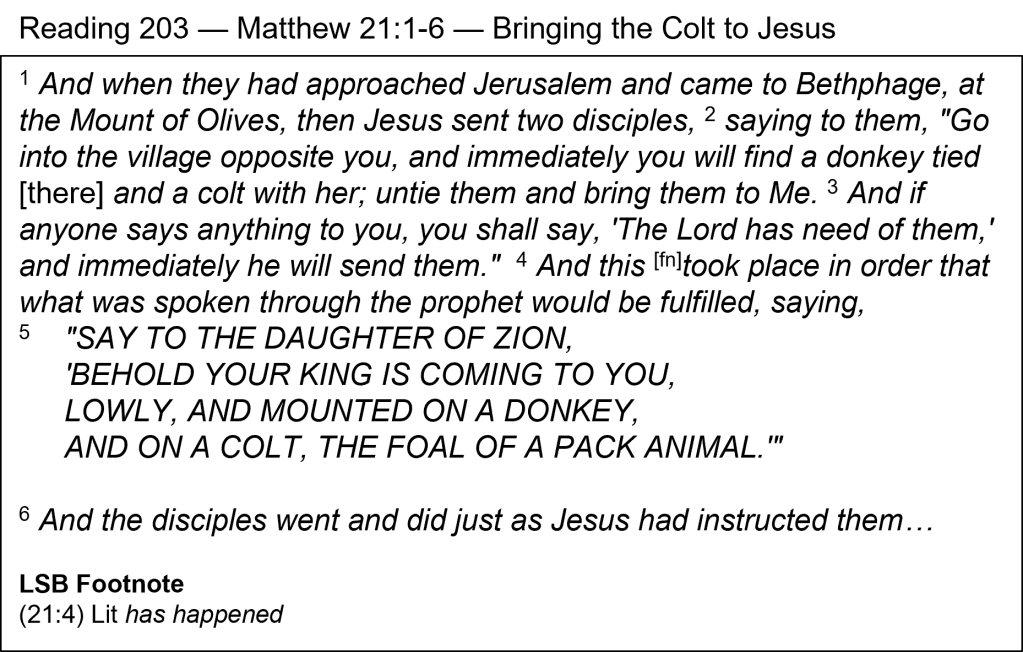
Your King is Coming — The Triumphal Entry is the official declaration of Jesus as the Messiah as He faced His sacrificial death. This occasion is of great importance, being only the second event recorded by all four Gospel writers (the first one being the feeding of the 5,000). Our reading for today shows, first, the omniscience (all-knowingness) of Jesus. He told the two sent disciples, “you will find a donkey tied there and a colt with her” (v. 2). He knew they were there in advance. If anyone questioned them, they were to say, “The Lord has need of them” (v. 3). That also shows Jesus’ authority. As “Lord,” He was steering the whole event. Finally, He was showing His obedience by fulfilling the prophecy of Zechariah 9:9. That “YOUR KING IS COMING TO YOU,” is an identification of Jesus as the Messiah, the final King of Israel. Jesus arranged His dramatic entry into Jerusalem on a donkey’s colt in order to fulfill a 500-year-old prophecy.
Lift Up Your Heads, Ye Mighty Gates – YouTube

 accbibleread.com