
Save or print this page by clicking on “Download” below:
July 9, Sunday
An audio recording of the following reading is available below.
xxx
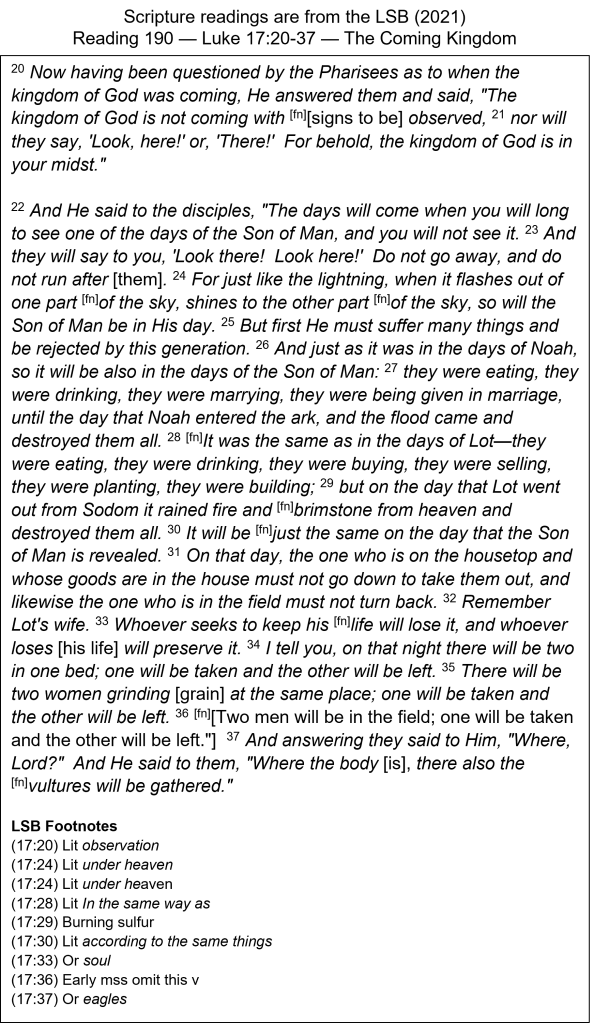
Now and Later — There are two kinds of kingdoms discussed here. The first is the spiritual kingdom offered by Jesus in His first coming: “The kingdom of God is in your midst” (v. 21). He said this to the Pharisees, who were not recognizing or accepting that kingdom. It had no dramatic signs, except the miraculous ones performed by Jesus. We are still living in that spiritual and internal kingdom realm today. The second kingdom is still in the future, and it will be ushered in at Jesus’ Second Coming. Two things are emphasized here about that event. First, it will be unmistakable, like lightning that flashes across the sky. Therefore, Jesus warned His disciples (and us) not to follow claims that Jesus had returned in some subtle way. Everyone will know when Jesus returns. The second emphasis of that event is that it will be sudden and unexpected. People will be going about their normal activities (“eating … drinking … buying … selling…”—v. 28) when that divine lightning flash will occur. They will not be expecting it. Jesus’ description also suggests that there will be no time to prepare when He appears, even to come down from a second story or come home from the field (v. 31). Suddenly, with two people together, one will be taken and the other will be left (vv. 34-36). Everyone must be ready now for this surprising and sudden reappearance of Christ.

xxx
July 10, Monday
An audio recording of the following reading is available below.

xxx
Persistent and Humble — Jesus didn’t hold back in pointing out the absurdity of proud people, apparently trying to wake them up to God’s view of them. In contrast, He put repentant sinners in a positive light. These two parables contrast different kinds of people with opposite attitudes. Persistence was the focus of the first parable. The widow kept after what was right, and she gained her goal. Persistence in prayer was the application. We are to pray “at all times” (v. 1) as well as “day and night” (v. 7). God honors persistence, which shows both our urgency and our faith. We believe that God will provide what we need. That is the faith Jesus will be looking for when He returns (v. 8). The second parable honors humility. The tax collector admitted his sin, calling himself “the sinner” (v. 13). He didn’t ask for reward but for mercy (v. 13). We are sinners, too, but like the Pharisee, we would rather think about our positive assets and accomplishments. The conclusion of Jesus’ teaching was that God humbles those who praise themselves, and praises those who humble themselves. It is a challenge for us to face reality. Who are we, really?
Lord, If Thou Thy Grace Impart – YouTube

xxx
July 11, Tuesday
An audio recording of the following reading is available below.
xxx
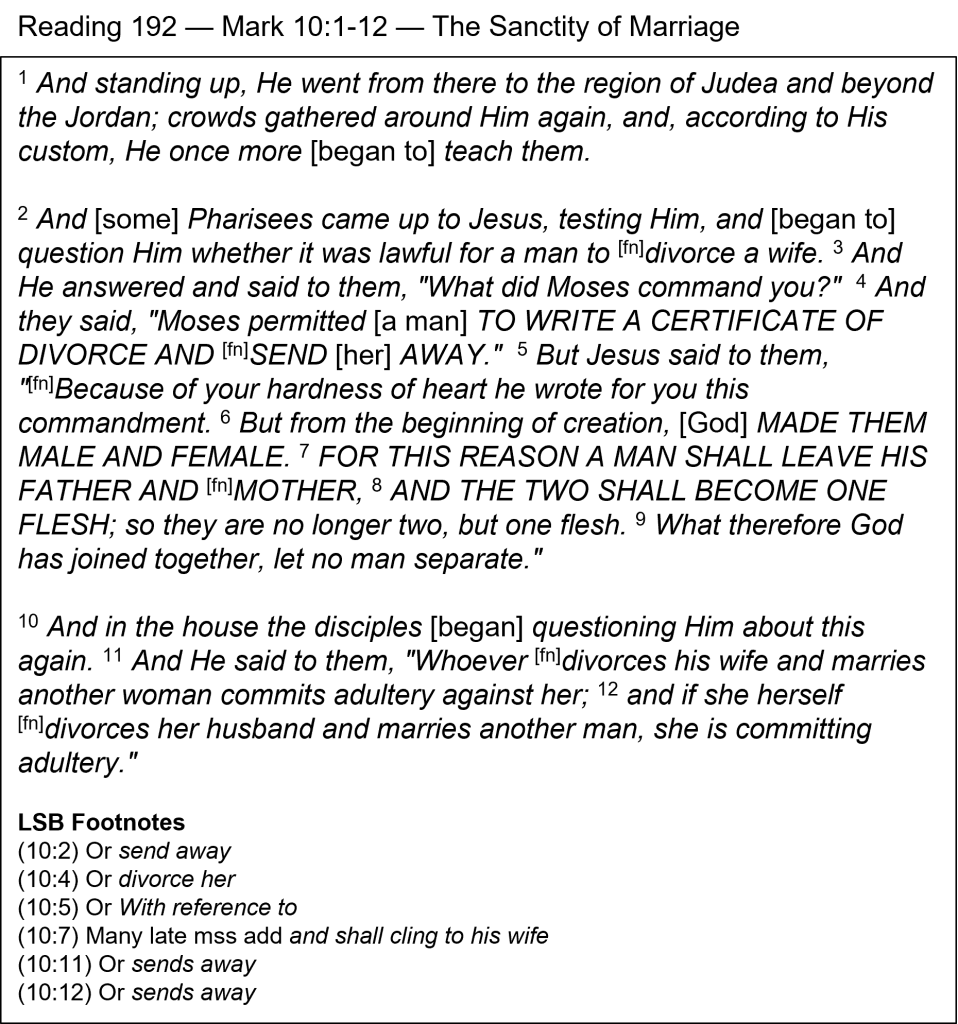
Holy and Permanent — The Pharisees always seemed to be testing Jesus. Here, the subject was divorce. Their question was “whether it was lawful…” (v. 2). They wanted His opinion. It is significant that Jesus’ answer began with asking them what God’s Word said about the subject: “What did Moses command you?” (v. 3). That should also be the starting point for all our questions about life: “What has God said?” The Bible is our ultimate standard. The Pharisees answered that Moses “permitted” divorce, but Jesus pointed out that it was an allowance made only because of the people’s sinful “hardness of heart” (v. 5). Divorce is not God’s will, however, as Jesus clearly pointed out. Since “God has joined [them] together,” man should not separate (v. 9). Marriage is a holy union in God’s sight, and it was designed to be permanent. To marry another following divorce is to enter a relationship of adultery. The only exception Jesus allowed was when the first marriage had ended because of sexual immorality (cf. Matt. 5:32; 19:9).
Blest Be the Tie That Binds – YouTube

xxx
July 12, Wednesday
An audio recording of the following reading is available below.

xxx
Coming in Humility and Trust — This is the second time we have read that Jesus took children into His accepting arms. The first time, it was to teach His disciples a lesson about humility after they were arguing about which of them was the greatest. He took a child into His arms and said, “Whoever receives one child like this in My name receives Me” (Mark 9:37). In our reading for today, it was the parents who were bringing their children to Jesus “so that He might touch them” (Mark 10:13). Jesus was loving and accepting of these children, even though His disciples didn’t like it. They probably thought that the children were not important enough to have that attention, or that Jesus had more important things to do. It was time for another lesson. God’s ways are not our ways. Jesus said that God’s kingdom can be entered only “like a child” (v. 15), i.e., in humility and in trust. We cannot earn our way into the kingdom of God; it is offered only by grace. When you go to God in prayer today, picture yourself as a young child, coming to Him willingly and humbly, trusting in His loving acceptance.
A Prayer of Humility – YouTube

xxx
July 13, Thursday
An audio recording of the following reading is available below.

xxx
Choosing Your God — We call this man, “The Rich Young Ruler,” even though Mark’s account says only that he was wealthy, with “much property”—v. 22). Matthew 19:20 adds, however, that he was “young,” and Luke 18:18 says that he was also a “ruler.” Verse 17 in today’s passage shows that he had some very positive qualities. That he “ran up to Him and knelt before Him” and called Him, “Good Teacher,” showed urgency and respect. His desire “to inherit eternal life” suggests that he probably had heard Jesus’ earlier teaching and that he wanted to make sure that he was doing all he could to please God. In response to his question, Jesus emphasized obedience as the primary consideration, pointing to the last of the Ten Commandments. The man must have had a smile of satisfaction on his face when he told Jesus that he had “kept all these things from my youth up” (v. 20). That sounds like the Apostle Paul, looking back on his religious life before meeting Jesus: “…as to righteousness which is in the Law, found blameless” (Phil. 3:6). Only Mark tells us that in His response, “Jesus loved him” (v. 21). In love, Jesus revealed that, in this man’s heart, he had not obeyed the first commandment: “You shall have no other gods before Me” (Exodus 20:3). His wealth was his god, and he was not willing to give it up for Yahweh. Jesus loved him, but He made him face the truth that he wasn’t willing to put God first. Are you sure that you have no other god before Yahweh?
Today I Choose to Follow You – YouTube

xxx
July 14 Friday
An audio recording of the following reading is available below.
xxx
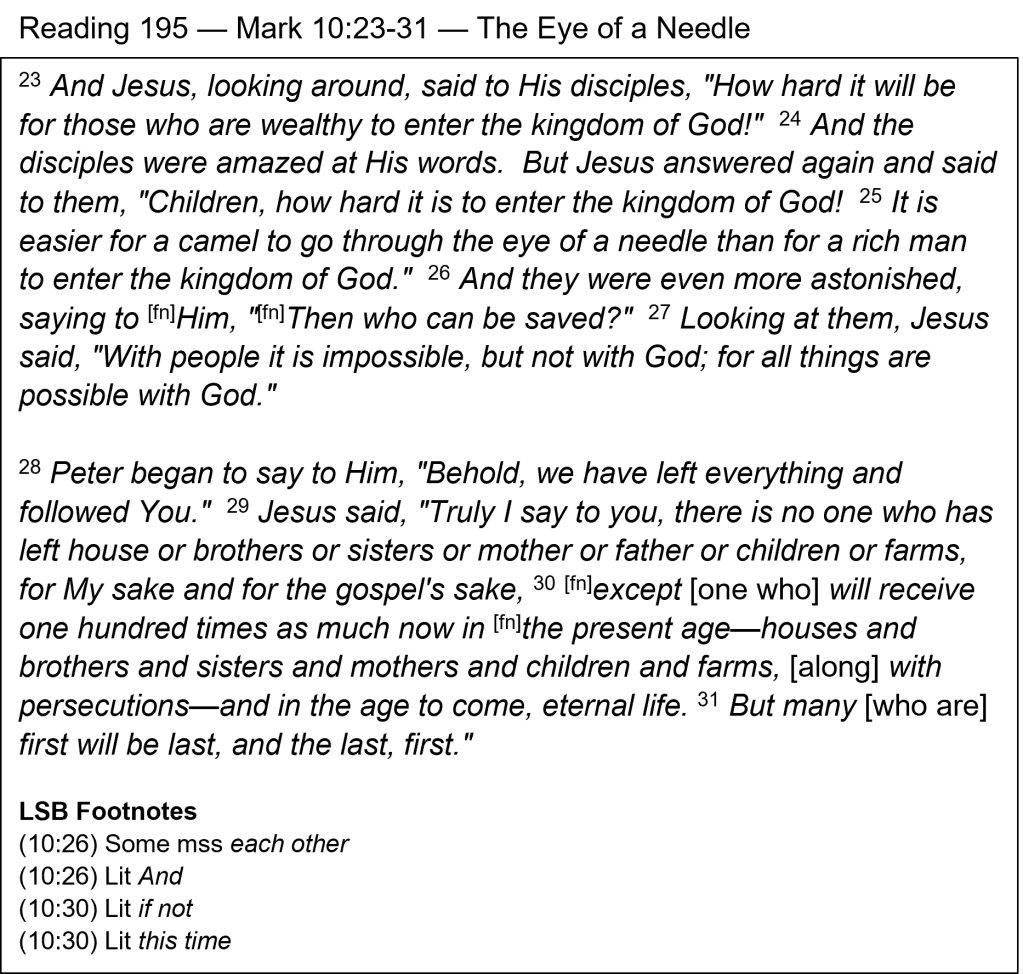
Tight Squeeze of Wealth — Our reading for today follows directly after the saddened rich young ruler walked away from Jesus, not being willing to give up his wealth. It was a great lesson opportunity, and Jesus gave one of several very “hard sayings” to His disciples: “How hard it is to enter the kingdom of God!” (v. 24). Some might ask, “Why would God make it so hard?” He doesn’t. What makes it hard is the draw of competing things that look more attractive to our sinful nature. It is the decision that is hard. In this case, the question is: “Is God more important to us than money and what it can buy?” The disciples had essentially left everything to follow Jesus, and yet they were amazed at this hard saying. Illustrating just how difficult it is to choose God’s kingdom over wealth, Jesus presented the “impossible” camel-needle picture. This time, the disciples “were even more astonished” and asked, “Then who can be saved?” (v. 26). This shows that rich people were still on a pedestal in their minds. Wealth is not evil, but its temptations to draw one away from God are huge. Because all things are possible with God, the wealthy Joseph of Arimathea got through the needle (Matt. 27:57). Other rich people have also made it, but it was only because they didn’t allow wealth to be their god. Jesus desires all people to come to Him, but He will not widen the eye of the needle.
I’m Leaving All to Follow Jesus – Bing video
xxx
July 15, Saturday
An audio recording of the following reading is available below.
xxx
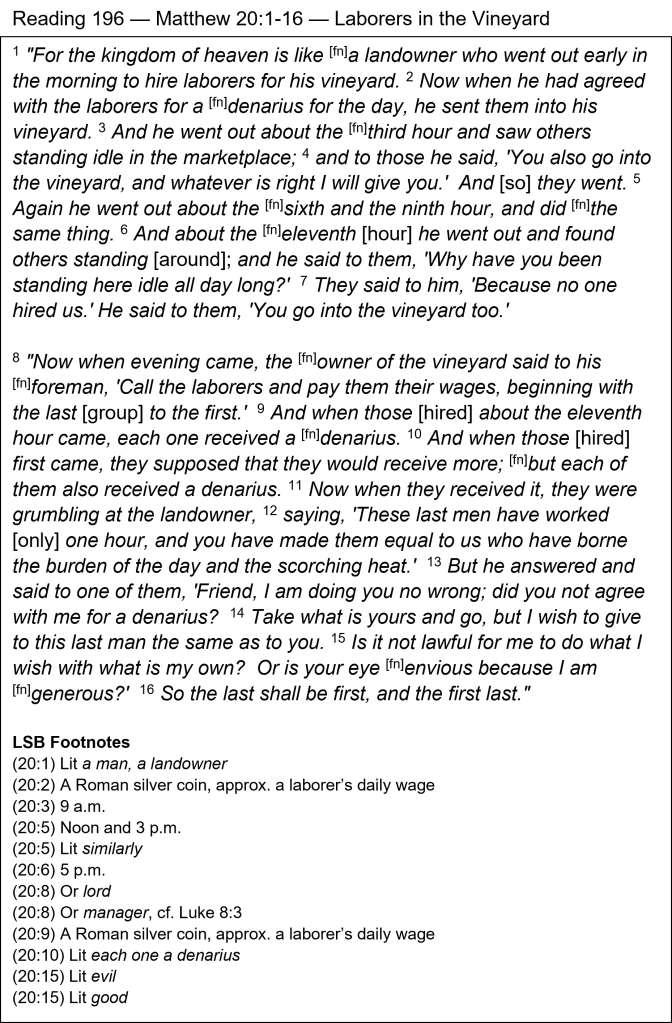
Is Grace Fair? — This parable is found only in Matthew, but it follows directly after yesterday’s reading, where Peter declared somewhat boastfully to Jesus that the Twelve had left all to follow Him. Both the eye-of-the-needle illustration and the vineyard parable are about entering God’s kingdom (“…the kingdom of heaven is like…”—v. 1). Heaven will be filled with people who began following Jesus when they were very young children, and there will also be many who came to Christ at the very end of their lives, like the thief on the cross. Is that fair? We tend to look at fairness from a human perspective, as if we deserve our eternal reward. From Jesus’ perspective, however, it is all about grace. It was by grace that the 9 a.m. laborers were hired at all, and it was by grace that those hired later received a full day’s wage. Whether someone is born again early or late in life, we should rejoice because it was only by God’s grace.

 accbibleread.com