Save or print this page by clicking on “Download” below:
June 18, Sunday
An audio recording of the following reading is available below.
xxx
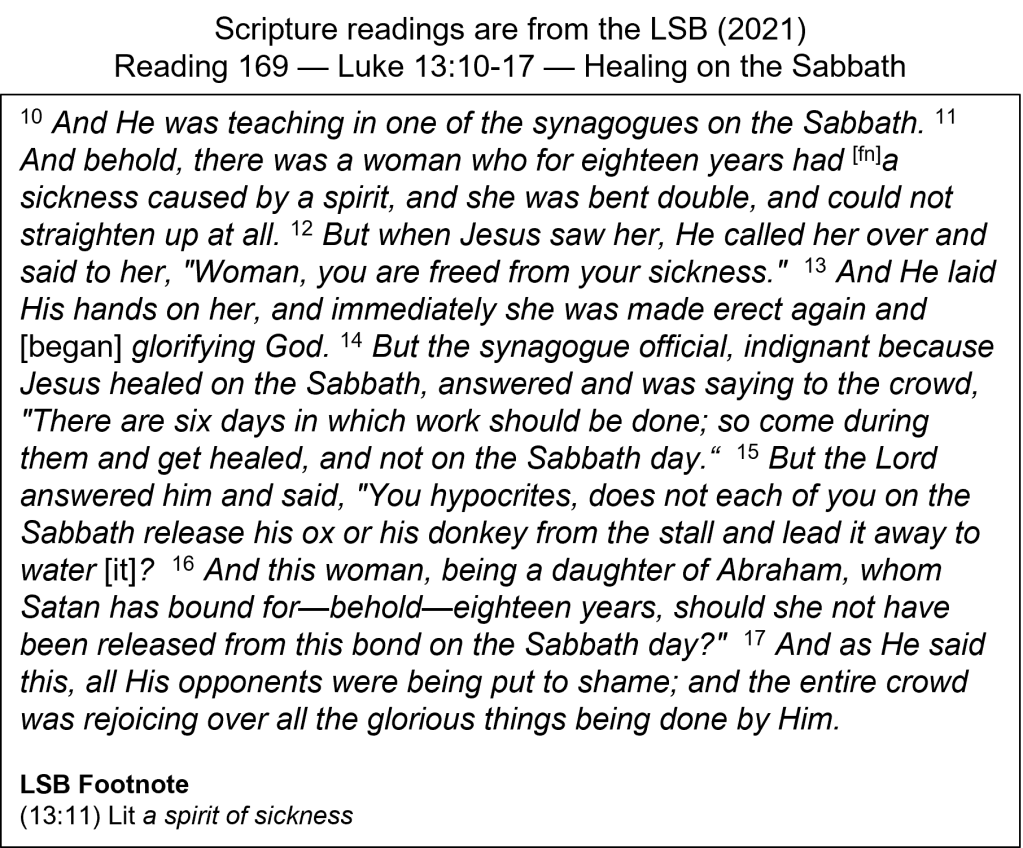
Show and Tell — Jesus was making a point in this story. The context shows that “He was teaching in one of the synagogues on the Sabbath” (v. 10). Apparently, while He was teaching, He saw this crippled woman in the crowd and “called her over” (NIV: “called her forward,” v. 12). Then “He laid His hands on her” (v. 13). They were “center stage” in this synagogue for a reason. It seems like Jesus not only wanted to heal her, but he also wanted to expose the hypocrisy of the Jewish leaders who insisted on obedience to their traditions which went far beyond the requirements of God’s Law. As expected, “the synagogue official [was] indignant because Jesus healed on the Sabbath” (v. 14). He was also rather cowardly in that, rather than rebuking Jesus for healing on the Sabbath, he challenged the crowd not to come to be healed on the Sabbath. Jesus then made him the center of attention, calling him and his fellow religious oppressors hypocrites (v. 15). They were careful to release their animal and lead it to water on the Sabbath, but they would not allow this woman to be released from her stall of suffering for 18 years. It was a “show and tell” event for Jesus not only to show his power, but also to expose religious hypocrisy. Let us be careful about imposing our own worship preferences on others.
Here is the first verse of an appropriate hymn that warns us about hypocrisy.

xxx
June 19, Monday
An audio recording of the following reading is available below.

xxx
Why Suffer? — We will break down this story of the blind man’s healing into three readings because it is both long and rich. The disciples reflected a common thought in their culture that illness and tragedy are results of personal sin. Sometimes it is, but not in this case. Since Jesus was God, He knew not only this man’s history but also the Father’s purpose. This man was allowed to live into adulthood without sight so that God could demonstrate His power and goodness. If that sounds unfair to you, remember that the Father allowed His own Son to suffer a beating and crucifixion so that He might provide the means of salvation for us and to show His power through Jesus’ resurrection. God often uses suffering to bring glory to Himself by how it makes us grow spiritually. When my wife was dying with cancer, she told a friend, “I would not wish this on anyone, but I would not trade it for anything.” She had grown very close to the Lord during her trial. Do you suffer from some kind of physical disability or other hardship? Then think of the suffering of the blind man and Jesus. How might God use your difficulty to bring glory to Him? When Jesus’ disciples were beaten by the Sanhedrin for preaching about Jesus, they were “rejoicing that they had been considered worthy to suffer shame for the Name” (Acts 5:40).
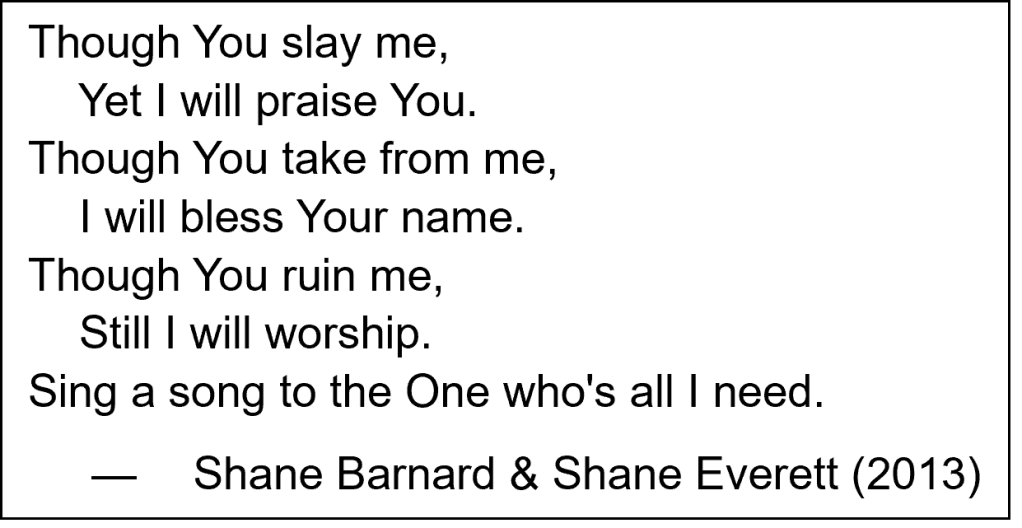
Here is a song focused on the “Why?” of suffering that
includes a 2-minute piece of a John Piper message.
Though You Slay Me – Bing video
xxx
June 20, Tuesday
An audio recording of the following reading is available below.
xxx
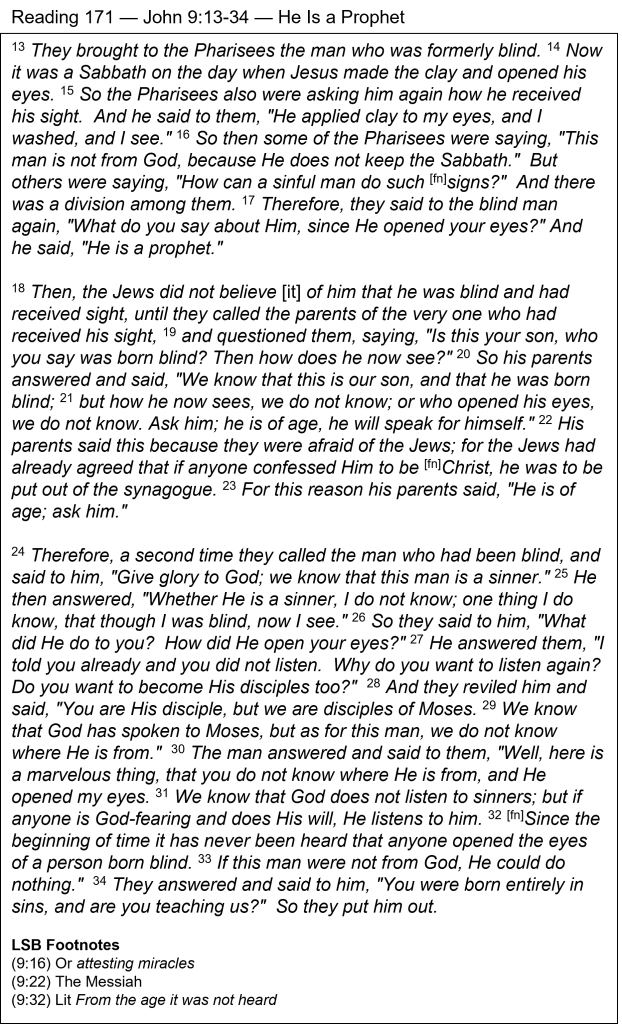
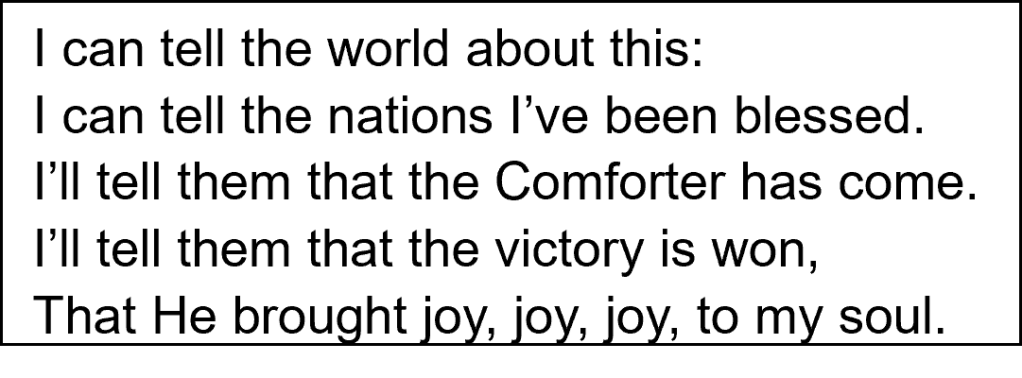
Sinner or Prophet? — There is much confusion in this story about what people thought regarding the identity of Jesus. Ten times in these 22 verses, people are said to “know” or “not know” about Jesus. Likely most of the Pharisees thought, “This man is not from God, because He does not keep the Sabbath” (v. 16). It was their man-made Sabbath rules they were concerned about. Mixing dirt with spit was not work, nor was it dishonoring God’s purpose for the Sabbath, but they were looking for how they could accuse Jesus. They said, “we know that this man is a sinner” (v. 24). When they told the man, “Give glory to God,” they were admitting that a God-caused miracle had taken place, but they refused to believe that God had worked through Jesus. Although the man’s parents were afraid to go against the Jewish religious leaders, the formerly blind man was not. When asked for his opinion about Jesus, he responded boldly, “He is a prophet” (v. 17). Actually, He was far more than a prophet, but the man was at least convinced that God used Jesus to heal him. He didn’t pretend to know much about theology, but he understood something very important about his experience: “…one thing I do know, that though I was blind, now I see” (v. 25). In a spiritual sense, that can also be our testimony. We were spiritually blind before Jesus opened our eyes to truth. It is difficult for people to argue against your experience. Just tell them what Jesus has done to you!
Here are two very different renditions of this African-American
song about telling others what we know:
I Can Tell the World – YouTube
I Can Tell the World About This – YouTube
xxx
June 21, Wednesday
An audio recording of the following reading is available below.

xxx
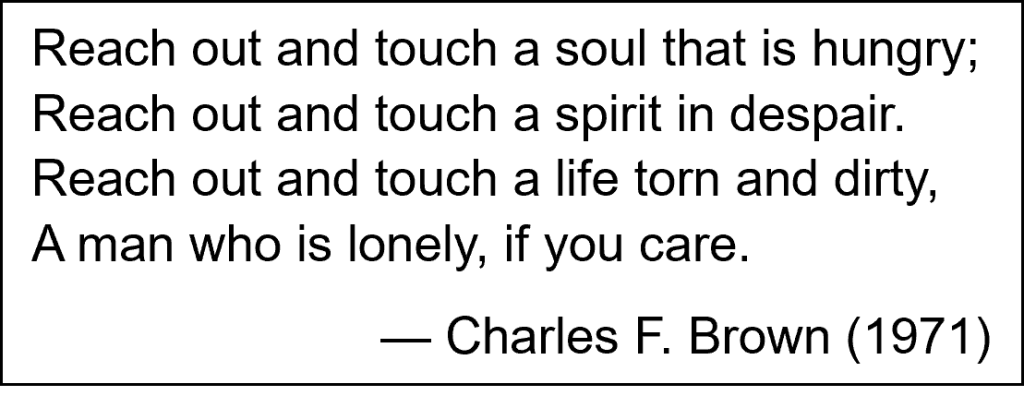
Finding Faith — The text doesn’t tell us that the man had seen Jesus after he gained sight. We read earlier that when Jesus told him to go to the pool of Siloam, he “went away” to wash his eyes (v. 7). Blind people, however, would recognize the voice of someone who had talked to them earlier. It is significant that Jesus took the initiative to look for him later (“after finding him”—v. 35). He wanted to follow up on this man’s spiritual condition and lead him to a greater understanding. Jesus’ question to him was, “Do you believe in the Son of Man?” (v. 35b). That seems like a rather vague question, but it carried a spiritual connection with Ezekiel and Daniel in the OT. The former blind man was very open, wanting to believe in this man who healed him, whoever He was. He asked, “Who is He … that I may believe in Him?” (v. 37). When Jesus identified Himself, the man immediately said, “I believe” and worshiped Jesus (v. 38). A caring Savior reached out to a hungry soul to also open his spiritual eyes.
xxx
June 22, Thursday
An audio recording of the following reading is available below.
xxx
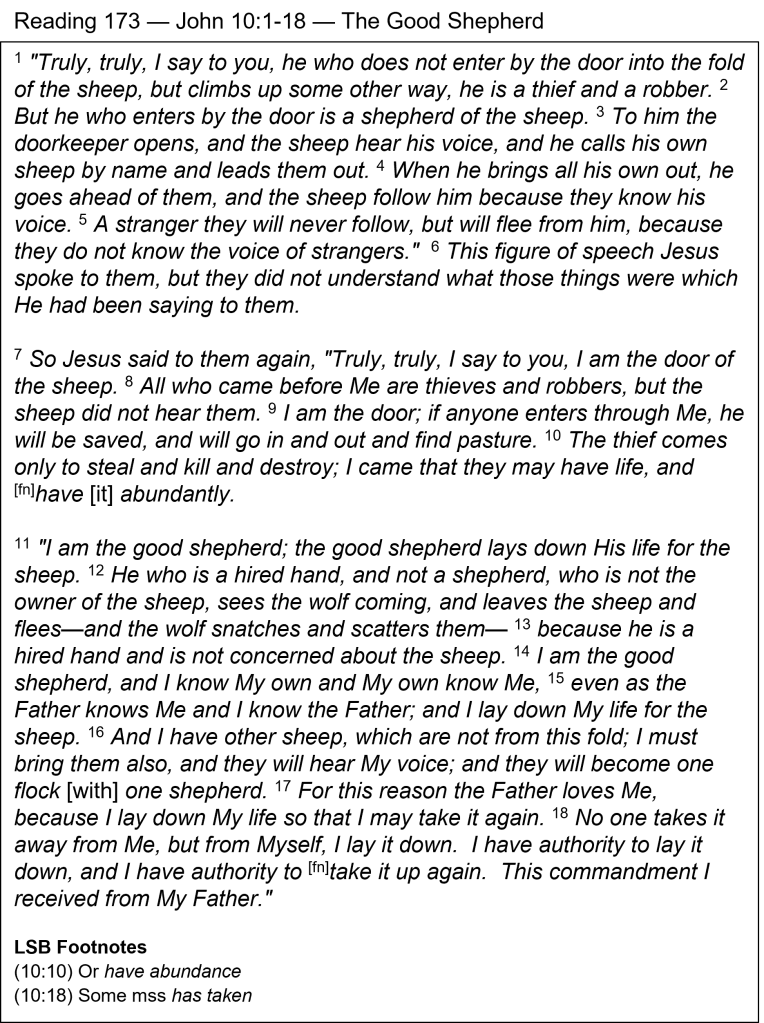
The True Shepherd — We see three great pictures of Jesus in this well-known passage where we find His third and fourth “I am” statements in John’s Gospel: “I am the door of the sheep” (v. 7) and “I am the good shepherd” (v. 11). The first picture is that of Jesus as the known shepherd. The first paragraph contrasts a true shepherd from a false one. The sheep know the difference and will only follow the true shepherd: “the sheep follow him because they know his voice” (v. 4). The relationship goes two ways; the sheep know the voice of the shepherd and the shepherd knows them: “he calls his own sheep by name” (v. 3). The second picture, in the next paragraph, shows Jesus as the saving shepherd. He pictured Himself as the door of the sheepfold, saying that “if anyone enters through Me, he will be saved” (v. 9). Jesus is the only way for someone to enter the sheepfold of His kingdom. The final paragraph presents the picture of Jesus as the sacrificing shepherd. Five times, Jesus speaks of laying down His life for the sheep, and it is done willingly and lovingly. He acts in contrast to the hired shepherd who “is not concerned about the sheep” (v. 13). Jesus knows us, saves us, and sacrifices for us.
Jesus, Shepherd of the Sheep – YouTube

xxx
June 23, Friday
An audio recording of the following reading is available below.
xxx
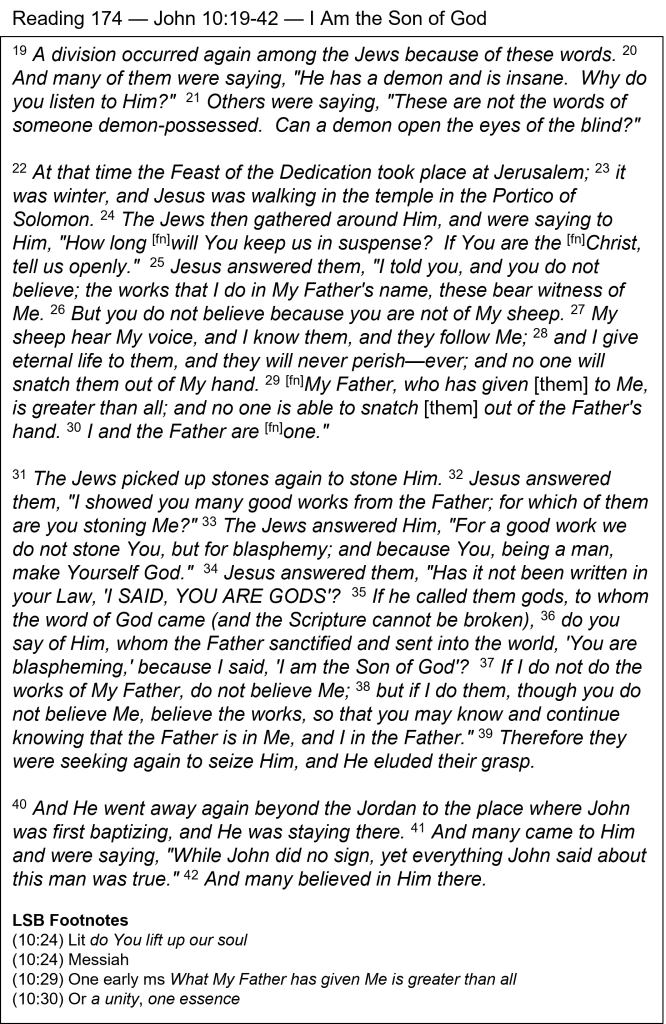
Works are Witnesses — The Pharisees wanted clear words from Jesus that said He was the Christ, the long-expected Messiah. Jesus said that He had told them, but they didn’t believe what He said (v. 25). Throughout Jesus’ ministry, He very sparingly made statements about being the Messiah, even warning His disciples not to share it with others. Why not? Perhaps part of it was that it would remove some of the need for faith. What Jesus did often encourage, however, was the fact that His works were witnesses that He was the Christ. He challenged these unbelieving leaders, “believe the works, so that you may know … that the Father is in Me, and I in the Father” (v. 38). Only God could do the things that Jesus did frequently. Even today most unbelievers are more impacted by what we do than what we say. Yes, we should witness to them with our words, but how we act and react are often very effective in causing them to think that there is really something different about us — something good, and something desirable. Our works are witnesses, too.
This appropriate song may be sung to the tune of “Stand Up for Jesus.”

xxx
Meditation: There is an interesting witness to the truth of the Trinity here. When Jesus said, “I and the Father are one” (v. 30), He revealed two important ideas about God. First, since He claimed to be the Son of God, the statement, “I and the Father,” suggests that there is complexity within the Godhead. Those are two Persons, showing the plurality of God. Second, the expression, “…are one,” reveals the unity of God. When adding the Holy Spirit, there are three Persons but one Essence. One complex God.
xxx
June 24, Saturday
An audio recording of the following reading is available below.

xxx
The Door of Decision — The basic question that brought on Jesus’ long answer was, “Will few be saved?” The answer centered on the door to the kingdom of God. How does one enter that door? Jesus’ answer was, “Strive to enter through the narrow door” (v. 24). It is a door of decision; do I really want to enter? To “strive to enter” not only shows effort and determination, but also its value and importance. It is worth striving for. The fact that it is a narrow door answers the basic question; relatively few will enter it. Many “will not be able” (v. 24), either because of their unwillingness to “strive” or that the opportunity has ended. That is the shutting of the door by the head of the house, representing Jesus. The third door connection is the knock of the procrastinators after the door was closed. The decision to strive was neglected and the decision to shut was final. It is not enough to be familiar with Jesus; the striving includes repentance and faith. We know that many Jews will be in heaven (“Abraham and Isaac and Jacob and all the prophets in the kingdom of God”—v. 28), but also many Gentiles (“they will come from east and west and from north and south”—v. 29). Jesus invites and He warns: enter while you can. His door of mercy is open.
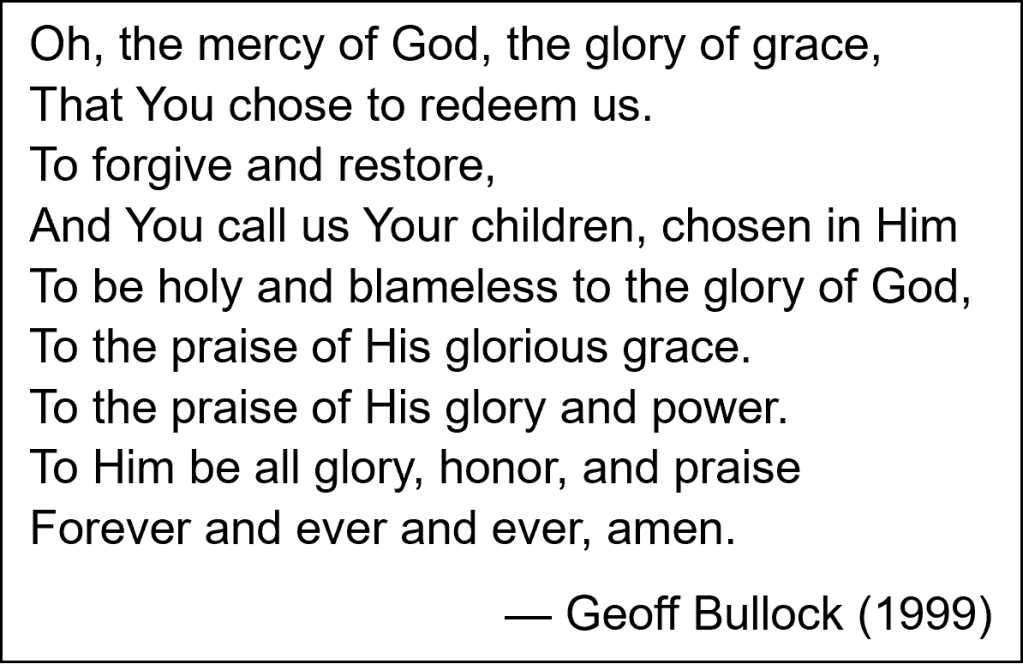
Oh, the Mercy of God – YouTube
 accbibleread.com